
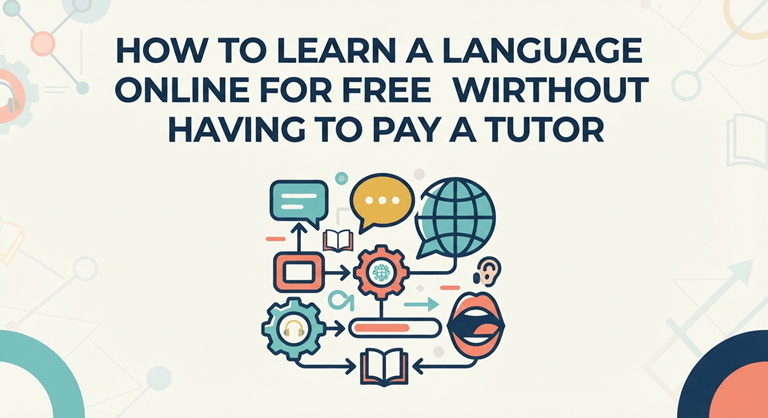
How to learn a language online for free without having to pay a tutor
Private tutors work, but they are costly – usually ₹800 to ₹2,000+ per hour or $ 20- $ 60 per hour if you are paying in dollars. The great news is that in 2026, nearly all of the input, correction, and actual conversation practice you receive from your tutor is available online for free if you know where to find it. Here are some tools and methods that you can use to become fluent without paying a penny for lessons.
To begin with, use a free structured application for the fundamentals.
You can’t have a conversation without some vocabulary and grammar. There are free apps that are actually great for this early stage, such as Duolingo, Memrise and Busuu. They make everyday practice fun so you’ll show up anyway, and that’s more important than any one feature. Use them for 15 minutes a day to develop your core vocabulary and familiarize yourself with sentence construction. Don’t ask them to speak fluent English – ask them to provide a good starting point.
Use spaced-repetition to make vocabulary stick.k
The reason you forget words is that you review them at the wrong time. Spaced-repetition software (SRS) corrects this by presenting a word just before you forget it. Here, Anki is the gold standard, and it’s free for desktop and Android (the iOS version is not free). Download a shared deck for your target language or create your own with words you encounter. An hour of passive learning will not be as effective as 15 minutes of Anki a day.
Get lost in content you would watch anyway.y
The word “immersion” once meant “to fly to another country. Now it’s about what you see on the screen. Change your favorite YouTube channels, podcasts, and shows to your target language, and enable subtitles in your target language (not your native language). Create content for learners, then progress to native content as your ear gets used to it.
A quick power trick: set the system language of your smartphone to the language you want to learn. You already know where each menu is, so you’ll pick up the vocabulary all day long, without paying a dime.
Write with instant free correction.
Writing requires you to make the language, rather than merely recognise it. You can write short entries and have them corrected by native speakers for free, while native speakers correct entries in your language as well (as in apps such as LangCorrect and journaly). AI chatbots are also great writing partners these days – ask one to correct your paragraph and explain your errors, and you will receive tutor-quality feedback in real-time and for free.
Practice speaking in real-life situations – something most people avoid.
This is where most self-learners get stuck. It is impossible to prepare vocabulary for a year and then not be able to understand it when someone actually speaks it. Reading and speaking are two different skills. The only cure is to speak to real people, face-to-face, with a bit of pressure.
Language exchange apps such as Tandem and HelloTalk match you with native speakers who wish to learn your language in exchange – for free. If the formal exchange format seems like too much of a commitment, however, a less formal approach is to just go into a platform where you can talk to strangers online and choose your region or interests to match those of speakers of your target language. The short unscripted conversations with people who don’t know you are perfect for practice: no grade, no awkwardness that follows you around, and every few minutes is another rep of thinking on your feet in a new language. The stumbles are the point – that’s how the words get from your notebook to your mouth.
Regardless of what you use, try to shoot for frequency rather than length. Five short conversations per week is better than one long, nervous conversation.
Talk to an AI when no human is around.
AI chatbots can now carry out a full conversation in dozens of languages, adapt to the level, role-play scenarios (“you’re a waiter, I’m ordering food”), and correct you as you go. They’re not a substitute for real humans, but they’re a great, non-judgmental warm-up and are available around the clock, for free.
Put it into a simple weekly routine.
A system is needed without which tools are useless. This is a free stack that covers all bases:
- Daily (15 min): Anki for vocabulary and 1 app lesson.
- Every day (passive): Language of the phone changed, content in target language.
- 3x per week: A real conversation – a language partner, an online cha,t or an AI role-play
- 2x per week: A brief written correction, corrected by a native speaker or AI
For zero rupees, that’s a complete learning loop – input, memory, output, correction.
The bottom line
A tutor is not a magic bullet; paying for a tutor gives you convenience and accountability. All of the ingredients of real language learning are now available online: structured apps for the basics; SRS for remembering; immersion for the ear; writing tools for correction; and a dozen ways to get real speaking practice with real people. The learners who succeed are not the ones who spend the most – they are the ones who show up every day and, most importantly, begin to speak early rather than hiding in flashcards.
Choose the tools from the above list, create the weekly plan, and begin messy, imperfect conversations as early as possible. It’s the quickest free route to fluency.
Popular on OTW Right Now!


About The Author

Gagan Bhangu
Founder of otechworld.com and managing editor. He is a tech geek, web-developer, and blogger. He holds a master's degree in computer applications and making money online since 2015.