
How to Evaluate SD-WAN Products for Your Network
Are you someone who has been managing WAN for some time? If yes, you already know that an MPLS-only setup just isn’t enough anymore.
Your traffic doesn’t look like what it used to be. Now there are cloud apps, remote work, branches, and hybrid work setups; all are connected and intertwined. While the traffic sources changed, the network design remained the same.
That’s where most IT leaders and enterprise decision-makers start the SD-WAN conversation. They start considering SD-WAN products for their networks to solve the traditional network design that slows down their workload and processes in today’s time.
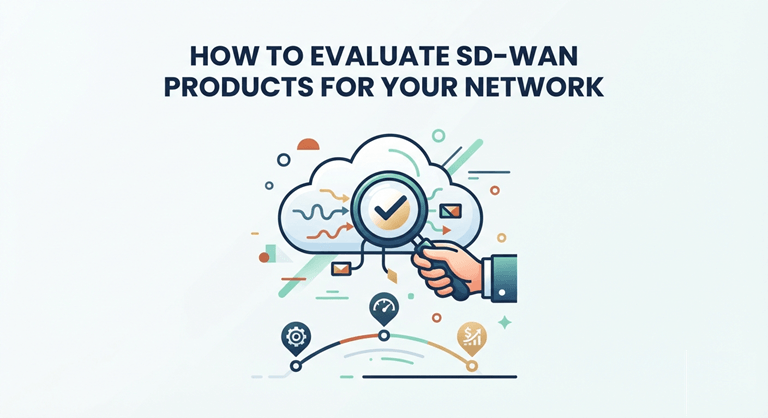
The good news? There are plenty of choices to consider in the market. That’s the bad news, too, because which one is right for a procurement team isn’t just about what they like to read on a glossy datasheet and marketing brochure.
So, what does a decision without any industry buzzword look like? Here, let us help you.
Core Technical Criteria: The 4 Pillars of Selecting SD-WAN Products
There’s a lot of noise in this space, so let’s narrow it down to what actually matters when you’re comparing SD-WAN products for enterprises.
1. Dynamic Path Steering & Application Performance
At its core, SD-WAN is supposed to be smart about where it sends your traffic. When a link starts degrading, whether that’s your MPLS circuit, a broadband connection, or 5G backup, the controller needs to notice and reroute application traffic before your users notice anything’s wrong.
Application-aware routing comes in handy here. Not only should the platform be able to tell if it is down, but it should be able to tell that your VoIP traffic is different than a bulk file transfer.
Inquire with vendors, and go with your gut feeling. Also give them a bit of a workout on voice quality, as MOS (Mean Opinion Score) is a good measure of how good your calls will sound in the event of a failover.
2. Native Security Integration (On-Box vs. Cloud/SASE)
This is a common shopping mistake. It is not the same as a box that routes packets well, and it’s not even the same as a platform that is truly designed for SD-WAN products. Its meaning is that it is baked into a next-generation firewall and Zero Trust access, not as an afterthought.
Request information on throughput of an encrypted tunnel under load. It’s a different story if they give you some great numbers with inspection disabled; then it’s another one when you enable SSL inspection for everything.
For additional consideration: Does it integrate with your existing SASE or cloud security solution, or is your current solution proprietary?
3. Centralized Management & Day-2 Operations
Honestly, this is the part most buyers underweight, and it’s a mistake when comparing SD-WAN products for enterprises.
Day 0 is buying the hardware. Day 2 is the next 5 years, and that’s where many teams get burned.
Don’t simply take it down as policy, but examine how the change spreads from one site to the other. Is it real-time, or does it take a while to wait and see if a config has been pushed?
If you’re deploying to dozens of stores and not sending out an engineer to every location, then Zero-Touch Provisioning is quite important.
And, don’t overlook the firmware update automation and API or telemetry access either, as you’re flying blind if you can’t get good data out of the platform when something breaks at 2 am.
4. Deployment Form Factors & Environmental Fit
The majority of SD-WAN content assumes that each site is a nice, well-heated and air-conditioned corporate office. Not so for many of us.
Whether you have manufacturing floors, OT (office of technology) stations, or remote branches that might be subject to heat, dust, or vibration, you need equipment that can truly handle the abuse, not home-brewed enterprise gear.
Review the MTBF figures, temperature and vibration limits, and above all, its throughput with full security inspection switched on. Everything might sound awesome on paper, but as soon as you start pushing real traffic through and enable everything, it might fall apart.
Total Cost of Ownership (TCO) & License Architecture
Where many budgets go wrong is when they find out after the fact that this is what they had in mind. The actual price of the equipment is not necessarily the total sum.
Be mindful of whether you need to pay for your license by the “bandwidth” or by the “device”; as you scale up, the decision can multiply.
Also consider who will handle this and determine whether to manage it by yourself or delegate to an MSP, which has pros and cons involving cost and control; there isn’t an obvious right or wrong side to that coin.
An overlooked benefit of SD-WAN that should be considered in your TCO calculations is carrier independence – being able to replace the pricey dedicated circuits with commodity internet links and maintain reliability. Check out some of the best SD-WAN software you can evaluate in 2026.
Executing a Meaningful Proof of Concept (PoC)
This isn’t a proper PoC if it only shows the box is on and it passes traffic. You want to work it. You want to work it indeed.
One way to do this is to degrade your networks deliberately, add some packet loss and added latency to your primary link, and observe the platform behavior. Does the failover really occur as described by the vendor?
As you do that, monitor the Application Response Time of the cloud applications that your business REALLY relies on, such as Microsoft 365. This is a lot more telling than the lab data a vendor could ever provide.
Expert Best Practices for Deployment Success
There are a couple of points to consider which are not always included in the standard buying guide:
Plan the security and routing from the start. Don’t start implementing Zero Trust policies after you’ve secured your WAN topology; that’s not much fun.
Don’t sign a contract until after test support response times are available for your PoC. Try out a fake ticket and discover what the turnaround time is for a real live person. Nothing in the contract’s fine print would tell you more about the SLA reality.
Furthermore, watch out for lock-in, which is sometimes proprietary. Open platforms such as MEF 70 and reasonably open APIs let you stay flexible when it’s time to change platforms—you can move to the cloud, for example, or evolve your security strategy.
Making the Final Decision
The bottom line? The decision of which SD-WAN products to select is not about which is the flashiest vendor’s list of features. It’s about the right mix of true security convergence, simplicity your staff can deal with, and performance from the squeaky clean corporate office to the dusty warehouse floor.
Popular on OTW Right Now!



About The Author

Gagan Bhangu
Founder of otechworld.com and managing editor. He is a tech geek, web-developer, and blogger. He holds a master's degree in computer applications and making money online since 2015.