
How to Build Brand Trust Using Social Media in 2026
The true currency in 2026’s fast-moving and changing digital world is brand trust rather than business attention. The fashion industry has been one of the most skeptical about sustainability, ethics, and other issues. In fact, as fashion businesses move towards a new paradigm of agentic commerce and hyper-realistic AI, the successful relationship between a brand and its customer will only be developed through transparency and human-oriented stories.
Today, the perfected images brands utilize to promote products don’t do enough to establish trust with consumers. Consumers today are much more educated, more cynical, and able to see greenwash and AI-wash at an incredibly fast rate than ever before. Therefore, for fashion brands to thrive, they need to use social media not just as a means of pushing out advertising but as a channel for open and honest dialogue with their audiences and communities.
1. Radical Transparency with Digital Product Passports (DPP)
By 2026, the fashion marketing focus shifted from storytelling to verifying marketing claims, as evidenced by the emergence of the DPP. Digital Product Passports (DPP) require brands to use transparent, traceable data to support their marketing messages.
In reaction, major brands such as Carhartt and Kering are sharing detailed details in the social media about their supply chain, sourcing practices, and manufacturing, and their dedication to sustainability.
Given that consumers are now able to access information when it becomes accessible, they are able to develop trust in the brand and also become more confident in the company in terms of being genuine and responsible. On the same note, the embroidered fashion is also heavily reliant on the trust score since it has a visual representation of branded logos.
For example, when brands rely on specialized partners to digitize image for embroidery, the precision of that process can also influence perceived quality and consistency. That technical accuracy can become part of how consumers perceive quality and brand reliability.
When AR filters or scannable on-screen codes are built into Instagram reels and TikToks, a consumer can verify the source of a design immediately. The latest statistics by the Transparency Index of Fashion Revolution show that three-quarters of consumers are ready to spend more on fully traceable products. To a brand, displaying a day in the life of a textile mill in Italy or strolling through sustainable sourcing actions is not only behind-the-scenes content, but a verifiable credential.
2. Human-in-the-Loop & AI Interactions

Although analysts project that AI shopping assistants will help make about a quarter of all fashion purchases by 2026, there is an implicit irony between the hyper-polished appearance of an AI and human errors. This has seen the consumers demand more and more products that have been produced by human beings, now to be called by some experts as human-made authenticity.
Luxury brand Gucci has been highly successful in applying AI technology to assist in logistics, but it has not yet lost its touch with humanity through its social media narration. The company uses organic flows and a social media post maker, such as behind-the-scenes shots and unpolished voice messages by designers, to connect with its audience on a personal level. By 2026, the meaning of authenticity has changed from being flawless to displaying the stutter, the flub, and the difficult creative process.
3. Decentralized Social Spaces
At this juncture, however, a significant shift in the media platform, where centralized platforms with advertisements are being replaced with decentralized networks such as Mastodon and Lens Protocol, has occurred. Therefore, it will not be just a case of posting done by fashion brands in 2026; rather, they will be hosting.
Nike (SWOOSH), among other brands and organizations, is building a culture of community ownership through the creation of a tokenized community following decentralized protocols. Nike is allowing consumers to participate in voting processes determining the color palette for each season’s collections. The procedure is accomplished using blockchain technology, which reinforces the psychological contract of trust between the retailers and consumers by giving them the power to influence the outcome of the process. As a result, consumers will not only be customers of fashion brands, but they will also have an important stake in the creative development process of the brand.
4. Employee Advocacy as the Ultimate Credibility Tool
The faceless corporation is a thing of the past. By 2026, consumers will be three times more confident with the people employed by the company than with the CEO of the company or press releases. Thus, the trend has seen a growth in the number of companies that introduce employee advocacy programs, whereby the brands have an avenue to relate to the employees at a more human level. It also makes customers feel more at ease with the brand since the employees are encouraged to share their experiences with their jobs.
A large number of businesses, including Zara (Inditex) have transformed employees into in-house innovators. If a pattern maker creates a video that shows how strong a particular seam is, it is much more convincing than a multi-million dollar advertising campaign. The value added by the people most familiar with the goods, such as Massimo and Dutti, creates a greater degree of credibility with the client than traditional advertising.
5. Agentic Commerce and Ethical Algorithms
This is the era of agentic commerce, wherein AI agents do the shopping on behalf of human beings. Brands in this new environment have to make their social media metadata algorithm honest.
AI agents consider both sentiment analysis of comments and the response time of the customer service as criteria to assess the trust score of a brand. Major brands such as Prada are also investing in social listening, where they do not simply delete negative comments but instead respond publicly with practical solutions. Accountability is not only a concern to human consumers in 2026, but also to their AI representatives.
We are on the verge of beginning the age of agentic commerce, in which artificial intelligence (AI) serves as a consumer shopping assistant. Brands will have to modify their social media user-generated content to fit the needs of what has been dubbed algorithm honesty. To make their algorithms generate a trust score for a brand. The AI agents utilize both the sentiment of the customer over the comments posted on a brand and the customer service issue resolution rate.
In reaction, major brands like Prada are targeting what has been termed as Social Listening 2.0, where they respond publicly to the negative commentary and offer customers solutions that can be put into practice, instead of merely deleting the comment. In the coming 2026, the expectation of brands to responsibly serve both its human and AI consumers will be more common.
Brand Trust Building: 2020 vs. 2026
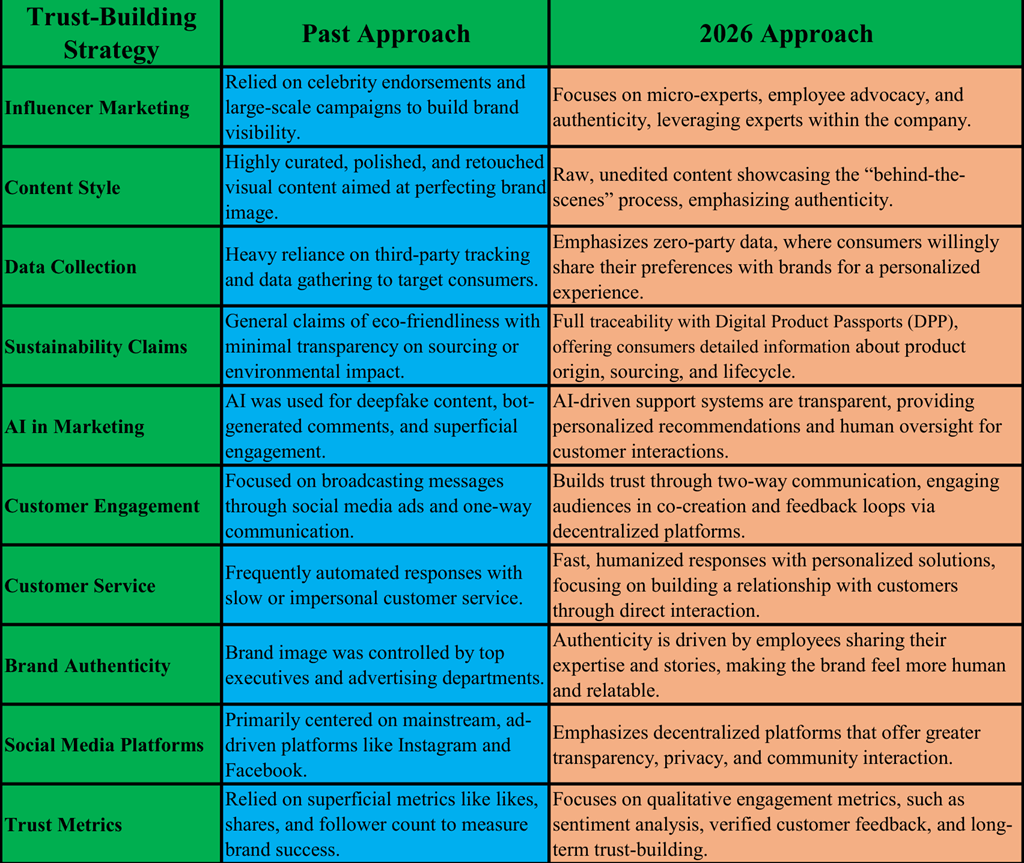
The New Social Contract
Brands need to aim at being transparent and cooperative to create sustainable consumer relationships and develop trust with customers. To achieve success and success in the fashion industry, fashion brands need to stop the exclusivity and go to the extreme in 2026 by incorporating inclusivity. Be it through the openness of digital product passports, or through TikTok videos, which are sincere and trustworthy in their production by employees of the brand.
The end result is to show that your brand is not all about profit, but people and planet. As more copycat synthetic media rise, only brands that cherish honesty, transparency, collaboration, and human-created authenticity will be capable of developing long-term consumer trust in 2026.
Popular on OTW Right Now!



About The Author

Gagan Bhangu
Founder of otechworld.com and managing editor. He is a tech geek, web-developer, and blogger. He holds a master's degree in computer applications and making money online since 2015.