
How Technology Is Reshaping Modern Liposuction
Liposuction may sound like a purely mechanical procedure: insert a cannula, remove fat, shape the treatment area.
Modern systems can be considerably more technical.
Some surgical workflows now combine ultrasound energy, powered cannulas, radiofrequency devices, 3D visualization and digital treatment planning. Each technology addresses a different part of the process, from loosening tissue to helping surgeons evaluate body contours before entering the operating room.
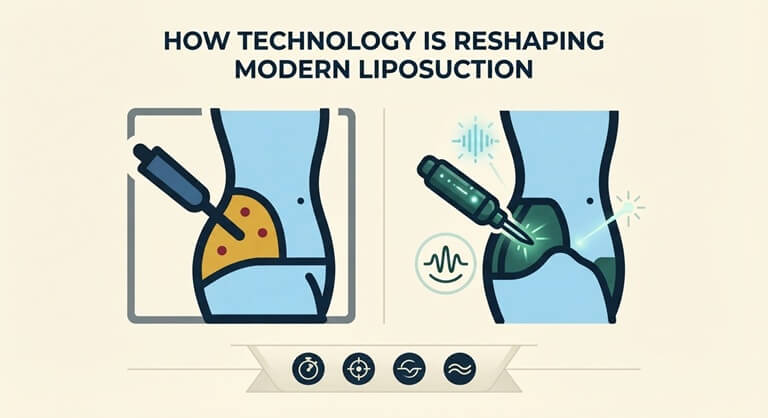
For technology audiences, the interesting story is not cosmetic surgery itself. It is how hardware, energy delivery and visualization tools are changing a procedure that once depended far more heavily on manual technique alone.
Ultrasound Can Change How Tissue Is Prepared
Traditional suction-assisted liposuction relies largely on movement of a cannula through fatty tissue before suction removes it.
Ultrasound-assisted systems add another step.
VASER, for example, transmits ultrasonic energy into the treatment area to help emulsify fat before aspiration. The technology can be particularly useful where tissue is more fibrous and mechanically difficult to work through.
That makes the system an example of energy-assisted engineering: rather than asking the mechanical tool to perform the entire task, another energy source modifies the material first.
The principle is familiar outside medicine as well. Industrial processes often use heat, vibration or sound to make later mechanical operations easier or more controlled.
Powered Cannulas Reduce Reliance on Manual Motion
Power-assisted liposuction takes a different approach.
Instead of depending entirely on the surgeon to move the cannula back and forth, the system creates rapid mechanical movement at the tip.
The surgeon still determines positioning, depth and contouring strategy, but the powered mechanism changes how the instrument interacts with tissue.
A real-world example can be seen in body contouring liposuction with Darren Smith, MD, where the described workflow combines VASER ultrasound with power-assisted techniques rather than treating “liposuction” as one single piece of hardware.
That distinction matters technologically: modern procedures may be better understood as device stacks, with different tools contributing different functions.
Radiofrequency Adds Controlled Thermal Energy
Another technology sometimes combined with fat removal is radiofrequency.
RF systems convert electrical energy into controlled heating within tissue. In body-contouring applications, they may be used where skin tightening is part of the treatment plan.
This creates a different engineering challenge.
Delivering useful thermal energy requires control over power, duration and tissue exposure. Too little energy may not achieve the intended effect, while excessive heating introduces safety concerns.
That makes monitoring and device design critical.
Similar ideas appear throughout data acquisition, where physical conditions are measured, converted into usable signals and interpreted by a control system.
3D Imaging Is Moving Planning Into Software
Some of the most interesting changes happen before surgery begins.
Three-dimensional imaging systems can capture body geometry and generate digital models that help clinicians discuss proportions and possible treatment approaches.
The technology is conceptually similar to the 3D workflows already transforming dentistry and orthodontics. Modern 3D scanning converts physical anatomy into a manipulable digital representation.
For body contouring, simulation does not guarantee a surgical result. Human tissue changes during healing, and no software model can perfectly predict biology.
Its value is instead in visualization: translating a physical treatment plan into something that can be inspected and discussed before the procedure.
Better Hardware Does Not Remove the Human Operator
It is tempting to describe advanced medical technology as making procedures automatic.
That would be misleading.
Ultrasound, powered cannulas, radiofrequency systems and imaging tools can provide additional capabilities, but they do not independently decide where tissue should be treated, how aggressively it should be approached or when a particular device is appropriate.
The operator still interprets anatomy and chooses how the tools are used.
This is an important pattern across healthcare technology. More sophisticated devices often increase the amount of information and control available to clinicians rather than replacing clinical judgment.
MedTech Is Becoming a System, Not a Single Device
The larger technology trend is integration.
A modern surgical workflow can include digital imaging before treatment, energy-assisted equipment during the procedure and connected clinical systems for documentation and follow-up.
That mirrors the wider movement toward more integrated healthcare technology.
Innovation increasingly comes from how different technologies work together rather than from one breakthrough machine.
Liposuction provides a surprisingly clear example.
What once appeared to be a relatively simple suction procedure can now involve ultrasound physics, mechanical actuation, thermal energy and 3D software within one clinical workflow.
The important technological shift is not that machines have replaced surgery.
It is that software and engineered devices are giving surgeons more specialized tools for different stages of the same physical problem.
This article provides general technology and health information and is not medical advice.
Popular on OTW Right Now!




About The Author

Gagan Bhangu
Founder of otechworld.com and managing editor. He is a tech geek, web-developer, and blogger. He holds a master's degree in computer applications and making money online since 2015.