
How Tech Overload Can Push Stress Toward Unhealthy Coping
The workday used to have a clearer ending. You left the office, shut the door, and went home.
That line has become harder to see.
Emails arrive during dinner. Slack messages light up phones before breakfast. Social media fills the small gaps between tasks. Fitness apps, banking alerts, breaking news, shopping notifications, and calendar reminders compete for attention from morning until bedtime.
The result is a strange kind of exhaustion. People can spend an evening sitting on the couch and still feel as if their brains never stopped working.
Researchers and health professionals have spent years examining the effects of screen time, workplace stress, sleep disruption, and social media use. More recently, the conversation has shifted toward something broader: what happens when digital pressure becomes part of nearly every hour of the day?
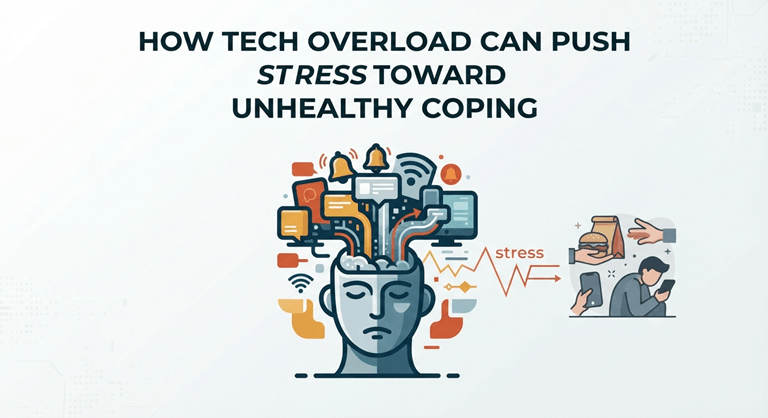
For some people, that constant mental strain does not simply lead to burnout. It can also change how they cope with stress.
Digital Burnout Doesn’t Always Look Dramatic
Digital burnout is easy to miss because it rarely arrives as one obvious event.
The pressure comes in tiny pieces
One notification is harmless. So is one email.
The problem is accumulation.
A worker finishes a meeting and checks Teams. Then comes an email. A text follows. During lunch, Instagram or TikTok fills the silence. After work, another message arrives from a colleague asking about tomorrow.
None of those moments seems serious on its own. Together, they can keep the nervous system in a state of low-level alert.
The brain gets very little quiet space.
That pattern also affects younger people, who often move between school portals, group chats, video platforms, gaming communities, and social media throughout the day. When anxiety, family stress, social pressure, or emotional problems are already present, constant connectivity can add another layer of strain. Families dealing with those patterns sometimes encounter services focused on therapy for teens and young adults as digital habits become part of wider conversations about emotional health.
Rest can still feel busy.
There is another odd feature of digital exhaustion.
People often use screens to recover from screens.
After eight hours on a laptop, someone may spend three hours watching short videos, gaming, scrolling Reddit, or streaming television. It feels different from work, so the brain reads it as downtime.
But the stream of information continues.
There are still sounds, images, decisions, messages, advertisements, and emotional reactions arriving every few seconds.
The body is resting. Attention is not.
When Alcohol Becomes the “Off Switch”
The change from the job market to the home market has always been coupled with a pint for some adults.
But that’s not the only reason why people may have a problem with alcohol. The concern comes when alcohol begins to do a certain job: extinguishing stress that the individual can’t turn off any other way.
From habit to coping mechanism
Suppose someone turns off their laptop at 7 p.m., after receiving emails all day, from 8 a.m.Suppose someone switches off their laptop at 7 p.m. after receiving messages all day, from 8 a.m.
They are tensed up on their shoulders. They are still thinking in terms of what they would do. Yet another e-mail comes before dinner!
A drink provides an instant change of mood.
But that’s where things get a bit rocky for the connection between digital stress and booze comes in. A drink is no longer just a part of dinner or socializing. It turns into a “wired to quiet shortcut.
That’s an association that can be strong if repeated often enough.
Work stress is associated with the consumption of alcohol. Worry causes drinking. Drinking is related to anxiety. Struggling to notify others of the problem results in drinking. Avoiding the dread of Sunday night is what leads to drinking.
It’s not a technology that’s addictive. However, an automated schedule can bring about the type of stress that makes it appealing to find fast alleviation.
Anxiety and Substance Use Can Feed Each Other
The relationship becomes even more tangled when anxiety already exists.
Stress rarely stays in one lane.
An anxious person might end up checking emails over and over again because they may worry that something important may have been missed. They may log in to social media to stay up to date on what is going on. They might have a problem with the distractions of notifications, as all of them appear critical.
When the constant checking takes place, you get more stressed.
It is a loop.
Other people can get into that loop as another technique for coping with the uncomfortable emotions. Alcohol can help relieve stress for the time being. There can be other drugs that alter mood, energy, sleep, or emotional awareness.
Relief may not be permanent.
As anxiety and substance use become intertwined, the problem can become known as co-occurring conditions. Programs such as an anxiety and addiction treatment program address both sides of that relationship rather than treating stress and substance use as unrelated problems.
The distinction is important because sometimes it’s not easy to determine what the initial trigger was.
Was the drinking due to worry? Did the anxiety get worse as a result of the increased amount of drinking? From the evidence of the participants, did job stress speed up the progress of both?
Many times, the solution is a jumbled mix.
Notifications Have Changed the Shape of Stress
Digital stress is different from older forms of workplace pressure because it follows people.
There is rarely a clean stopping point.
A shift in the factory is over. A store closes. When employees were forced to leave work, a traditional office had to become impassable suddenly.
Cloud applications did just that.
Employees have dozens of tools right in their pocket, such as Microsoft Teams, Slack, Gmail, Zoom, Asana, WhatsApp, and more. They can be reached anywhere in the world with performance.
But it is not an expectation that all employers have for constant availability. But it is the temptation created by the device itself that makes it a problem.
Perhaps someone reads one e-mail before going to sleep at night.
Then another.
Next, they see the calendar for the next day.
Now they are considering an event that isn’t yet in existence.
Social platforms create a similar pattern outside work. News alerts, online arguments, financial updates, celebrity drama, group chats, and algorithmic feeds keep producing fresh material long after a person has absorbed enough for one day.
The brain gets no “closed” sign.
When Coping Starts Carrying Consequences
Not everyone who suffers from tech overload becomes addicted to the technology. Most do not.
The negative coping behaviors tend to ramp up slowly and don’t always happen in a dramatic fashion.
The warning pattern is often repetition
Someone begins drinking at night because it helps them sleep.
Difficult shifts lead to someone using substances, as they do not feel they can relax any other way.
Someone else realizes that on the weekends, they are recuperating from the workweek’s stressors.
There is an additional risk of physical dependence. Once stress management has become a problem with regular use of the substance, and withdrawal symptoms are experienced upon its cessation, it is no longer just a stress management problem. Medical services such as a drug and alcohol detox program deal with the withdrawal phase that can occur when alcohol or other substances leave the body.
This is where it might be too little to talk about “screen stress”.
Yet the pathway often starts with ordinary feelings: fatigue, tension, irritability, bad sleep, or the sense that the brain will not shut up.
The Search for Relief Is Also Becoming More Personal
Coping is a highly personal experience; technology has made life more connected.
Some people deal with stress by exercising. Others isolate. Some binge-watch television. Some drink. Others seek treatment through religious groups, family support systems, therapy, or a formal recovery program.
Recovery does not follow one template.
That variation is also visible in addiction care.
The programs increasingly become personal and based on different values and backgrounds. Others focus on clinical treatment. Some people receive treatment and spiritual help or support from their community. Resources centered on faith-based addiction recovery represent one part of that broader landscape.
The problem is everybody is searching for methods to settle the distress.
With the advent of technology, it has become a lot easier to carry the distress around with you wherever you go.
A phone can intrude into the bedroom, lead to news headlines for breakfast, lead to social comparisons for an afternoon quiet, and lead to office tension at a family dinner.
It’s extremely helpful. It’s also quite proficient at not going out of your way.
The Always-On Problem Is Becoming Harder to Ignore
In fact, the larger issue with tech overload isn’t that technology at large is bad or that being on a phone or app or at home is bad.
It’s the fact that there’s been a lot more eliminated from the natural breaks between activities with modern digital life.
There was previously an idle period.
There was a waiting time to wait for a bus. Line meant line, and people in line stood in line. One had to wait until the following morning to be contacted when off duty.
Almost all of the time, it is possible to fill the gaps.
Stress has become a constant stream of input and has affected their behavior. Stress at work is a problem that can carry over into home life. Teenagers are being sucked into society in their bedrooms. Everyone is following the news to bed.
Then when folks can’t shut down their brains, some begin searching for more powerful off switches.
It’s here that technology, stress, alcohol, drugs, and mental health start to overlap. Not all at once but a hundred little times: one message, one late e-mail, one restless night, one glass of wine to relax.
Then another.
Popular on OTW Right Now!


About The Author

Gagan Bhangu
Founder of otechworld.com and managing editor. He is a tech geek, web-developer, and blogger. He holds a master's degree in computer applications and making money online since 2015.