
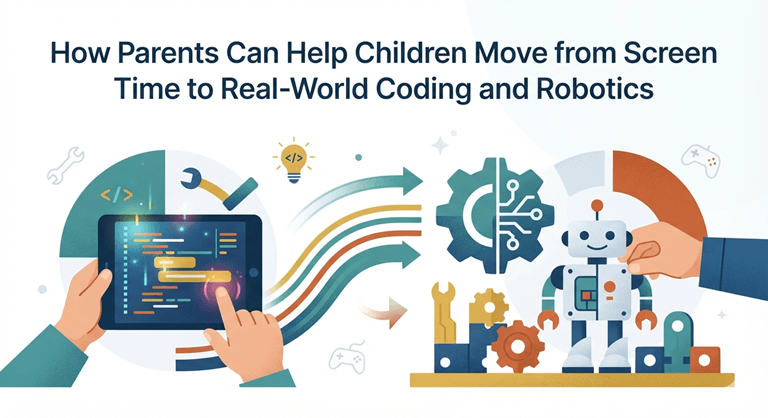
How Parents Can Help Children Move from Screen Time to Real-World Coding and Robotics
For many teenagers, technology is already part of everyday life. They use apps, play games, watch videos, and experiment with new digital tools almost without thinking. Yet being comfortable with technology is not the same as understanding how it works—or seeing the possibilities it can create.
That is where practical STEM exposure matters. Science, technology, engineering and mathematics become far more meaningful when young people can connect them to something they can build, test or improve. A child who finds a textbook chapter abstract may become deeply curious when the same idea is used to make a robot move, design a simple game or understand why a bridge stays standing.
Parents do not need a technical background to encourage this curiosity. What children need most is the freedom to explore, a suitable learning environment and adults who take their questions seriously.
Start with the interest, not the subject label.l
Teenagers rarely announce that they want to study “STEM”. Their interest usually appears in a more specific form. One child may be fascinated by space. Another may enjoy taking apart old gadgets, editing videos, solving puzzles, es or designing imaginary cities.
These interests are useful clues. A teenager who enjoys strategy games may take to coding or mathematics naturally. Someone who constantly sketches inventions may enjoy product design or robotics. A child interested in climate change may connect with environmental science, electronics, or data analysis.
Instead of beginning with a course catalog, parents can begin with a conversation:
- What do you enjoy making or figuring out?
- Which problem would you like to solve?
- What have you watched or read recently that made you curious?
- Would you rather build something, investigate something, or design something?
The answers help narrow the field without forcing a premature career decision.
Give experimentation more value than early expertise
Parents sometimes worry that their child has “started too late” because another student already knows a programming language or has participated in a robotics competition. That comparison can turn a promising interest into unnecessary pressure.
Early STEM learning should be exploratory. A short workshop, trial class or small home project can tell a family much more than committing immediately to a long program. The aim is not to produce an expert in a few weeks. It is to observe whether the teenager enjoys the process of testing ideas, dealing with mistakes and trying again.
This also permits children to change direction. A student may discover that coding is not enjoyable, but electronic design is. Another may enter a robotics class for the machines and stay because of the teamwork. Exploration is useful even when it rules something out.
Look for evidence of active learning.
The quality of a STEM program depends less on impressive terminology and more on what students actually do during the session. Parents should look for classes where children spend meaningful time making decisions, building projects and explaining their reasoning.
A useful class may include:
- age-appropriate projects with a clear purpose;
- opportunities to work independently and in teams;
- instructors who ask questions instead of giving every answer;
- room to test, fail safely and improve;
- projects that become gradually more challenging;
- feedback on both the final result and the thinking behind it.
Batch size matters too. Younger learners and beginners often need more individual attention, particularly when equipment or unfamiliar software is involved. A trial session is a practical way to see whether the teaching style suits the child. Parents in Bengaluru can compare coding and robotics classes for children by location, reviews, programs and trial availability before shortlisting options.
Treat mistakes as part of the curriculum.
STEM projects rarely work perfectly on the first attempt. Code produces errors. Models collapse. Measurements turn out to be wrong. These moments can be frustrating, but they are also where some of the most valuable learning happens.
When adults rush in to fix every problem, children may finish the project but miss the lesson. A better response is to help them slow down and diagnose what happened:
- What did you expect to happen?
- What happened instead?
- Which part can you test separately?
- What would you change in the next version?
This turns failure from a verdict into information. Over time, teenagers learn to approach difficult problems with patience and method rather than assuming that an imperfect first attempt means they lack ability.
Connect projects to people and everyday life.
As children explore technology, parents should also keep online discovery age-appropriate. OTechWorld’s guide to safe search engines for kids is a useful companion for families that want children to research, learn and explore more safely.
Technical learning becomes more memorable when teenagers can see who it helps. A basic sensor project can be connected to water conservation. Data analysis can be used to understand local air quality. A simple app can be designed around a real problem faced by classmates, grandparents, or neighbors.
Parents can encourage this connection by asking children to explain the user or purpose behind a project. Who is it for? What problem does it address? Is it easy and safe to use? Could it create an unintended difficulty?
These questions bring communication, ethics, and empathy into technical learning. They also show teenagers that STEM is not an isolated collection of formulas. It is a way of thinking about the world and contributing to it.
Keep the balance between guidance and ownership
Parents play an important role in opening doors, arranging transport, evaluating safety, ty and paying for learning opportunities. But the child should retain some ownership of the journey.
Let teenagers help choose between shortlisted programs. Ask them to set a small goal for the first month. Invite them to show the family what they have created, without turning every project into a performance review. Interest is more likely to last when young people feel that the work belongs to them.
Not every child who explores STEM will become an engineer or scientist, and that should not be the only measure of value. Practical STEM experiences can strengthen logical thinking, creativity, collaboration, and confidence with unfamiliar problems. Those capabilities travel well across subjects and careers.
The most useful question, therefore, is not “Will this activity guarantee a future profession?” It is “Does this experience help my child become more curious, capable and willing to learn?” When the answer is yes, the exploration has already been worthwhile.
Popular on OTW Right Now!




About The Author

Gagan Bhangu
Founder of otechworld.com and managing editor. He is a tech geek, web-developer, and blogger. He holds a master's degree in computer applications and making money online since 2015.