
How Much Power Do You Really Need for Off-Road Riding?
If you look at how people shop for off-road bikes—especially electric ones—it’s easy to think power is everything. Motor wattage, peak output, and top speed often dominate the conversation. Bigger numbers feel safer, as if more power automatically means more capability.
However, after getting down to actually riding off-road, the power-versus-experience correlation is no longer so simple. Trails, terrain, and rider behavior soon modify the amount of power you actually apply. The actual issue is not the amount of power a bike can generate but the amount of power you actually use when you are riding.
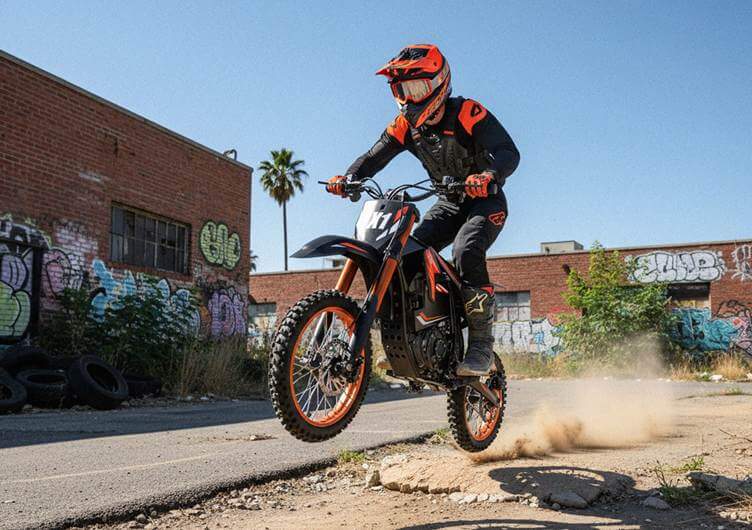
Why Power Numbers Can Be Misleading Off-Road
Power ratings are easy on paper. The more the higher the bike is stronger and faster. However, long-distance off-road riding seldom permits riders to ride at maximum output.
Trails have many variables, unlike in pavement riding: rough terrain, narrow bends, shifting traction, and unexpected features. To ensure balance and control, riders continuously change throttle input. Under such conditions, peak power is less of a working point and rather a reference point.
This is especially noticeable with electric off-road bikes, where instant torque can make even moderate power levels feel strong. A bike doesn’t need extreme output to feel responsive; how power is delivered often matters more than how much is available at the top end.
How Terrain Changes How Much Power You Need
The terrain has a larger proportion of power consumption than most riders anticipate.
On narrow, technical trails, the riders spend the bulk of their time going along the corners, roots, and mini elevation features. A smooth throttle control that is smooth is much more important than actual speed. Excessive power in such scenarios can even result in a rider being more exhausted since the rider is always trying to control the input in order to prevent a loss of traction.
Unstable surfaces such as sand, gravel, or loose soil also restrict usable power. Traction rather than motor output is the bottleneck. The horsemen tend to use pressure slowly to maintain the bike rather than pressing.
The necessity is not necessarily peak power even on hilly slopes. Constant torque and predictability contribute to the rider being able to move forward without disturbing the equilibrium. In reality, lots of riders ascend hills at a regulated speed and do not race up to the full capacity.
How Most Riders Actually Use Power on the Trail
When you observe the manner in which individuals ride off-road, a certain trend emerges: most of them do not spend much time on full power. Rather, they ride in a good range that enables them to respond to the terrain and exhaustion.
Biking is not an easy task. Body position control, bump absorption, and trail-reading are all energy-consuming. Riding at full power at all times would reduce rides and increase errors. This effectively causes riders to just adopt a pace that is more about control rather than straight speed.
This is what causes the rider to talk about specs on headlines and move on to feel. It also turns out that the rate at which power is developed, the smoothness of response, and the ease with which the power can be turned up and down is more valuable than the highest number on a spec sheet, with a number of prospective customers purchasing electric dirt bikes coming to this realization at one time or another.
When Higher Power Actually Makes Sense
All this does not imply that more power is not required. It is true that there are other instances when marginal output is really beneficial.
Heavy riders, such as, might enjoy a higher power to keep them on the same performance with other riders. A higher top-end performance can also be more applicable in wide-open riding environments, such as desert terrain or a large off-road park. Within such settings, riders are likely to enjoy greater space to employ greater speeds safely.
The right gearing and traction can also be used on Steepers, which are subjected to sustained climbs. In such situations, power is a store and not something that is in constant use.
The point is that greater power only serves better when it servesa certain necessity, not when it is discussed as a general necessity.
Why Control Often Matters More Than Raw Output
Confidence to many riders dictates the pleasure they get from off-road riding. A bike that is predictable enables the rider to rest, get more lines, and ride longer without getting tired.
It is through the mannerin which power is dispensed that control is achieved. Nimble throttle, controllable torque, and similar behavior on various surfaces all add to the impression of a bike that is easy to ride, even though the peak output might be comparatively high.
Some higher-performance electric dirt bikes illustrate this balance well. The Qronge X1 SPARK, for instance, is listed with a 4500W peak motor, triple-mode drive, and an advertised top speed of up to 50 mph. Rather than being about riding flat-out, setups like this allow riders to adjust output for different terrain and situations, which reflects how power is actually used off-road.
What to Think About Before Choosing Power Levels
Rather than beginning with a number as large as one can begin with, it is sometimes more convenient to ask some practical questions:
- Where do you ride most often—tight trails, open areas, or mixed terrain?
- How long are your typical rides?
- Do you prefer relaxed exploration or aggressive riding?
- Will the bike be shared with other riders who may have different experience levels?
These variables are more likely to influence satisfaction as compared to peak power ratings. When a bike fits your pace of riding, then it will most likely be used frequently and will be appreciated over time.
Finding the Right Balance
Off-road riding does not lie in the acceleration or maximum speed. It is being able to manoeuvre, to be in control, and to have fun. Whereas power is a critical component of that equation, it is still a component.
The vast majority of riders do not require the maximum possible output as much as to have fun and ride. What they require is an accessible power that they can utilize easily, predictively, and reliably. That balance is a much greater thing in most instances than the headline figure that is affixed to a motor.
Final Thoughts
How much power do you actually require to do off-road riding? To the majority of people, the answer is not as much as they may assume. Raw output is less rewarded than trials’ confidence and endurance.
When considering the bike to ride, it is usually better to select it depending on the way you will ride it, not on how fast the bike would be in favorable situations. In off-road riding, usable power exceeds maximum power nearly on a regular basis.
Popular on OTW Right Now!



About The Author

Gagan Bhangu
Founder of otechworld.com and managing editor. He is a tech geek, web-developer, and blogger. He holds a master's degree in computer applications and making money online since 2015.