
How Marketing Data Connectors Eliminate Manual Reporting and Save 40+ Hours Monthly
Marketing teams routinely burn substantial hours monthly on reporting: exporting files, standardizing formats, adjusting dashboards. As marketing stacks grow more complex, this time investment multiplies.
Senior professionals end up doing administrative work instead of strategic analysis, insights arrive days late, and human errors create inconsistent metrics.
The solution? Marketing data connectors that optimize this entire process, automatically extracting and consolidating data from all your marketing platforms.
Marketing Data Connectors for Reporting Explained
Instead of manually logging into each platform to export data, data connectors for marketing apps solve this problem through automation. These tools connect directly to your marketing platforms through their APIs. It gives you the ability to get a unified view of your marketing performance.
What Can Marketing Data Connectors Do?
Marketing data connectors provide the following:
- Automated data extraction from multiple marketing platforms
- Standardization of different data formats across systems
- Consolidation into a single reporting system
- Real-time or scheduled data synchronization
In brief, they help marketers eliminate the need to juggle separate marketing dashboards manually and focus on strategy.
As an example, consider SellThru, a digital marketing agency.
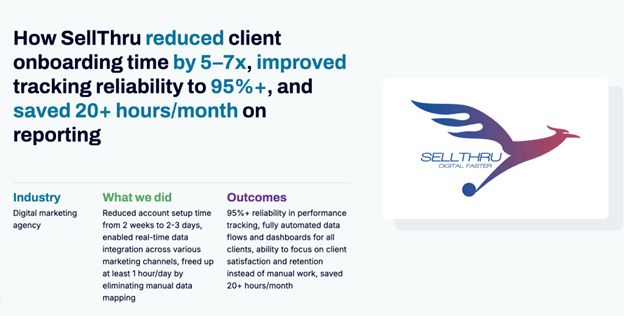
Before implementing a marketing data connector, their client onboarding process required over two weeks of manual data setup and consolidation.
With the data connector for marketing sources by Coupler.io, they reduced this timeline to just 2-3 days while achieving over 95% reliability in performance tracking.
The time savings allowed their team to focus on strategic client work and campaign optimization rather than data mapping and manual reporting.
This way, marketing data connectors functionality increases to more benefits:
- Eliminate inconsistencies from manual data handling
- Provide real-time insights instead of weekly retrospective reports
- Free up marketing talent for higher-value strategic work
- Enable focus on analyzing trends and optimizing campaigns rather than building spreadsheets
How Marketing Data Connectors Work
Marketing data connectors operate through several key steps:
- API Connections: Establish direct connections to each marketing platform (Google Ads, Facebook, Google Analytics, HighLevel, etc.)
- Automated Data Extraction: Pull data according to predefined schedules, for example, daily, hourly, or in real-time
- Data Transformation: Unify metrics and formats across platforms (so, for instance, “cost per conversion” means the same thing everywhere)
- Unified Storage: Flow standardized data into your chosen destination: spreadsheets, data warehouse, or BI tools
In a nutshell, the connector establishes API connections to each of your marketing platforms. Then, it extracts data according to predefined schedules. Data transformation happens behind the scenes to address format inconsistencies, a one of manual reporting’s biggest challenges. Finally, you get a standardized data flow in Google Sheets, Looker Studio, Power BI, BigQuery, or other platforms.
Moreover, some marketing data connectors like the one by Coupler.io, a Supermetrics competitor, provide webhooks for event-triggered data refresh and ready-made integrations with AI agents like Claude, ChatGPT, and others. This way, marketers can go beyond just automating data collection, but initialize real-time, proactive analytics in natural language queries without hard-tech setup.

Connectors also handle the technical complexities that make manual integration so time-consuming: API rate limits, authentication protocols, error handling, and data quality checks. When platforms change their data formats or API structures, the connector adapts automatically rather than breaking your reporting workflow.
Choosing the Right Marketing Data Connector
Not all marketing data connectors are created equal, and understanding the different approaches helps you choose the right solution for your specific needs.
All-in-one marketing platforms
These solutions offer built-in connectors as part of comprehensive marketing suites:
- Pros: Integrated experience with everything under one software
- Cons: Limited flexibility and potential vendor lock-in situations
Dedicated marketing data connectors
Tools that focus specifically on connectivity between platforms excel in this space. Coupler.io, for example, offers extensive support for marketing platforms (over 100) combined with flexible data destination options:
- Pros: Broad platform coverage and flexible output options
- Cons: Often requires separate tools for data visualization and analysis
Enterprise solutions
Advanced business intelligence connectors cater to larger organizations:
- Pros: Powerful analysis capabilities and advanced data modeling
- Cons: Complexity and higher costs, often overkill for most marketing teams
The final decision depends on your team’s technical capabilities and the complexity of your marketing stack. It’s also critical to know how you plan to use your data, e.g. back ups, shareable reports or summaries, live multi-channel dashboards, etc. Needless to say, budget and scalability options are also crucial factors of choice. So, take some time to evaluate these key aspects while choosing the right data connector provider.
Data Connectors for Marketing Apps: Implementation Steps
Getting started with a marketing data connector requires a systematic approach that begins with understanding your current processes.
Audit existing workflows
Document which platforms you’re currently using, how much time your team spends on data collection and report building, and where the biggest pain points occur. This baseline helps you measure success after implementation and ensures you’re solving the right problems.
Match capabilities to needs
If your team relies heavily on Google Ads and Facebook Ads with some email marketing, you’ll want a solution with robust support for those platforms. If you’re managing complex multi-touch attribution across dozens of marketing channels, you’ll need more sophisticated data modeling capabilities.
Configure connections
Most modern connectors are designed for marketing professionals rather than technical specialists, making implementation more accessible than traditional data integration projects.
Train your team
This often means shifting from manual data compilation habits to focusing on data analysis and strategic decision-making. The goal is to ensure your team takes advantage of the time savings rather than simply checking automated reports more frequently.
Final Words: Connecting Marketing Data and Measuring Success
The implementations of data connectors redirect reclaimed hours toward high-value activities, such as campaign optimization, creative testing, strategic planning, and deeper client relationship building.
That’s why the most valuable outcome is the shift in working with marketing data. This shift from operational data management to strategic analysis represents the true value of marketing data connector implementation.
Popular on OTW Right Now!




About The Author

Gagan Bhangu
Founder of otechworld.com and managing editor. He is a tech geek, web-developer, and blogger. He holds a master's degree in computer applications and making money online since 2015.