
How Healthcare Technology Is Moving From Virtual Visits to Continuous Care
For years, telehealth was largely defined by one simple idea: bringing the doctor’s office to the patient through a video call. Virtual visits made healthcare more convenient, reduced unnecessary travel, and expanded access to clinicians.
But digital healthcare is now moving beyond the virtual appointment.
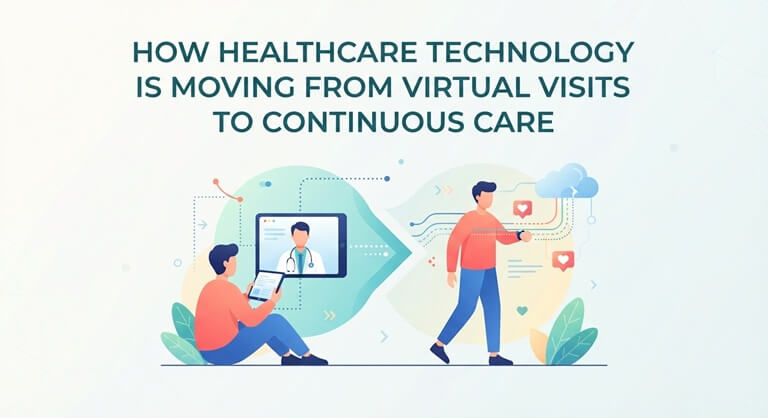
The next stage is continuous care—a model in which technology helps providers understand, monitor, and support patients between appointments rather than waiting for the next scheduled encounter. Remote patient monitoring, connected devices, wearable technology, patient portals, artificial intelligence, digital therapeutics, and automated care-management tools are helping create this shift.
The transformation is significant because many health conditions do not follow an appointment schedule. Blood pressure changes between visits. Diabetes management happens every day. Mental health symptoms can fluctuate from week to week. Recovery after surgery can change rapidly.
Healthcare technology can help clinicians see those changes as they happen.
From Episodic Healthcare to Continuous Care
Traditional healthcare has historically been episodic. A patient schedules an appointment, meets with a provider, receives an assessment or treatment plan, and then returns home until the next encounter.
Virtual care improved the location and convenience of that interaction, but the underlying model remained similar.
Continuous care changes the model by extending healthcare beyond the appointment.
Instead of relying exclusively on information collected during an office visit, providers can combine clinical encounters with information collected throughout a patient’s daily life. Remote patient monitoring, for example, can transmit blood pressure, weight, glucose, oxygen levels, heart rate, and other health information to a healthcare team.
This creates a more complete picture of the patient’s health over time.
Rather than asking, “How are you feeling today?” providers can increasingly examine trends that occurred over days or weeks.
Remote Patient Monitoring Is Helping Make Care Continuous
Remote patient monitoring (RPM) is one of the clearest examples of the transition from virtual visits to continuous care.
RPM allows patients to collect health information outside traditional healthcare settings and share it with their providers. Depending on the patient’s condition, connected devices may monitor blood pressure, blood glucose, weight, oxygen saturation, heart rate, sleep, or other measurements.
The value is not simply collecting more data. The important step is turning that information into appropriate clinical action.
For example, a patient managing hypertension might regularly transmit blood pressure readings. A care team can identify changes in the patient’s readings and determine whether additional communication, a follow-up appointment, or a treatment adjustment is appropriate.
CMS describes remote patient monitoring as involving patient education and device setup, collection and transmission of health information, and provider treatment or management based on that information.
This represents a major conceptual change: healthcare can become an ongoing process rather than a series of disconnected appointments.
Wearables Are Turning Everyday Health Data Into Clinical Information
Wearable devices are another important part of continuous care.
Smartwatches, connected blood pressure monitors, glucose-monitoring technologies, pulse oximeters, sleep trackers, and other devices can generate information outside hospitals and clinics. HHS notes that wearable technologies can continuously track measures such as heart rate, activity, and sleep, while other connected devices can transmit specific physiological measurements to providers.
The challenge is determining which information is clinically meaningful.
Healthcare organizations cannot simply collect unlimited amounts of patient data and expect clinicians to manually review everything. Continuous care therefore requires intelligent systems that can organize information, identify meaningful changes, prioritize alerts, and integrate relevant data into existing clinical workflows.
This is where artificial intelligence and healthcare automation can become increasingly important.
AI Can Help Turn Continuous Data Into Action
Continuous monitoring creates an enormous volume of information. Without appropriate technology, that information could increase rather than reduce clinician workload.
AI can help address this challenge by identifying patterns and prioritizing information that may require attention.
For example, an AI-enabled healthcare platform could potentially identify a meaningful trend in a patient’s readings, summarize relevant information for a clinician, or help categorize patients according to risk. AI can also support documentation, clinical workflows, patient communication, and administrative processes.
However, AI should complement clinical judgment rather than replace it. Continuous care still requires human oversight, particularly when decisions involve diagnosis, treatment, risk, or significant changes to a patient’s care plan.
The goal is not to make healthcare completely automated. It is to make healthcare teams better informed and more responsive.
Digital Healthcare Is Expanding Beyond Primary Care
Continuous care is not limited to one medical specialty.
Chronic disease management is an obvious application, including conditions such as diabetes, hypertension, heart disease, and pulmonary disease. Remote monitoring can also support cancer care, pregnancy, postoperative recovery, nutrition management, and other healthcare needs.
The same technology-driven model is also influencing administrative healthcare operations.
For example, healthcare organizations need accurate provider information and efficient administrative processes to maintain access to care. Credentialing is an important part of this infrastructure. Organizations may rely on specialized Dental Credentialing Services to manage credentialing requirements for dental professionals, while nurse practitioner credentialing services can help organizations manage the administrative requirements associated with nurse practitioners.
Behavioral healthcare is another area where technology can support an ongoing model of care. As virtual behavioral health expands, organizations may also need efficient Insurance Credentialing For Therapists to help qualified providers participate in insurance networks and improve patient access.
These processes may not appear as technologically advanced as remote monitoring or AI, but they are essential to building a healthcare system capable of delivering continuous care at scale.
The Rise of Technology-Supported Chronic Care
The shift toward continuous care is also becoming visible in healthcare policy and payment models.
In 2026, CMS launched the ACCESS model, a 10-year voluntary model designed to support technology-enabled chronic care. The model includes services such as remote monitoring, wearables, coaching, lifestyle support, and medication management for conditions including hypertension, diabetes, chronic musculoskeletal pain, and depression.
This is important because technology adoption in healthcare depends on more than having the right devices and software. Providers also need sustainable workflows, reimbursement models, staffing structures, and incentives that support ongoing patient engagement.
Continuous care becomes more practical when healthcare organizations have both the technological infrastructure and the financial framework to support it.
Patient Engagement Becomes More Important
Continuous care also changes the patient’s role.
Patients are no longer simply recipients of healthcare services. They can become active participants in monitoring and managing their health.
A patient may use a connected device, complete a digital questionnaire, communicate through a patient portal, follow a personalized care plan, or receive reminders about medication and lifestyle behaviors.
HHS identifies patient engagement, prevention, convenience, behavior change, and improved communication as potential benefits of remote patient monitoring.
But technology must remain easy to use.
If patients struggle with device setup, confusing applications, excessive notifications, or complicated digital workflows, engagement can quickly decline. Continuous care therefore needs to be designed around the patient experience—not simply around the technology itself.
Healthcare Data Must Become More Connected
Another major requirement for continuous care is interoperability.
A patient’s information may exist across an EHR, patient portal, laboratory system, pharmacy, wearable device, billing platform, and specialist practice. If these systems cannot communicate effectively, clinicians may still have an incomplete view of the patient.
Continuous care requires healthcare organizations to move toward connected ecosystems in which relevant information can move securely between systems.
The objective is not to create another dashboard for clinicians to check. It is to integrate meaningful information into the workflows they already use.
This distinction will become increasingly important as healthcare organizations adopt more digital tools.
Privacy and Security Cannot Be an Afterthought
More connected healthcare also means more sensitive health information moving through digital systems.
Wearables, mobile applications, remote monitoring devices, patient portals, and cloud platforms can all contribute to the digital health ecosystem. Protecting the confidentiality, integrity, and availability of patient information therefore becomes essential.
Healthcare organizations need appropriate security controls, access management, encryption, data governance, vendor oversight, and privacy practices.
Patients also need transparency about what information is collected, why it is collected, and who can access it.
Trust will be one of the foundations of continuous digital healthcare.
The Future Is Not Virtual Care Versus In-Person Care
The transition toward continuous care does not mean traditional healthcare will disappear.
Instead, healthcare delivery is likely to become a combination of in-person visits, virtual consultations, remote monitoring, asynchronous communication, automated support, and continuous data collection.
A patient might have an in-person examination when necessary, use a video consultation for a follow-up, monitor specific health metrics at home, and communicate with the care team through a secure digital platform.
Each method serves a different purpose.
The objective is to provide the right type of interaction at the right time.
What Continuous Care Could Mean for Healthcare
The long-term impact of this transformation could be substantial.
Healthcare may increasingly move from reacting to problems after they become clinically significant toward identifying changes earlier and managing health proactively.
Instead of healthcare being concentrated around a few appointments each year, technology can help create a continuous connection between patients and care teams.
CMS’s ACCESS model reflects this broader direction by supporting technology-enabled chronic care and outcomes-focused approaches.
However, technology alone will not create continuous care. Healthcare organizations will need to redesign workflows, address interoperability challenges, protect patient data, train staff, and ensure that digital tools actually improve—not complicate—the patient experience.
Conclusion
Healthcare technology has already moved the industry from the traditional doctor’s office toward virtual care. The next transformation is taking healthcare beyond the virtual appointment itself.
Remote monitoring, wearables, AI, connected platforms, digital communication, and technology-supported care models are creating opportunities for healthcare to become more continuous, proactive, and personalized.
The future of digital healthcare may therefore be less about replacing the doctor’s visit and more about connecting the moments between visits.
When technology can help providers understand what is happening before, during, and after an appointment, healthcare becomes more than an episodic service. It becomes an ongoing relationship between patients, clinicians, data, and technology.
Popular on OTW Right Now!



About The Author

Gagan Bhangu
Founder of otechworld.com and managing editor. He is a tech geek, web-developer, and blogger. He holds a master's degree in computer applications and making money online since 2015.