
How an Aerial Work Platform Lift Keeps Crews Safe Around Energized Lines
Electricity will always take the path of least resistance to earth. For a crew working around overhead power lines, the entire safety procedure comes down to ensuring that path doesn’t go through the person. An aerial work platform lift designed for this type of work deals with the issue in a number of ways at once: via insulation, testing, equipment design, and good work practice.
The best way to get a handle on how that protection works is to trace the path that the electricity would attempt to take, starting at the line and ending up at the ground down under the truck. Every point along that path has its own set of risks and its own set of defenses.
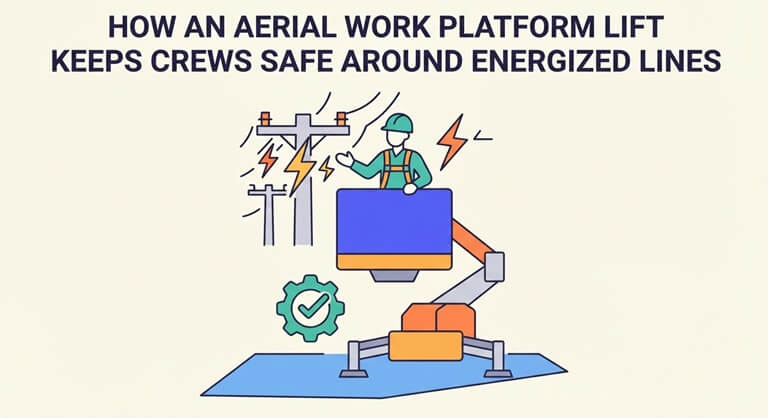
Distance: The First Line of Protection
Prior to any equipment feature coming into play the most important protection is space. OSHA generally requires unqualified personnel and their equipment to remain at least 10 feet from overhead lines up to and including 50 kV with the required distance increasing as the voltage increases. Qualified electrical workers operating under OSHA’s power line rules (29 CFR 1910.269) have their own set of minimum approach distances based on voltage, along with specific training and procedures.
Insulated equipment never replaces the use of distance. It’s an additional layer of protection in the event of something going wrong (boom swinging unexpectedly, a gust of wind, a misjudged position etc). Every good job in the vicinity of energized lines begins with a plan to keep the platform and its crew as far away from the conductors as the work will permit.
Many crews will also have an observer on the ground whose sole job is to be looking at the clearance between the boom, the platform and the lines. It’s very difficult to judge depth from the basket and a second set of eyes looking at it from the side can spot a closing gap a lot earlier than the operator will be aware of.
The Platform: Where Workers Meet the Hazard
The basket is the bit of equipment that the workers are closest to the line so it gets its own protection. Insulated platforms typically use a basket made of fiberglass with a dielectric liner fitted to it, which will prevent current from passing through the basket walls if a tool or conductor should make contact.
Workers in the basket will have personal protection on top of that. Rubber insulating gloves and sleeves (rated for the voltage and tested regularly) will protect the hands and arms. Line hose, blankets, and other cover-up gear can be placed over adjacent conductors to reduce the chance of accidental contact. Tools used in the vicinity of the line will be insulated as well.
Clean, dry equipment is important here in a way that many people don’t appreciate. Dirt, moisture and grease on the fiberglass can all provide a path for current. That’s why the crews keep their liners and booms clean and won’t do any work on an energized system if it’s wet.
The Boom: The Insulated Link in the Chain
The boom is the core of an insulated machine. On these units, at least one section of the boom is fiberglass rather than steel. That insulating section is what separates the platform from the rest of the machine so current entering the basket has no easy route down to the truck.
In North America, vehicle-mounted aerial devices are covered by the ANSI A92.2 standard, which sets categories based on how the insulating boom is designed and tested, including whether it serves as primary insulation for certain types of live line work or as secondary protection. Some units include a lower test electrode system that allows leakage current to be measured during testing. Choosing an aerial work platform lift with the right insulation rating for the voltage and the work method is one of the most important decisions on any electrical job.
Insulation only works if it’s maintained. ANSI A92.2 requires periodic dielectric testing, and many organizations will test their insulated units at least once a year, with additional tests being carried out following any repair work. The test records should be with the machine so that the crew and the site owner can verify that the unit is up to date.
The Truck and Chassis: Managing What Reaches the Ground
Even with an insulated boom the truck itself has to be looked after. If there’s contact and current gets to the chassis, the vehicle can become live. Some units have a chassis insulating system or insulating sections in the lower boom to provide an additional barrier.
Crews also have the responsibility of managing the vehicle’s connection to ground. It may be grounded or bonded depending on the work and the utility’s procedures. The purpose of this is to ensure that if a fault does occur, the current will take a known path rather than an unknown one.
The Ground: Protecting Everyone Around the Truck
The last point on the path is the ground itself and the people on it. When a vehicle is energized, the ground around it can have very dangerous voltage gradients. A person touching the truck or even walking near it could be exposed.
That’s why the area around the vehicle is barricaded when work is being carried out in the vicinity of energized lines, and access to the vehicle is restricted. Ground crews who are working on the ground and passing tools and materials to the platform have a very strict set of procedures and PPE is used. There is a clear communication plan between the basket and the ground from the outset.
Protection at Each Point Along the Path
| Point on the path | Main hazard | How the risk is controlled |
| Distance to the line | Accidental contact or arc | Minimum approach distances, careful positioning |
| Platform and workers | Direct contact with conductors | Dielectric liners, rubber gloves and sleeves, cover up equipment |
| Boom | Current traveling down the machine | Fiberglass insulating sections, periodic dielectric testing |
| Truck and chassis | Vehicle becoming energized | Chassis insulation on some units, grounding or bonding procedures |
| Ground around the truck | Voltage gradients, contact with the vehicle | Barricades, controlled access, protective equipment |
No single layer is expected to work alone. Safety near power lines comes from all of them working together.
What Should Crews Check Before Every Job?
Prior to work commencing, crews will normally check the voltage on the adjacent lines and the required approach distances, check that the machine has an appropriate insulation rating for the job, and that the dielectric test records are up to date. The fiberglass sections, liners and hoses will be visually inspected for cracks, contamination and moisture. Weather will be checked as well since rain and high humidity will have a negative effect on the insulation. There will be a short tailboard briefing to confirm roles, communication signals and emergency procedures for all on site.
Frequently Asked Questions
Does an insulated platform make it safe to touch a power line?
No. Insulation is a backup. Only competent personnel using approved methods and PPE may work on or around live conductors and approach distances still apply.
How often are insulated booms tested?
Periodic dielectric testing is required, and many organizations test at least once a year, plus after any repair that could affect the insulation.
Why does weather matter for insulated equipment?
Moisture and contamination on fiberglass surfaces can let current travel along them, reducing the protection the insulation provides.
Closing Thoughts
Working safely around power lines is all about managing every point that the electricity could possibly pass through, from the distance between the platform and the line to the ground around the truck. An aerial work platform that’s been designed and built for this type of work will have an insulated boom, an insulated platform, equipment that’s been tested and proven and of course a whole suite of safe working procedures. If you’re planning a job in the vicinity of an energised line you can talk to the experts at https://www.bladeplatforms.com/ about the insulated options and the site requirements. Having that conversation early in the process gives you the time to get all the appropriate layers of protection in place.
Popular on OTW Right Now!




About The Author

Gagan Bhangu
Founder of otechworld.com and managing editor. He is a tech geek, web-developer, and blogger. He holds a master's degree in computer applications and making money online since 2015.