
How 3D eCommerce Product Modeling Boosts Engagements and Transaction Totals
The gap between casual browsing and actually buying has never felt wider as online retailers struggle with stagnant conversion rates (globally, around 2.69%) and inherently low average order volumes (close to $172). This raises an important question for the majority of eCommerce businesses: Can online shopping really replace the tactile experience of a physical showroom?
Static 2D images cannot. They fail at conveying the size, texture, or fit of a product, leaving shoppers hesitant and underconfident to make the purchase. As an eCommerce business, this can be a direct drain on your bottom line because many users stop exploring, abandon carts, or turn to in-store shopping (about 45%) after a few failed online experiences.
This is where 3D eCommerce product visualizations come in. While 3D models still don’t eliminate the imagination gap, they do make it a bit smaller because they allow users to actively and sensually explore the product, rather than just scroll through a bunch of images. As users can visualize the object in digital space, they will have the confidence to invest. Let’s explore in detail how 3D models enhance eCommerce interaction.
Where 2D Static Product Images Fail?
For decades, the product photo has been the standard in eCommerce and has been the retail baseline, but they’ve always had a narrow window of observation that prevents the buyer from understanding. This leaves out a lot of product-related questions that are left unanswered, creating points of friction in the user’s journey. Here is why:
- Fixed Perspectives: Static 2D images prevent users from inspecting the product from every angle, often hiding important ports, seams, or back-panel details.
- Scale Misinterpretation: Without dynamic or 3D product visualization, customers often misjudge the actual dimensions of an item, leading to “too small” or “too large” surprises upon delivery and ultimately, returns.
- Tactile Ambiguity: 2D images struggle to convey the true depth of textures or how different materials, like brushed metal or velvet, react to light and movement.
- Passive Interaction: Standard galleries offer a linear experience that fails to engage the shopper, resulting in shorter time-on-page and lower brand recall.
- Inaccurate Customization: For products with multiple colors or features, static images often fail to show the exact combination a user wants, causing hesitation at the final checkout stage.
How 3D Product Modeling and Visualization Address These Gaps?
“Life is in 3D. That, to me, is the first part of spatial commerce. You can actually feel and be closer to your favorite brands.” – Farhan Thawar, VP of Engineering at Shopify.
Your buyers will have a real-life shopping experience if you have a realistic 3D model or render of your products. These include the use of the software program Autodesk 3ds Max, rendering software such as Blender, and CAD-like technology to produce a photorealistic (or non-photorealistic) image based on an idea, 2D wireframe, or a reference image. These images can be further manipulated in post-production to include any specific lighting, material, or special effect needed to produce a realistic eCommerce 3D product visualization.
The transition to immersive 3D models directly resolves 2D friction points through the following specific upgrades:
Total Visual Transparency
The user may rotate the model 360 degrees around all axes so that they can see all surfaces. With this, you can check on a granular level the ports, hinges,s or rear-panel specifications that 2D galleries are not necessarily able to.
DimensionalAccuracAR-powered “View in Room” or “Try-On” is possible with advanced 3D modeling for e-commerce. This enables a customer to “try on” a virtual replica of the item in the real world or on themselves, to ensure that scale, colour, appearance, and fit are perfect.
Tactile Mimicry
Physically Based Rendering (PBR) is the term used for simulating how light interacts with an object in high-fidelity 3D visualizations, such as those used in 3D modeling. A very common way to get the matte finish of an appliance or the grains of a leather bag is a visual indicator of quality.
Instant Iteration
Advanced eCommerce 3D product visualization enables live product configuration. A user can instantly switch between 40 different fabrics and 5 different hardware finishes, and is able to see exactly how the finished product will look before purchasing.
Mechanical Clarity
eCommerce 3D product visualizations can also convey complex motions. Hatches or hinges on laptops can now be seen to open and close, and modular shelving can be seen to open and shut, eliminating functional ambiguity that leads to support tickets.
This allows 3D modeling for e-commerce to create a virtual space that can be as close to a physical showroom, helping to close the imagination gap to additional conversions.
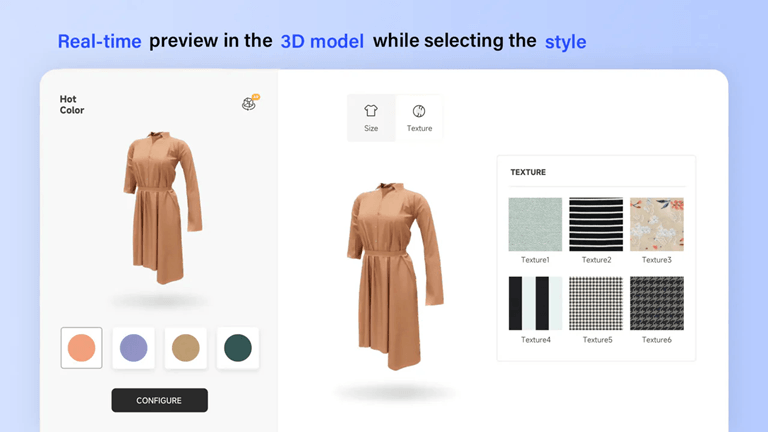
Source: Shopify App Store | Alt Text: 3D Product Models
Consequent Impact on Customer Engagement and AOV
3D eCommerce product visualizations also drive a higher transaction total due to the following psychological and functional reasons:
- Premium Feature Upselling: When customers can see high-definition details of premium materials, the value proposition becomes self-evident.
- Reduced Purchase Hesitation for High-Ticket Items: Buyers are almost always cautious with expensive online purchases. But the 360-degree transparency provided by 3D visualization reduces the hidden risk factor, making them more likely to buy expensive products.
- Increased Cross-Selling Accuracy: Interactive 3D visualizations for e-commerce can also help users see how multiple accessories or related products go together. This encourages the addition of multiple items to a single cart.
- Reduced Product Returns: A 3D product model leaves little to no room for surprises upon delivery. IKEA’s Place App is a classic example. When it was launched, the company experienced a solid 23% reduction in product returns as users were able to map the exact product sizes with the available space.
- Confidence in Customization: For products with tiered configurations, seeing a personalized, high-fidelity render of a custom build gives the confidence to opt for expensive add-ons and other finishes.
- Extended Brand Interaction: The longer a user engages with a 3D model, the higher their emotional investment in the product. This statistically correlates with a higher likelihood of choosing certain products or brands over others.
The eCommerce ROI: 3D Modeling vs. Traditional Photography
Traditional photography has been in use for e-commerce and retail businesses for a long time. Today,y however, with e-commerce expectations of speed and the rapid pace of selling, the logistical complications of a “real-world” photoshoot can delay product releases. This means that photography to 3D-first is an asset allocation change as well.
A Side-by-Side Comparison
| Feature | Traditional Photography | 3D Product Modeling |
| Logistics | Requires physical products and shipping. | Can be done via CAD files; no shipping needed. |
| Cost per Variation | Typically High: new shoots for every new angle, color, and line of product. | Generally Cost Efficient: multiple renders can be created from one master file. |
| Speed to Market | Slow: depends on photography-editing cycle, photographer availability, and shipping. | Fast: Creating 3D models is much faster than clicking and editing photographs. |
| Visual Consistency | Variable: changes with light and setup. | Perfect: fixed digital parameters. |
| Interaction | Passive: viewing only. | Active: rotate, zoom, and configure. |
| Content Longevity | Static: cannot be repurposed easily. | Dynamic: can be used for AR/VR simulations, video, and ads. |
The Takeaway
The move to 3D modeling for e-commerce is a direct response to an increasingly picky target market that values visual evidence over assurances when making purchases online. With this, businesses can go beyond their typical catalogs and provide highly engaging experiences that guarantee higher conversion rates and a notable increase in AOV.
Making the switch to a 3D-first storefront, however, is not very convenient. There are several technological obstacles involved. Model optimization, PBR texturing, and multi-platform compatibility must be expertly handled when creating photorealistic, lightweight 3D assets to guarantee quick load times without compromising realism.
For enterprises managing multiple catalogs with thousands of products, this can also interfere with the operational flow. This is why many consider opting for 3D product modeling services for end-to-end expertise and outsourcing. The goal is to present all your products in a way that best represents them, whether done internally or with an experienced service partner.
Author Bio:
Nathan Neal is a seasoned photo editing and retouching expert at PicsMatic, a leading photo editing company. With a versatile skill set encompassing fashion photo retouching, portrait enhancement, real estate photo editing, and 3D modeling, he brings extensive expertise to each project. His creative prowess is warranted through a portfolio of over 10,000 edited photos, catering to a diverse array of brands and businesses, from startups to global conglomerates across various industries. Committed to excellence, Nathan keeps himself updated with the latest trends and practices in the photo editing industry.
Popular on OTW Right Now!




About The Author

Gagan Bhangu
Founder of otechworld.com and managing editor. He is a tech geek, web-developer, and blogger. He holds a master's degree in computer applications and making money online since 2015.