
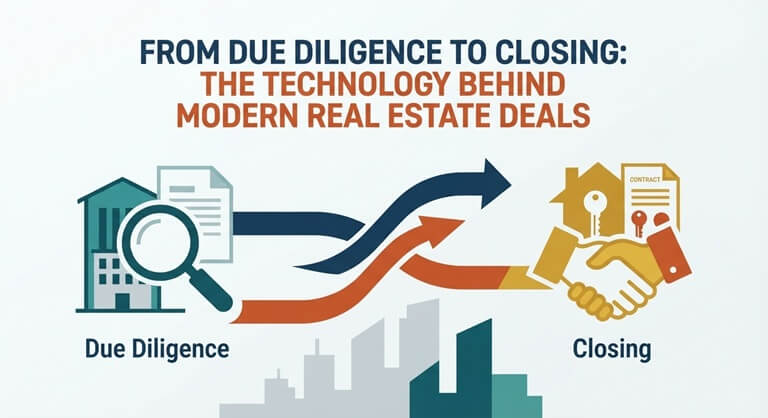
From Due Diligence to Closing: The Technology Behind Modern Real Estate Deals
Real estate transactions depend on coordination between buyers, sellers, brokers, lenders, attorneys, accountants, and technical advisers. Each party may need access to different information, often under tight deadlines.
From underwriting and document review to approvals and closing, digital tools now help deal teams organize information and keep transactions moving.
Deal evaluation starts with better data.
Before a transaction is even in its due diligence phase, technology is already impacting a transaction.
Buyers would be required to review the rent rolls, operating statements, lease information, market data, capital expenditure requirements, and financing assumptions.
With today’s technologies, underwriting and document processing can automatically read property data from property records and plug it into structured models. AI can also find figures, clauses, and patterns within collections of large documents. Analysts still need to check the output, but AI can automate much of the work, freeing up time for valuation and risk assessment.
Due diligence creates a document management challenge
When a buyer gets in touch, the amount of information will rapidly grow. Real estate due diligence can include title documents, surveys, environmental reports, operating statements, tax records, insurance policies, service contracts, engineering reports, financing materials, leases, and rent rolls.
The files may require the review of multiple internal and external experts. This means it is essential to organize documents, control access to them, and manage their versions.
For more complex deals, teams may use a real estate data room as a secure digital workspace for storing and sharing confidential transaction documents. Unlike a basic cloud folder, a virtual data room is designed around controlled access, structured review, and transaction-specific security.
Every document can be stored in a detailed folder structure with various permission levels for buyers, lenders, attorneys, consultants or investment partners. Features like view-only access, download restrictions, dynamic watermarks, multifactor authentication, and audit logs reduce unnecessary exposure of sensitive property and financial information.
Data rooms also help to streamline the due diligence process. Reviewers are able to work from a central document set, utilize search and indexing features to find documents and know when new versions are uploaded. For competitive sale processes, you can manage different groups of bidders without disclosing one group’s activity to another.
MCP-enabled data rooms bring AI into the workflow
AI data rooms are moving beyond a single document summary. A novel method is the Model Context Protocol, or MCP, which is an open standard to enable AI assistants to communicate with business systems outside the application.
In an MCP-enabled data room, an AI assistant can work with any deal content without first downloading documents and uploading them to a separate chatbot. Depending on permissions and the platform, the assistant can search files, summarize leases, find clauses, compare information across files, or organize diligence findings.
For real estate teams, this can be beneficial for a transaction that involves hundreds of leases, contracts, property reports and financial files. Users can run specific queries across the document set and keep the documents in the transaction space.
However, security still depends on implementation. Access to AI should align with the permissions granted within the data room, and actions should be still be controlled and auditable. AI can help make this process more useful during the due diligence process, but it can’t replace the need for human verification or robust access control.
Workflow tools keep multiple workstreams moving.
Do not expect commercial real estate deals to unfold linearly necessarily. Financial analysis may proceed during the legal due diligence process; financing discussions may go along with inspections and negotiations and even with internal approvals.
Workflow tools can assist teams in monitoring these activities from a single location. Teams can assign tasks, track deadlines, and identify outstanding items before they negatively affect other aspects of the transaction.
Electronic signatures simplify execution
When electronic execution is legally permissible, electronic signature platforms can be used to share, sign, and track agreements. Signatory authority is yet to be determined, proper execution of the correct version, and full closing records for teams remain to be completed.
Closing technology improves visibility
As closing approaches, the need for coordination becomes more urgent. Various documents such as financing documents, escrow instructions, corporate approvals, insurance confirmations, and purchase agreements may need to be signed in a certain order.
Digital closing checklists enable teams to keep track of each item to ensure that all items are approved and documents are present. Automated reminders can also reduce follow-up efforts as deadlines approach.
The technology should fit the deal.
More software doesn’t always mean better. Issues arise when underwriting data sits in one system, transaction documents in another, tasks in a third, and key discussions in email.
When choosing technology, deal teams should consider usability, integrations, access control, data ownership, and export options. Simple home or single-property transactions might require only a few fundamental tools, whereas portfolio or cross-border transactions may involve more complex security, permissions, workflow management, and reporting.
Technology supports the full transaction lifecycle
Real estate technology is most effective when it reduces friction at a specific point in the transaction.
Tools for underwriting can speed up the analysis. Data rooms can facilitate secure data room due diligence. AI can be integrated into controlled document workflows via MCP connections. Project management software can track deadlines, and electronic signatures and digital closing tools can streamline execution.
Highly skilled investors, attorneys, lenders, brokers, and advisers will continue to play a key role in real estate transactions. However, technology provides those professionals with new tools to handle information, decision-making, and coordination needs that help get a deal from due diligence through closing.
Popular on OTW Right Now!




About The Author

Gagan Bhangu
Founder of otechworld.com and managing editor. He is a tech geek, web-developer, and blogger. He holds a master's degree in computer applications and making money online since 2015.