
Cloud, Security, and Infrastructure: Connecting the Pieces of Business IT
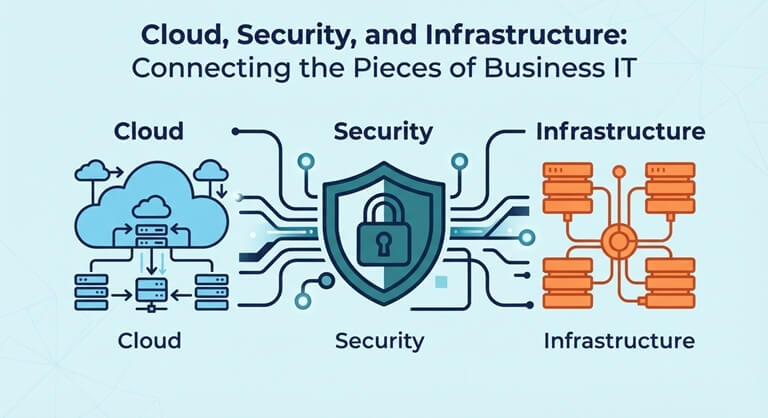
The only sure way to avoid compounded outages and to ensure business continuity is to integrate your cloud, security, and physical infrastructure. At present, most IT managers deal with a number of fragmented and isolated systems that do not communicate with each other.
The way you’re handling this leads to costly, reactive band-aid solutions that use up money and upset employees. By contrast, it takes your operations from a state of reactive troubleshooting to one of proactive alignment and thus ensures that your business continues to run without any interruption.
Key Takeaways
- The main cause of avoidable business interruptions and ongoing operational expenses is isolated IT systems.
- Real resilience can only be achieved through an integrated strategy in which physical infrastructure supports cloud workloads and security safeguards each layer.
- Integrated technology ecosystems eliminate the single points of failure that cause catastrophic network outages.
- Proactive IT alignment by Yakima tech experts transforms technology from a sunk cost into a reliable driver of operational ROI.
What Is Business-IT Alignment (And Why Does It Prevent Downtime)?
Business-IT alignment ties your technology investments directly to your operational objectives in order to improve efficiency, and it avoids downtime by replacing fragile and isolated systems with a coherent strategy, thereby changing your whole IT approach from one of reactive troubleshooting to one of proactive prevention of problems.
True alignment makes a fundamental change to an organization’s IT position since many companies at present do not allocate resources to repair a system until it breaks. This kind of reactive approach ensures that interruptions occur frequently. An aligned strategy, on the other hand, plans for hardware life cycles, software updates, and bandwidth needs in advance.
When companies set up a unified ecosystem, they remove the single points of failure that lead to downtime since separate systems are unable to communicate with each other. If your cloud storage automatically synchronizes with your physical servers using the same security measures, a local problem will not cause the whole company to come to a halt. Because unified systems are able to share data easily, the chance of a complete stoppage of operations is reduced.
Sustaining that level of operational resilience comes down to having dedicated IT support in Yakima to manage your network infrastructure, safeguard critical business data with automated backups, and provide rapid help desk assistance. Having experienced local specialists oversee your cyber defenses, cloud backups, and core systems ensures your technology stays reliable so your team can focus on growing the business.
How Cloud, Security, and Physical Infrastructure Depend on Each Other
Seeing cloud systems, security, and the physical infrastructure treated as separate silos leads to dangerous deficiencies in both performance and safety. When a holistic ecosystem is employed, it operates like a single machine, with the physical infrastructure forming the foundation for the cloud and security providing complete protection for both of these layers.
Ensuring that these three components are separated leads to operational difficulties, since it is impossible to operate a high-speed cloud environment using outdated cables, and cloud data cannot be secured if the physical endpoint is compromised. The first step in building a reliable network is to realize the close interdependence of these three elements.
Infrastructure: The Physical Backbone for High-Demand Cloud Workloads
A solid physical network is an absolute necessity if you are to support modern cloud applications; failing to upgrade your basic hardware when migrating workloads will result in bandwidth bottlenecks, excessive latency, and daily workflow interruptions that are very frustrating for the whole team.
The infrastructure consists of a physical and network foundation made up of high-speed fiber, structured cabling, and custom servers. It is a common error for many companies to buy costly cloud software and then run it on a network that is ten years old. This mismatch causes data packets to stall, leading to dropped VoIP calls and frozen collaborative documents.
Making your physical assets future-proof means ensuring that they are able to cope with scalable business growth and heavy data pipelines. The best way to do this is to replace the existing copper wiring with fiber optics and to have your switches and routers examined every year. By upgrading these physical components, you can be certain that your network will have the bandwidth to support any cloud tools that your team decides to adopt in the future.
Cloud: Driving Agility and Operational Resilience
Because the underlying infrastructure is strong, integrated cloud solutions offer the possibility of flexible workflows and reliable business continuity, as well as enabling remote collaboration and ensuring that your data remains accessible during local disruptions so that your team can stay productive from any location.
Cloud-based productivity ecosystems enable smooth collaboration for remote and hybrid work arrangements. Employees are able to co-author documents, access client records, and have video conferences without having to be tied to a particular desk. This flexibility speeds project delivery and boosts employee satisfaction, but it depends entirely on the continuous availability of your physical network.
The cloud also has a vital role to play in automated, off-site backups; by continuously copying your data to a secure remote server, cloud backups make it possible to quickly recover from data loss or from local disasters. In the event that a flood or fire damages your physical office, your team can just log in from a new location and get back to work immediately.
Security: Unified Protection Across Every Layer
Cybersecurity has to be smoothly incorporated into both the physical endpoints and into cloud environments if catastrophic breaches are to be avoided; if you only secure one layer then your whole system remains at risk since attackers will always go for the weakest link in order to get into your network.
Since an outage can reveal or damage data, it has become clear that problems with IT systems and security flaws are essentially connected. Hackers often carry out Distributed Denial of Service (DDoS) attacks to bring a network down, taking advantage of the resulting disorder to steal unencrypted files. Recently, IBM has discovered that the average cost of a data breach has hit a remarkable $4.88 million worldwide.
To protect data whether it is at rest or being transmitted, you need a thorough threat defense strategy. This should involve the use of advanced endpoint detection so that malware and ransomware can be stopped on physical devices. You should also combine these technical defenses with regular employee training to prevent breaches. By teaching your staff to spot phishing emails, you prevent attackers from taking advantage of human error to get past your firewalls.
Conclusion
To avoid suffering severe operational downtime, you need to regard your cloud environment, your security measures, and your physical infrastructure as interrelated components of a single, integrated strategy. Only when these three essential elements function together can the single points of failure that lead to expensive network outages be eliminated. With a unified system in place, your physical infrastructure will manage the bandwidth your cloud tools require, while your security protocols protect the data moving between them.
The way to achieve long-term operational efficiency is to move from relying on emergency repairs to adopting a proactive and integrated IT environment, since this changes your technology from a frustrating cost into a reliable source of daily productivity. If you want to have your current arrangement assessed, contact a unified technology partner to spot and eliminate your infrastructure gaps today.
Popular on OTW Right Now!
About The Author

Gagan Bhangu
Founder of otechworld.com and managing editor. He is a tech geek, web-developer, and blogger. He holds a master's degree in computer applications and making money online since 2015.