
From Chicken Manure to Protein: A New Agritech Revenue Model
For decades the poultry industry has worked on one aspect of its operations—increasing the amount of chicken and eggs it produces at lower costs. Yet every chicken that is produced results in another by-product which farms have to deal with: manure.
In a business that rears poultry, manure is generally recorded as an expense on the balance sheet since it necessitates collection, storage, transportation, treatment, and land management; the greater the number of birds the farm raises, the bigger this issue becomes.
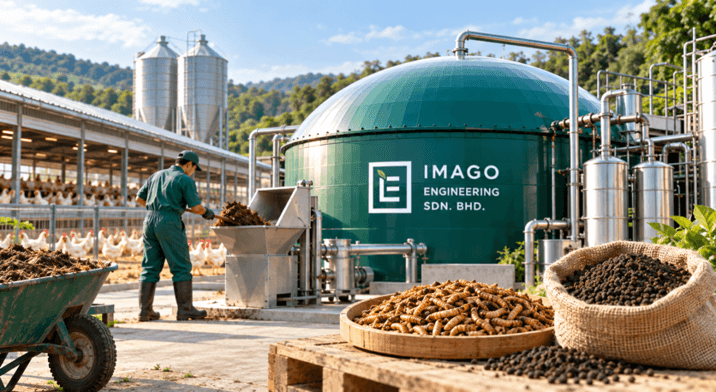
Suppose there is a commercial poultry operation which produces hundreds of thousands of birds each year. The business obtains revenue by selling chickens or eggs, but each bird also produces organic waste that has to be dealt with continuously. While feed and live animals do have economic value, manure has hitherto had only limited direct economic value.
The transformation of chicken manure into protein alters this calculation.
Rather than viewing manure only as a waste-management issue, biological conversion technologies are investigating the possibility of recovering the nutrients from poultry waste and turning them into useful agricultural products.
IMAGO Engineering is carrying out the development of this method using a closed biological processing system which turns poultry manure into insect-based feed protein and organic fertiliser. The company states that about one ton of poultry manure yields roughly 90 kg of insect protein and 570 kg of organic fertiliser during a four-day processing cycle. However, these figures are estimates provided by the company and the actual results will vary according to the operating conditions.
The greater opportunity isn’t just about speeding up the processing of waste; it’s about establishing a new way of generating revenue from a resource which poultry farms already produce every day.
Every Chicken Produces More Than One Economic Output
When it comes to calculating the profitability of poultry, farmers generally concentrate on the end product.
For broiler farms:
Feed » chicken production » meat sales
For layer farms:
Feed » egg production » egg sales
However, both systems create another continuous output:
Chicken production » manure generation
This secondary output has historically been treated as a cost.
A farm producing more chickens increases its main revenue, but it also increases:
- manure volume
- storage requirements
- handling requirements
- transportation needs
The problem is particularly significant for large farms since a business might have the capacity to produce more birds but could still end up encountering limits due to its waste management facilities.
The principle associated with turning chicken manure into protein is that farms should not limit themselves to measuring productivity in terms of the number of birds they produce; they should also take into account how much value can be recovered from each aspect of the production process.
Why Chicken Manure Creates an Economic Challenge
It is not difficult to deal with poultry manure since it contains few nutrients; the difficulty lies in the fact that farms have to manage huge amounts of organic matter continuously.
A commercial poultry operation may spend money on:
- collecting manure from production areas
- storing it safely
- transporting it
- processing or applying it
- managing environmental requirements
Carrying out these activities results in operational expenses even if they do not always produce direct income.
For instance, a farm which produces 1,000 tons of manure each year has to find a method of handling that manure no matter what the market situation is. The manure will keep on accumulating whether or not chicken prices are high or low.
This creates a business question:
Should manure be considered an unavoidable expense, or has it the potential to become a productive input in agriculture?
Waste-to-value systems are designed with the aim of providing an answer to that question.
How Chicken Manure to Protein Conversion Works
The principle of biological conversion is simple in that it involves using natural processes to obtain value from organic material.
IMAGO Engineering uses an enclosed bioreactor system based on housefly larvae, Musca domestica. Fresh poultry manure enters a controlled environment where larvae process the organic material and convert nutrients into insect biomass.
The process creates two outputs:
- Insect-based protein
- Organic fertilizer
The approach changes the traditional waste pathway:
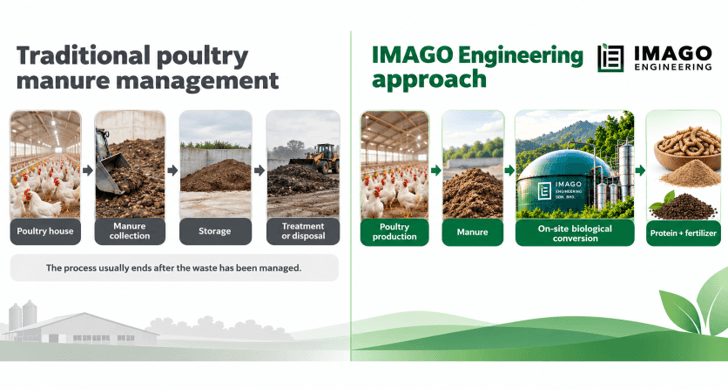
The method alters the conventional waste management process since, whereas the second model comes to an end when manure is removed, it also produces extra products which can be entered into agricultural markets.
Insect Protein Creates a New Feed Supply Opportunity
Protein is one of the key elements in animal nutrition.
Producers of animal feed worldwide depend on protein ingredients in order to carry out the production of poultry, livestock, aquaculture, and pet food. With demand for animal products rising, so too does the requirement for reliable protein sources.
The idea of turning chicken manure into protein is rather unusual.
The poultry farm currently provides the necessary raw material for biological conversion; rather than letting the nutrients in the manure leave the agricultural system, they could potentially be converted into insect biomass.
IMAGO states that the crude protein content in its insect meal is about 55 to 67 per cent.
The commercial logic is:
Poultry manure » insect protein » animal feed supply chain
The value is not only in reducing waste. It is in creating another agricultural product from a material that previously generated mainly management costs.
Organic Fertilizer Creates a Second Agricultural Product
The model’s protein output is only one aspect of the whole.
The leftover processed material can be turned into organic fertiliser, thus providing a second source of income.
It is important since agriculture relies on a number of markets.
Protein bonds with animal feed.
Fertilizer is linked to crop production.
A poultry farm which processes manure is therefore not merely producing one product; it is generating outputs that can be used by various parts of the agricultural economy.
IMAGO states that one ton of poultry manure can yield about 570 kg of organic fertiliser together with insect protein.
This creates a more diversified value model:
One input » multiple agricultural products
Rather than assessing manure solely on the basis of the cost of getting rid of it, farms could consider the value that might be recovered from each ton.
The Economics Per Ton of Chicken Manure
The best method for assessing this model is not to consider only the cost of the equipment.
This is achieved by calculating the value on a per ton basis of manure.
Traditional approach:
Collection + storage + transport + treatment = waste management cost
Waste-to-value approach:
Protein value + fertilizer value + avoided waste costs − processing costs = potential recovered value
For example, if a farm already spends money transporting manure away from the site, an on-site processing system may create value in two ways:
- Reducing some waste-handling requirements
- Creating sellable agricultural products
However, the economics depend on real operating conditions.
Factors such as:
- local feed prices
- fertilizer demand
- labor costs
- electricity costs
- regulations
- processing efficiency
all influence the final business case.
The important change is that manure can now be evaluated as a resource rather than only an expense.
Why Faster Processing Changes Farm Operations
In poultry waste management, time has economic value.
A farm that produces manure each day must have a continuous capacity for processing; if the waste is stored for long periods then the farm will need more land and infrastructure.
IMAGO claims that its biological conversion process is based on a four-day processing cycle.
A shorter processing period can influence:
- storage requirements
- land use
- manure accumulation
- handling frequency
To compare, the technology information provided by IMAGO gives traditional composting periods that last from about 90 to 180 days, even though the actual composting time will depend on the method employed.
For a big poultry farming operation, it is possible to gain operational benefits by decreasing the quantity of manure that has to wait for treatment, even if you do not take into account any revenue from the product.
On-Site Processing Keeps More Value at the Farm
Another important factor is location.
To remove untreated manure from a farm involves transporting a low-value and bulky substance.
A different model is:
Mix the manure where it is generated.
Then transport higher-value products such as:
- protein meal
- fertilizer
It alters the logistics equation.
Rather than taking the waste away from the farm, companies might instead put their finished agricultural products into the existing markets.
The benefit depends on local conditions, including transportation costs, farm size, and available markets, but the principle is straightforward:
The priority should be recovering the value, with transporting the products coming second.
A New Opportunity for Poultry Farm Expansion
Waste infrastructure may act as an unseen restriction on farm growth.
A poultry company might wish to boost its level of production by constructing more houses and putting in more birds. The result of increased production, though, is a greater amount of manure.
This creates a practical question:
Can the farm’s waste management system increase at the same rate as production?
Chicken manure-to-protein technology introduces another option.
Instead of only expanding the number of birds, farms can improve the value generated from existing production systems.
The opportunity becomes:
More value per bird, not only more birds.
Why Investors Are Looking at Poultry Waste Technology
The opportunity behind this model extends beyond waste management.
It connects several industries:
- poultry production
- alternative protein
- fertilizer
- agricultural technology
- circular economy infrastructure
More and more investors are showing an interest in technologies which not only deal with current industrial problems but also produce commercial products.
IMAGO Engineering’s investor model focuses on developing poultry waste processing infrastructure that can generate value through protein and fertilizer production.
The chance for investment is not just about setting up a waste facility.
It is establishing the necessary infrastructure for a continuous agricultural resource.
Modular Technology Makes Adoption More Flexible
The quantity of manure produced is not the same at all poultry farms.
A small farm and a big industrial operation have different requirements when it comes to processing capacity.
IMAGO offers a range of modular processing solutions suitable for various scales, including those based on containers and larger industrial plants.
This is important since the economics are largely based on matching capacity with the actual amount of manure produced.
A farm considering this technology needs to evaluate:
- daily manure volume
- available space
- processing requirements
- product markets
- operating costs
It does not follow that the most suitable system is the one that is largest.
It is the one which corresponds to the real production conditions of the farm.
The Future of Poultry Economics Is Beyond Chicken Production
The greatest change that chicken manure has brought about in protein technology is not just improved waste management.
It represents an alternative method of measuring agricultural productivity.
Traditional poultry economics focus on:
- eggs produced
- chicken sold
- feed efficiency
A circular agriculture model asks another question:
What value can be obtained from each resource produced during the process of production?
Poultry farms produce manure every day and this situation is altering what takes place at that stage.
By converting manure into insect protein and organic fertilizer, technologies like IMAGO’s approach demonstrate how a traditional waste stream can become part of a larger agricultural value chain.
The future of poultry farming might involve producing more chickens.
It could be that we create more value from each chicken that has already been produced.
Popular on OTW Right Now!
-
 Why is single-source publishing important for content teams?
-
 Looking to understand the types of SEO promotion or how to transform a healthcare business?
-
 Can Charter Buses Cross the U.S.–Canada Border? Everything Group Travelers Need to Know
-
How Software Consulting Reduces Risk Before Development Starts




About The Author

Gagan Bhangu
Founder of otechworld.com and managing editor. He is a tech geek, web-developer, and blogger. He holds a master's degree in computer applications and making money online since 2015.