
Custom ERP Development Timeline: From Business Analysis to Final Deployment
Most ERP projects don’t fail because of technical complexity. They fail because buyers never questioned the timeline they were handed. If you’re evaluating custom ERP development services, the number quoted in a vendor proposal often has less to do with your project’s actual scope and more to do with how that vendor manages its own delivery risk. Padding gets built into phases. Integrations get under-scoped. Testing cycles get reclassified as the client’s problem. By the time you notice the pattern, you’re already six months in, absorbing costs nobody truly planned for in the first agreement.
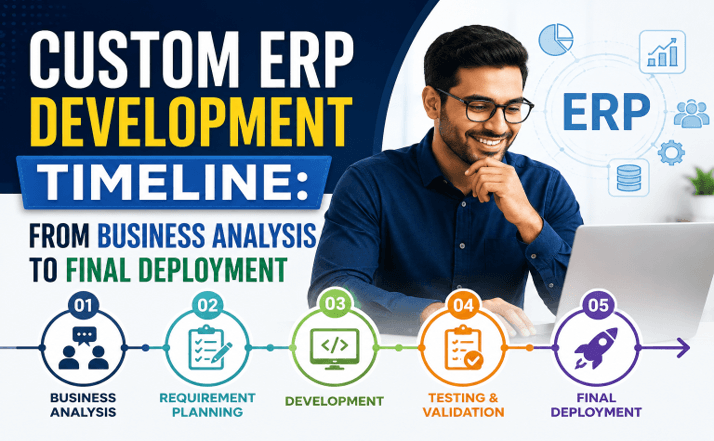
This post kinda breaks down the precise vendor behaviors that stretch ERP timelines; it points out the phase where most of the harm happens, and it lays out the exact questions you should ask before you sign anything, even if it “looks fine” in the moment. The criteria here separates a credible delivery model from one that shifts risk onto you the moment things get complicated.
If your timeline keeps slipping, the project scope is rarely the actual problem.
The Real Reason ERP Projects Run Over Schedule
The default explanation for ERP delays is complexity: too many modules, too many stakeholders, too many moving parts. That framing is convenient for vendors and largely inaccurate for buyers.
Timeline inflation is primarily a vendor-side problem. It lives in how proposals are structured, how integrations are scoped, and how testing gets classified. Vendors build cushion into every phase at the proposal stage — not to protect delivery quality, but to absorb their own execution risk. When a project runs over, the buyer is told this is “normal for a project of this scale.” That narrative works precisely because it reframes a structural vendor problem as an inevitable feature of ERP complexity.
The habits driving this are specific and repeatable. Discovery phases get padded. Integration requirements get deferred. UAT gets handed to clients without the support needed to run it. Each of these habits operates quietly inside a contract the buyer has already signed.
Three Vendor Habits That Silently Extend Your ERP Timeline
Discovery Phase Padding
Vendors routinely overestimate discovery timelines in proposals. A BA phase that a process-mature team completes in 10 to 14 days gets quoted as three to five weeks. Buyers never flag this because it arrives framed as thoroughness.
A disciplined BA phase produces specific, tangible outputs: workflow maps for each department, data ownership matrices, exception-handling rules, and role-permission structures. These outputs don’t require weeks of exploratory conversation. They require the right frameworks and a team experienced enough to run structured interviews efficiently.
When a proposal lists BA as an open-ended discovery period with no defined deliverables at the close of that phase, the padding is already built in.
Integration Scoping Deferred to Mid-Project
This is the single most expensive timeline driver in custom ERP builds. Integrations with legacy systems — payroll platforms, CRM tools, third-party APIs — are routinely under-scoped at proposal stage. The complexity is real, but the under-scoping is a choice.
Vendors price integrations lightly because full scoping requires deep discovery they haven’t completed when the proposal is written. They fill the gap mid-project through change orders. The buyer pays twice: once in additional fees and once in delayed deployment.
Any proposal listing integrations as a single line item, without specifying data mapping requirements, API availability, middleware needs, and exception-handling logic, is incomplete. That gap has a cost, and the buyer absorbs it.
The UAT Blame-Shift: A Timeline Problem Disguised as a Client Problem
Timelines tend to fade into the back corners of UAT. They receive a system that is practically ready to use with little documentation, little or no structure in the test scripts, and a short testing window from the vendors. The process is executed by the client. When problems arise (and when they do at scale), fixes are classified as out-of-scope rework. The client is responsible for delay and remediation costs.
This helps the vendor. It makes it the client’s responsibility to implement a shared quality gate.
Vendors also have different UAT ownership responsibilities. It contains pre-written test scenarios that are detailed per module, structured feedback loops that have known categories for triage, and rework cycles that will be included in the original quoted timeline and not added on after sign-off.
ERP software developers in India who operate at a serious delivery standard treat UAT as the final checkpoint in a shared quality process, not a handover formality. The difference between those two approaches can add four to eight weeks to a project’s actual completion date. Businesses comparing custom ERP development services should treat UAT policy as a non-negotiable evaluation criterion, not an afterthought.
What to Ask Any ERP Vendor Before You Sign
The questions below aren’t adversarial. They are standard due-diligence markers. Any credible vendor should answer them without hesitation. If they can’t, the proposal isn’t ready.
- How are third-party integrations scoped at proposal stage? Ask what triggers a change order and whether integration complexity is re-evaluated after BA closes.
- Is UAT time included in the quoted timeline? Confirm whether rework cycles are absorbed within the quoted schedule or billed separately.
- What is the rework policy post-handover? Understand what’s covered, what’s billable, and where the vendor draws the line between a defect and a scope addition.
- How does the vendor handle scope changes that originate from their own discovery gaps? This question surfaces how much delivery risk the vendor actually holds versus what gets transferred to the client.
- What does the BA phase deliverable look like, and when does the client sign off on it? A BA phase without a formal sign-off document at its close is a vendor risk-management gap, not a process.
Experienced ERP software developers in India working with international and domestic clients at scale will have clear, documented answers to every one of these questions.
How a Transparent Development Model Changes the Timeline Equation
The practices described above are not a given in the delivery of ERP. They are decisions made during the process. A delivery model based on timeline integrity is designed differently from scratch.
The deliverables that are delivered at the end of the BA phase are milestone-related. Integration requirements are not rough estimates that change via change orders; they are documented pre-build requirements. The client is not the first to be invoiced until UAT cycles are recorded with specified rework windows in the quoted schedule.
Businesses evaluating top-rated custom ERP development services should expect this level of structural transparency before a contract is signed. It’s not much to ask. Any delivery model tested at scale must include it at a minimum.
The timeline issue is very real and to a significant extent avoidable — if the right questions are asked at the right time.
Partner With an ERP Team That Owns the Timeline
Time out of sequence doesn’t start when deployed. They start during the initial proposal stage, discovery phases that are padded out with excessive time, under-scoped integrations, and UAT structures that shift risk to the client prior to the project going live.
Arobit develops a custom ERP system with a delivery model designed to eradicate these habits at the process level. Each engagement starts with a structured BA phase which ends with sign-off by the client. Integrations are defined as part of the scope for a pre-build stage. UAT is not a handover to the client; it is a joint quality inspection.
The outcome is a timeline the client can use to hold the vendor accountable.
If you’re evaluating custom ERP development services for your business, Arobit brings the process rigor and technical depth to deliver on schedule, without redefining “on schedule” halfway through the project. Talk to the Arobit team before you sign your next ERP contract.
Frequently Asked Questions
1. How do I know if a vendor has padded the discovery phase in their ERP proposal?
Request a clearly defined list of what the BA phase will deliver and the date you’ll be satisfied with those items. A discovery phase with padding doesn’t have any concrete results, and no formal end. The bottom line is that if the vendor cannot give you a clear description of what it is that they provide as a result of the BA phase in terms of output, the time estimate for that phase is not trustworthy.
2. Why do ERP vendors under-scope integrations at the proposal stage?
Full integration scoping requires deep discovery, which vendors don’t do while writing the proposal. Instead of holding up the proposal, they make a tentative estimate and make up the difference at the time of mid-project change orders. Make sure to ask any vendor what data mapping is required, which APIs they are dependent on, and what middleware is required per integration before you sign. If not, the scope is not ready.
3. Is UAT always the client’s responsibility in a custom ERP project?
Not a structured engagement. Vendors that view UAT as a client task are passing delivery risk on by delivering with little information and no test scripts. A transparent model is where the vendor provides module-level test scenarios, controls feedback loops, and takes up rework in the same time as he originally quoted.
4. Can timeline inflation be identified before a project starts, or only after delays begin?
It can be recognized at the proposal phase. Red flags include integrations reported as a line item rather than broken down; no formal BA sign-off milestone; UAT treated as a client-led process; and no rework policy after handover. A legitimate ERP supplier will be able to provide clear, documented responses to all these before signing the contract.
Popular on OTW Right Now!



About The Author

Gagan Bhangu
Founder of otechworld.com and managing editor. He is a tech geek, web-developer, and blogger. He holds a master's degree in computer applications and making money online since 2015.