
Choosing the Right Robot Vacuum for Small Apartments
When it comes to a small apartment, the ideal robot vacuum is a compact model that comes with strong app-based mapping capabilities, a slim body that can easily slip under furniture, and a self-emptying base, only if you can allocate space for the dock. You don’t have to purchase the highest-priced flagships. When it comes to manoeuvrability and quieter operation in confined spaces, far more important than raw suction power, or a 4000 Pa suction level, which would be useful in a large carpeted home.
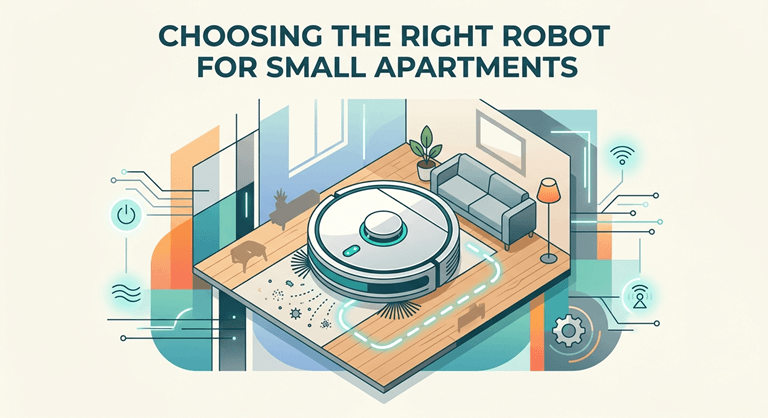
The error most people make is buying a robot cleaner for a small flat as if it were a house. A large robot with very aggressive edge behaviour, a very large charging station, and for 40-70 square meters it’s just too muc,h and it might actually do more harm than good, bumping furniture, getting stuck under any low furniture, a small charging station will be placed in the hall and… Smaller spaces favour accuracy and a low height instead of using brute force.
What Specifications Actually Matter in a Small Flat
The first spec to look at is height, and the one that most buyers tend to overlook. With a height of just 9-10cm, it’s easy for a robot to hide under most sofas and beds. But for models 11 cm or taller, with a turret-style sensor up to 13 cm, they will be blocked right where dust is most likely to collect. Therefore, the clearance measurements underneath furniture before buying are important, as this will make or break the robot’s ability to clean the messiest places.
Contrary to the marketing claims, vacuum power or suction is not as important. In most small apartment houses, there are possibly one rug or two rugs, and 2000-2500 Pa is sufficiently adequate. Therefore, if it is only a standard carpet, the top-of-the-range carpet numbers are almost redundant at 6000 Pa. But the thing that counts is a good brush and good edge cleaning – it’s the corners and along the skirting board where the tiniest bits of dirt hide.
Navigation is actually the major factor that separates one from another. Less expensive robots rebound randomly, which can be satisfactory in a single open room, but it will be extremely annoying in a flat with several small rooms and doorways, as they will miss some spots athe nd the battery will be wasted. One feature of a robot that costs about 250 francs or more lets the robot clean straight rows, it memorises your floor plan and the no-go areas, that’s what makes a gadget an appliance you don’t have to remember to put away.
How Much You Need to Spend and Where the Price Jumps Are
Robot vacuums with a sound map come in at the 250 to 450 franc mark—just about the price range of what any flat-dweller would want. Everything below 200 francs is a bunch of random navigation and battery management, as far as I can tell, which is fine for an apartment in one room, but not one in the whole apartment. The upgrade from random to smart mapping is the most valuable one for which you can pay.
At the next level, 500-900 francs, it’s primarily a story of self-emptying docks and mopping. This is very convenient as you’ll only have to empty the dustbin every 2-3 weeks rather than every few days, but the dock is a considerable size and will need to be located on a permanent base and provided with a power socket. That’s the negative side of it when you have a small flat. If you are going to purchase one, be sure to have a nice corner to have a station this size, as large as a kitchen bin.
Other than self-washing mop pads, hot-air drying, and auto-refill water tanks, the only extras that are available in higher-priced models (over 900 francs) are none. They’re Sure a sight to behold, and in most cases, they can even do as much as or more than that, but for the honest answer, 90% of what the flagship can do, a mid-range mapping robot can do in less space for half the price, most of the time anyway.
Mopping, Bins, and Maintenance in Tight Quarters
A hybrid vacuum and mop model is also desirable by small apartment buyers because it is typically a hard floor apartment, and a robot that vacuums and then mops is a dream come true. Nevertheless, the low-cost hybrid models that can be cleaned with simple vibrating or dragging mop pads only clean the area a little, making them more of a “plus” than a “must have,” so just think of them as an extra and not a substitute for a proper mop every once in a while. The higher systems with rotating pads work pretty well, but to the same extent, they put you into the higher price categories.
Maintenance is simply the thing people ordinarily overlook until they hit it. On a compact robot, the dustbin will also be very small, typically between 300 and 500 ml, and if the robot is not self-emptying,g then the dock, which empties the dustbin of the robot after each round or every two/three rounds, is essential. Hair removal of brushes, filter knock-out or rinse every few weeks and refilling of mop reservoirs. None of these is difficult, but when a flat has a dog or cat, more fur will be produced than the little can handle, and this is when it can be helpful that a self-emptying base is there.
When you are comparing models and stocking up on replacement filters or brushes, buying from a local retailer where you can shop at pandaloo.ch keeps the accessories easy to reorder and the warranty straightforward, which matters more than people expect with a device that has consumable parts. A robot vacuum is no better than the person who can provide it with new filters a year later, so a local source is better than a slightly less expensive one-shot import.
Matching the Robot to How You Actually Live
The type of floor and your family make-up are really critical when deciding what type of vacuum cleaner to use. If your floors are predominantly hard surfaces and you don’t have any pets, for instance, you may only need a thin vacuum cleaner that simply fits into your room and doesn’t have a dock. The small dustbin can be emptied easily by you. If you own a cat or dog that sheds, however, you’ll need a self-emptying base and a tangle-resistant brush, as pet hair will fill the dust bins rather quickly, and will tend to tangle around brush rollers.
In case ya ou’re a house renter or someone who moves around a lot, you should purchase simple and lighter models, devoid of any permanent docks, as it’ll be more useful to simply pick it up and take it with you. You want quiet robots when working from home – preferably no louder than 65 decibels – so that they can operate while you make calls. If you’re out all day, it’s not crucial that the noise disturbs you, and you can just time the robot to clean at midday, and come home to clean floors.
The arrangement of an apartment is also a factor. The open space studio is a space where any robot will do, as it is forgiving, but in a flat with multiple rooms separated by small doors and corners, it really does need good mapping with the ability to jump over the doors/thresholds that are at least 2cm high, or else your robot will be stuck in one room. Also, if the floor is dark (or the carpet is too thick), some sensors may have trouble working; check these against this particular room.
Before purchasing a robot, consider what you think you would find in your home if he was to clean there! See the robot’s perspective and identify where there is the lowest furniture clearance, potential dock locations, number of furniture threshold crossings, and dominant floor types – hard vs. soft. If you are able to answer those four questions correctly, you’ll be able to select a mid-range automobile that’s relatively popular, that will handle your requirements for years to come. However, the highest cost robot on the shelf may not be able to reach the corner where the dust gathers or under the bed area where the dust collects, so it won’t be what you’re expecting.
Popular on OTW Right Now!



About The Author

Gagan Bhangu
Founder of otechworld.com and managing editor. He is a tech geek, web-developer, and blogger. He holds a master's degree in computer applications and making money online since 2015.