
Can You Walk Through a Metal Detector with a Phone in Your Pocket?
Everyone’s had this moment. You’re in line at the airport, or maybe it’s a courthouse, or you’re shuffling toward the gate at a concert, and you catch yourself patting your pocket wondering – do I need to pull my phone out for this, or is it fine?
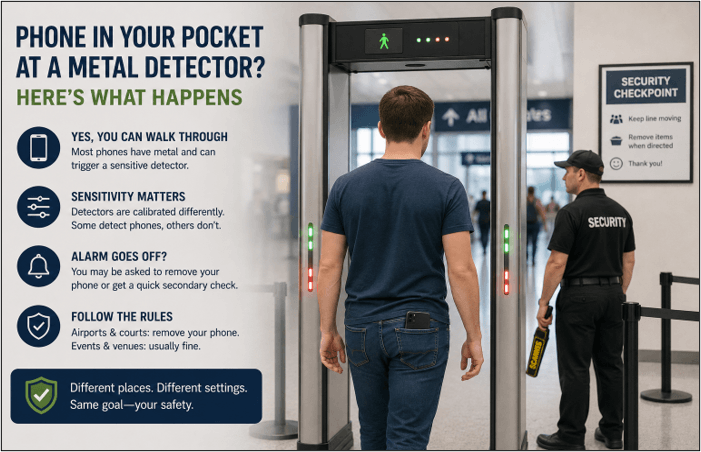
Technically? You can walk through with it still in your pocket. Nothing stops you physically. Whether that’s actually a good idea, and what happens if the thing beeps, is where it gets a little more interesting.
Why Everyone Asks This
Metal detectors have quietly taken over – schools have them now, government buildings, stadiums, obviously airports, even some office buildings. Meanwhile our phones are basically surgically attached to us. So naturally people wonder if they’ve got to empty their pockets every single time they walk past one of these things.
Makes sense why people assume the worst, too. Phones are stuffed with metal – the battery, the circuit board, sometimes a metal or aluminum frame. Detectors detect metal. Feels like those two facts should collide every time.
They don’t, though. Not always.
Does It Actually Set the Thing Off?
Honestly, it depends – on the detector itself and how someone’s dialed it in.
The big walk-through archways, the kind you see at airports and stadiums, usually run more sensitive than the handheld wands guards wave around for a second check. And a properly calibrated archway is built to notice a pretty wide range of metal objects. Smartphones tend to land right inside that range.
Most phones these days carry enough metal – between the battery, the camera module, the charging port, maybe a steel or aluminum frame – to trip a sensitive detector without much effort. Which is exactly why the TSA has you tossing your phone into a tray along with your keys and belt before you even get near the archway.
But here’s the thing – not every detector runs at that sensitivity. Plenty of schools, retail stores, event venues, they calibrate toward catching the big stuff – weapons – and just ignore smaller everyday items like phones or spare change. So your phone might set off an alarm walking into one building and do absolutely nothing fifteen minutes later somewhere else. Same phone. Different machines, different settings.
Airports Play by Their Own Rules
Worth pulling airports out as their own category, because honestly the process there doesn’t match anywhere else.
TSA has you remove electronics no matter what – even if the metal detector itself might not flag your phone at all. That’s not really about the detector, though. Phones, tablets, laptops, they usually need to go through the X-ray machine separately anyway. So out it comes, regardless.
Other places vary a lot more. Stadiums, concerts, courthouses – a lot of these run detectors tuned specifically for weapons, and phones just aren’t part of what they’re looking for, so yours might stay in your pocket the whole time without a hiccup. Some stricter venues will still ask for everything out, phone included, just to be safe.
Alarm Went Off – Now What
Don’t panic if it beeps because of your phone. This happens constantly, and security treats it as completely routine, not some suspicious event. Usually what follows is one of these:
- They’ll ask you to pull the item out and walk back through, just to double-check it was actually the phone.
- Sometimes it’s a handheld wand instead, which narrows down exactly where the trigger came from.
- In stricter spots – airports, government buildings – maybe a quick pat-down or a bag check gets added on top.
None of that is about you specifically. It’s just how the process stays consistent for everyone moving through the line.
Sensitivity Matters More Than You’d Think
This is probably the part people overlook the most. Security teams can turn a detector’s sensitivity up or down depending on what they actually care about catching. Turned low, it’ll ignore a phone, a belt buckle, sometimes even a small pocketknife. Cranked up high, something as small as a metal button on your jeans can set it off.
That’s really the whole explanation for why walking through security feels so inconsistent depending on where you are. The airport wants every pocket emptied, and then the stadium down the street barely blinks when your phone, keys, and wallet all pass through together. It’s not that one place is careless and the other’s careful – it’s just calibrated for a different job.
If You’re Not Sure What to Do
A few things that tend to make this easier:
- Listen for the staff. They’ll usually just tell you what needs to come out before you even reach the detector.
- Think about where you are. Airports, courthouses – assume it’s coming out. A casual outdoor event? Probably fine to leave it.
Small habits, but they save you the whole awkward back-and-forth of setting off an alarm and having to try again.
Why Isn’t There Just One Standard?
Comes down to what each place is actually trying to catch. Airports are thinking about aviation safety broadly – so they’re screening for a wide range of stuff, small items included. A concert venue or a retail store is mostly worried about weapons, knives, firearms – and a phone in your back pocket just doesn’t register as a concern the same way.
That difference in priorities is basically the whole reason equipment gets set up so differently from one venue to the next – and why your experience never really feels the same twice.
So, Bottom Line
Can you walk through a metal detector with your phone in your pocket? Often, yeah – especially anywhere calibrated to focus on bigger threats instead of everyday electronics. But at airports and other high-security spots, just plan on taking it out. Saves you the alarm, and keeps you in line with how things are supposed to go anyway.
At the end of the day, what your phone triggers – or doesn’t – really comes down to the equipment itself and how it’s tuned for that space. Which is exactly why the right security equipment matters so much for facilities of any kind. At PTI, we build walk-through metal detectors that give security teams real control over sensitivity – whether that means catching every small metal object or staying focused purely on genuine threats like weapons. The goal, really, is a setup that balances thorough screening with a checkpoint that doesn’t slow everyone down.
FAQs
Will my phone always set off a metal detector?
No. It depends on the detector’s sensitivity and what the venue is screening for.
Why does the TSA make me remove my phone anyway?
Because it needs to go through the X-ray machine separately, not because of the metal detector itself.
Can I leave my phone in my pocket at a concert or stadium?
Often, yes – these are usually tuned to catch weapons, not everyday electronics.
What happens if the detector beeps because of my phone?
Nothing serious. You’ll likely walk through again or get wanded to confirm.
Why do different places have different rules?
Each venue screens for different threats, so sensitivity settings vary.
How do I know if I’ll need to take my phone out?
Assume yes at airports and courthouses; casual events usually let you keep it in.
Popular on OTW Right Now!



About The Author

Gagan Bhangu
Founder of otechworld.com and managing editor. He is a tech geek, web-developer, and blogger. He holds a master's degree in computer applications and making money online since 2015.