
7 Best Transactional Email API Services for Developers in 2025
If shipping updates, account notifications, order confirmations, and password resets fail to deliver, the business impact is immediate – users get frustrated, which results in cart abandonment or a flood of support tickets.
Now, hold onto that thought because choosing the best transactional email API means your primary focus should be
- Reliability
- Security
- Inbox placement
- Speed of delivery
We’ve analyzed a bunch of platforms to identify seven that can consistently deliver high inbox rates, robust API, and developer-friendly documentation.
So, dive in.

What makes a great transactional email API?
Here are the aspects of an ESP you should focus on.
- Deliverability rate: This is defined as the percentage of emails reaching the inbox, not the spam folder. The platform you choose should offer a 95%+ inbox rate for transactional emails.
- API: The API needs to have a RESTful architecture and clear documentation. You can also integrate a free SMTP relay server alongside the API to handle flexible email routing and improve delivery control. Also, the implementation is significantly faster if the provider has official SDKs for popular programming languages.
- Infrastructure reliability: The email provider you choose needs to have 99.9% uptime (ideally, a verifiable service status page where you can check the info). In addition, there should be an established fallback mechanism to prevent message loss during peak traffic.
- Analytics: All transactional email providers offer a tad more than the basic analytics (delivery, open rates, bounces, etc.). But the trick is to find the provider that makes it easy to analyze the data using clear dashboards and one-click access to drill-down reports.
- Sender reputation management: At best, the transactional email provider handles DNS records for you (no need to create them on your own). And the provider has to employ strict IPS monitoring.
- Support quality: Aim for a provider that offers various channels to contact support, and look for those that have 24/7 customer support (even if it’s only on higher plans).
Best transactional email API services: Quick overview
Now, let’s check the six email providers that tick all the right boxes for the areas discussed above.
1. Sender
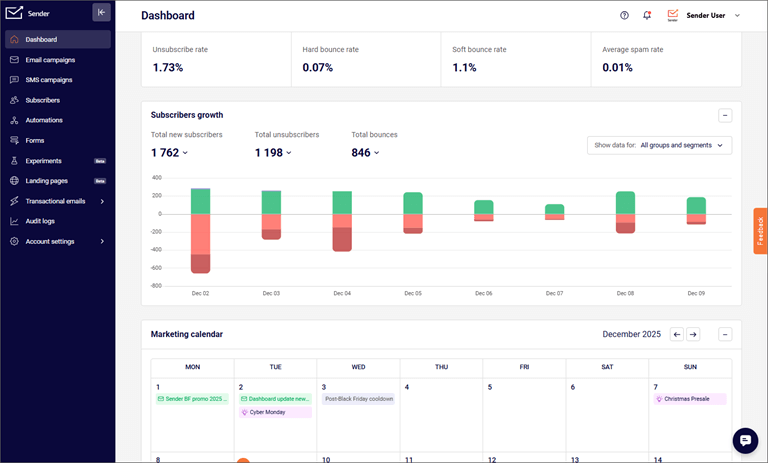
Sender is a feature-rich email marketing platform built for small and growing businesses that want one platform to handle both transactional and marketing emails. It’s designed to be easy to use while still giving you the API-level control developers expect from a transactional email service.
Why do developers choose Sender?
Sender offers a transactional email feature that you can trigger over REST API or SMTP, with ready-to-use code examples for multiple programming languages. You can generate API keys or configure SMTP from a dedicated “Transactional emails” section in the dashboard. This makes it easy to integrate the platform into your app for order updates, password resets, or account alerts.
All-in-one for transactional, newsletters, and bulk campaigns
Unlike tools that focus solely on infrastructure, Sender lets you run transactional emails, newsletters, and bulk campaigns from a single platform. You get a drag-and-drop builder, automation workflows, segmentation, landing pages, and signup forms alongside transactional sends. This way, you can handle marketing and system emails from a single platform instead of juggling multiple tools.
Built-in automation and analytics for small teams
Sender’s Free Forever plan includes up to 2,500 subscribers and 15,000 emails per month, with automation, segmentation, and analytics available even on the free tier. This means you can test transactional and marketing flows, like welcome emails, order notifications, and behavioral follow-ups, before committing to a paid plan, while still monitoring performance through detailed reports.
Pricing: Sender has a generous Free Forever plan (2,500 subscribers and 15,000 emails/month, including transactional sends). Paid plans start at $7/month and scale by subscriber count and email volume.
2. Mailtrap Email Delivery Platform
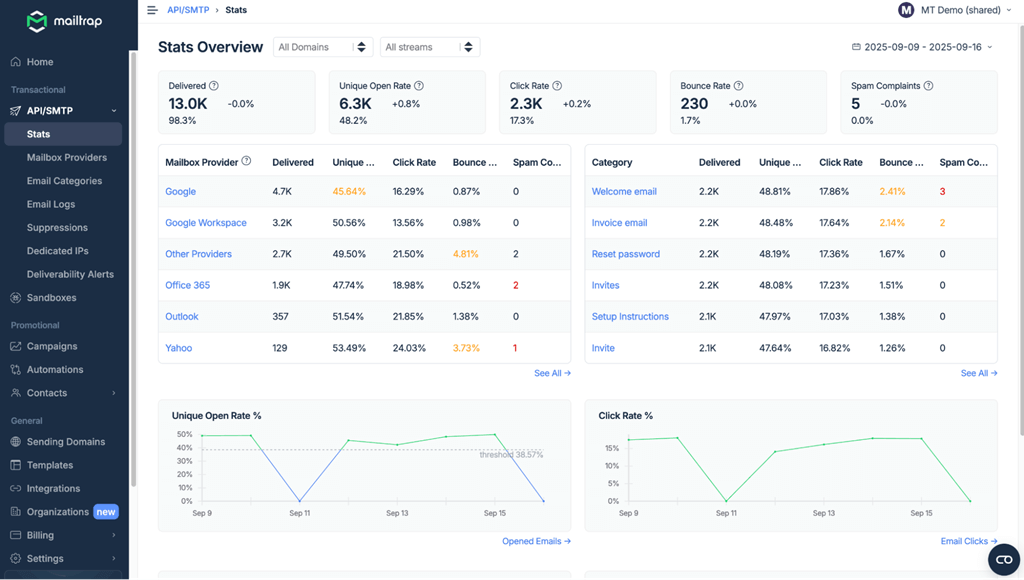
Mailtrap Email Delivery Platform stands out as the best service for one reason. It’s built specifically for transactional infrastructure with high inboxing rates and fast email delivery.
Why developers choose Mailtrap?
It has a RESTful API that can integrate into various environments out of the box. And Mailtap has official SDKs for all popular languages/frameworks (Node.js, Python, Ruby, Java, etc.).
Additionally, there are separate streams for transactional and bulk emails. So, there’s no chance for promotional messages to tarnish the reputation of your transactional IP. This is particularly important if you’re on a shared IP.
Enterprise-grade infrastructure
Mailtrap’s clients include Atlassian, PayPal, and Adobe for a reason. The platform runs on redundant SMTP servers across multiple data centers with automatic failover. If there’s an issue with one of the servers, the traffic automatically routes to healthy nodes, so there’s no failed delivery.
Also, dedicated IP addresses are included with higher plans to give you complete control over your sender reputation. The platform monitors your email performance across all major ISPs (Gmail, Yahoo, Outlook), and you get an alert before a more serious issue arises.
Industry-best analytics
Mailtrap’s dashboard offers exceptional visibility with a single helicopter-view dashboard where you can assess email performance at a glance. But what sets it apart is the one-click access to drill-down reports across different verticals (email categories, mailbox providers, clicks, etc.).
Of course, you get access to webhooks (even on a Free plan) for real-time email performance analytics.
Expert support
Starting from the most popular Business plan, Mailtrap offers 24/7 support with deliverability experts on call. If necessary, you can get migration assistance as well. For instance, the support can analyze your authentication records, review email content, and even recommend fixes based on the ISP feedback loops.
Pricing: Mailtrap’s paid plans start at $15/month for 10,000 emails, and there are no hidden fees for webhooks, analytics, API access, or anything else.
3. SendGrid
SendGrid is the veteran of the transactional email market, offering extensive documentation and high uptime (99,9% based on their claims).
Their API supports RESTful endpoints, and similar to Mailtrap, you get official libraries in all major programming languages. The analytics dashboard is very comprehensive, but sometimes it can feel a bit overwhelming with all the subcategories available (there were 12 of them at the time of writing).
SendGrid’s deliverability is still strong, at about 95%+ for transactional emails, assuming you properly configured the account. But keep in mind that new, or better said, newer accounts typically face reputation-building periods that enforce stricter sending limits.
Pricing: The platform has a 60-day Free Trial at 100 emails/day, and paid plans start at $19.95 for 50,000 emails.
4. Amazon SES (Simple Email Service)
SES is among the most affordable services in this list, but, at the same time, it’s also one of the most technically demanding. But if you have an experienced dev team and already use AWS, SES could be the right choice for you.
The service integrates seamlessly with Lambda, S3, or CloudWatch. For example, you can trigger emails from Lambda functions and monitor metrics through CloudWatch dashboards.
With that in mind, Amazon SES has quite limited analytics out-of-the-box, so you might want to consider a third-party integration. More importantly, you are responsible for bounce handling, reputation monitoring, and complaints processing.
Due to the above, deliverability may vary significantly based on your configuration and warm-up process (but this isn’t a shortcoming of Amazon SES). As hinted, the more experienced you are, the better it will be.
Pricing: $0.10 for 1000 emails and the free tier of 62,000 emails/month for AWS users. But our advice is to check the official pricing page closely since it’s very nuanced and you also pay for data transfers.
5. Postmark
Like Mailtrap, the platform separates transactional from what they call broadcast (bulk) streams. Again, this works well to protect your transactional sender reputation from bulk messages.
As for the API, it’s well-documented and clean with libraries and SDKs for major programming languages. Interestingly, Postmark also has one of the largest pools of community libraries.
Postmark’s deliverability is consistently high, and they have one of the fastest times-to-inbox in the industry. To that, their customer support is quick to respond, even on lower-tier plans, and the whole platform is well-documented, including some video tutorials.
Pricing: The pricing starts at $15/month for 10,000 emails with no feature limitations. Though there are some optional add-ons, the offering is transparent, without hidden fees.
6. Mailgun
Mailgun is known for its straightforward API features and flexible routing options. In addition, the platform is good at email list verification and email validation, which can help reduce bounces, for example.
The service gives you the ability to build complex workflows, which may include:
- Forwarding incoming emails to a specific endpoint
- Triggering content-based webhooks
- Storing attachments in the cloud automatically
Lastly, Mailgun’s analytics are very good, giving you insights based on email performance for specific ISPs.
Pricing: They have a Free plan of 100 emails/day, and paid plans start at $15/month for 10,000 emails/month.
7. Brevo (formerly SendinBlue)
Brevo offers transactional email APIs and email marketing automation features. Their transactional API supports SMTP relay and RESTful endpoints with libraries for PHP, Node.js, Python, Ruby, and C#. The setup is straightforward, and you get working code examples for each of the libraries.
Unlike most platforms in this list, Brevo offers SMS messages, which can be useful, for instance, if you send backup notifications, payment confirmations, or critical security alerts.
Pricing: Brevo has a free tier of 300 emails/day; and paid plans start at $8.08/month for 5000+ emails.
Final words
Keep in mind that transactional infrastructure isn’t something you revisit every quarter. Frequent migrations can disrupt your workflows and may tarnish your deliverability during the warm-up period.
So, feel free to test your options thoroughly before committing. Use the services’ free tier or trial period to check email workflows, documentation, and overall performance before you take the plunge.
Popular on OTW Right Now!




About The Author

Gagan Bhangu
Founder of otechworld.com and managing editor. He is a tech geek, web-developer, and blogger. He holds a master's degree in computer applications and making money online since 2015.