
AI-Powered Learning vs Academic Integrity: Can Both Coexist?
The use of AI has altered the way learners conduct themselves when studying. At present, various applications such as chat gpt, Grammarly, and Turnitin are employed in educational institutions.
It has also led to an issue surrounding education in which one set of individuals contends that artificial intelligence aids in learning, while another holds that artificial intelligence enables cheating by learners.
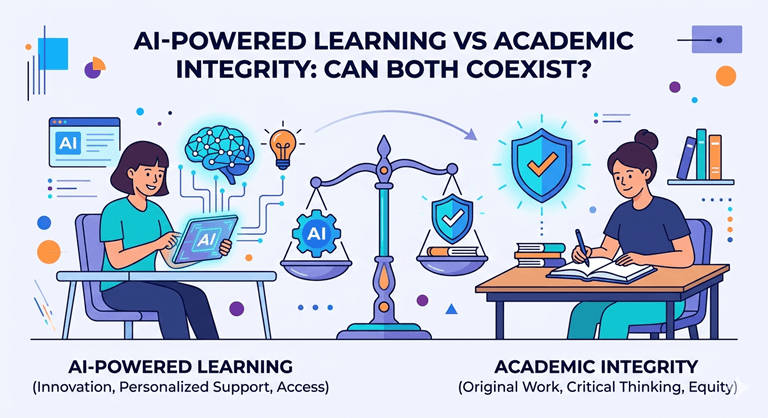
Finally, the question raised in this controversy is as follows:
- Can AI-powered learning and academic integrity exist together?
Like all other issues, there is never a definite solution to this problem.
What Is AI-Powered Learning?
AI Learning is the process of using sophisticated computerized personal assistants that aid the learner in understanding different concepts, doing assignments, and developing skills. They enable one to turn complicated content into simple language, generate summaries from lengthy texts, and provide instant solutions to all difficulties.
In today’s world, students are not only using chatbots but also depending on some of the best note-taking apps to make their study process more organized and effective. Popular tools like Notion, Evernote, and RemNote are widely used because they include powerful AI features.
These tools will help students to make clear notes, remember information better, and to organize study resources and materials without getting overloaded.
What Is Academic Integrity?
Academic Integrity is nothing more than honesty in academic endeavours. This encompasses your own work, referencing your sources, and avoiding unfair means to obtain results.
It would be easier to spot plagiarism in the past when students typically copied and pasted text from books or websites. However, the times have changed with technology. Now, it’s more difficult, again, to determine what constitutes learning support and what constitutes cheating.
Academic integrity has become a shifting rather than a rules-based topic with the advent of AI tools to help with idea generation or writing enhancements.
Why Is This Debate Growing So Fast?
In this article, you can find the impact of AI on education in 2023. The use of AI in education has grown at a rapid pace since 2023. It’s hard to find students today who are not taking advantage of some kind of artificial intelligence in their studies. This definitely signals that the education system needs to adapt to the present technologies.
One of the biggest challenges teachers face today is how to check if a student used ChatGPT or any similar AI tool while completing an assignment. This task has become difficult because AI-generated content often looks natural and closely matches human writing.
As such, teachers are increasingly relying on technology and manual checks for the potential use of AI.
The most difficult problem is that content created by AI and content written by people will be hard to distinguish. While tools such as GPTZero and Copyleaks have evolved significantly, they cannot accurately identify plagiarism all of the time.
Therefore, instructors resort to several techniques, including:
- Comparing the writing style with previous examples
- Asking students to justify their conclusions and arguments
- Employing artificial intelligence detectors as supplementary tools
Benefits of AI in Learning
There are numerous positive effects of AI in the education sector. It has facilitated learning to be easier and more flexible for students from all over the world.
First, AI can assist students in comprehending tricky topics at a faster rate due to the explanations provided in simple terms. It also enables personalized learning, as students can learn at their own speed, free from any pressure.
One of the other benefits is immediate feedback. Students can benefit from feedback on their work without having to wait for teachers to assess it. In order to correct grammar errors and make sentences clearer, students use tools such as Grammarly.
Risks of AI in Education
While there are numerous advantages to AI, there are also significant risks that come from AI when it is used incorrectly by students.
One risk students face is the potential for reliance on AI and the reduction of creative and critical thinking. The first is that students might become overly reliant on AI, losing their ability to think for themselves. There might be some students who will copy answers without knowing what they are copying. This can affect an individual’s critical thinking and learning capacity.
Secondly, AI tools don’t always provide correct information. At times, they give inaccurate or misleading information. If a student has complete faith in these answers, he/she may learn incorrect information.
Fairness is an issue as well. There are students who are able to leverage AI tools more than others, and this gives them an unfair advantage. However, it is still challenging to identify this type of misuse. Even the most sophisticated AI detectors aren’t always accurate.
Best AI Tools for Students (2026)
Today,y there are numerous AI tools that students use, each with its own specific application. There’s some assistance with studying; there are others who are into writing or editing.
Here is a comparison:
| Tool | Best For | Main Use | Risk Level |
| ChatGPT | Learning & writing | Answers, explanations | High |
| Grammarly | Writing improvement | Grammar & clarity | Low |
| QuillBot | Rewriting content | Paraphrasing | Medium |
| Turnitin | Checking originality | Plagiarism & AI detection | Low |
| GPTZero | AI detection | Identify AI text | Medium |
| RemNote | Smart studying | Notes + flashcards | Low |
RemNote can be of particular benefit to students who desire to learn and understand the material rather than just get through it and finish their homework. The app is both an active learning and a long-term memory retention tool, but maintains academic integrity as well.
How Students Actually Use AI
The majority of students don’t typically rely on AI solely for plagiarism. They commonly use these tools to help them comprehend topics better and enhance the quality of their work.
For instance, given that a student uses ChatGPT to gain insight on a topic, then makes notes with RemNote, and makes changes to those notes by hand.
Why Is Academic Integrity Changing
The meaning of academic integrity is slowly changing. A large number of students now view AI as something that is no longer exceptional or unique to education, but rather like search engines or calculators.
The majority of students feel that using AI is fine as long as it doesn’t take the place of their own thinking ability.
The Role of Schools and Universities
Schools are beginning to embrace the use of AI. This has led to the emergence of AI policies in numerous schools and universities, and the shift in assessment approaches. They’re also promoting the conversation around the ethical use of AI and educating students on the responsible use of AI.
Can AI and Academic Integrity Work Together?
Yes, but if the use of AI is done properly. A.I. should aid in learning, not take the place of the work entirely.
Students ought to utilize AI to enhance understanding and learning, but still work independently on their own assignments. RemNote is a great example of an AI tool that can help a student learn without allowing them to “cheat.RemNote is a great example of an AI tool that can help a student learn, but does not enable the student to “cheat.
FAQs
Is Using AI Cheating?
No, not always. The question of whether AI use is considered cheating will depend on the individual’s usage. AI learning concepts are ok. It is not appropriate to simply copy answers verbatim from an AI without any work.
How To Identify a Student Who Used ChatGPT?
Most teachers rely on GPTZero, Turnitin, and their own writing style to determine if there is plagiarism. They can also request students to elaborate on their work and thoughts.
Do Students Have To Mention AI Use?
Yes. Learners should acknowledge the use of AI tools if they have used these to produce or enhance content. This aids in ensuring honest and trustworthy dealings.
Are Detection Tools Reliable?
They come in hand,y but they’re not flawless. This is why they should be used as tools to support rather than be the end goal.
How Should One Use AI Properly?
AI should be leveraged to enhance learning concepts, comprehension of ideas, and work quality. However, pupils should still work independently and do their own work.
Popular on OTW Right Now!
-
 How to Set Up an AI Voice Agent Platform for Patient Intake (No-Code Walkthrough)
-
 How I Use AI Anime Art Tools to Turn Character Ideas Into Better Visuals
-
 Seedance 2.5 Up to 30 Seconds: Why Longer AI Video Generation Matters
-
 Prompt Engineering and Computer Vision: The Two AI Specializations Every Tech Company Needs in 2026

About The Author

Gagan Bhangu
Founder of otechworld.com and managing editor. He is a tech geek, web-developer, and blogger. He holds a master's degree in computer applications and making money online since 2015.