
A Data Governance Blueprint for Enterprise LLM Post-Training
Enterprise post-training data rarely arrives as a clean set of prompts and answers. It often includes support transcripts, tool traces, account records, reviewer notes, and policy documents, each with different permissions and retention needs.
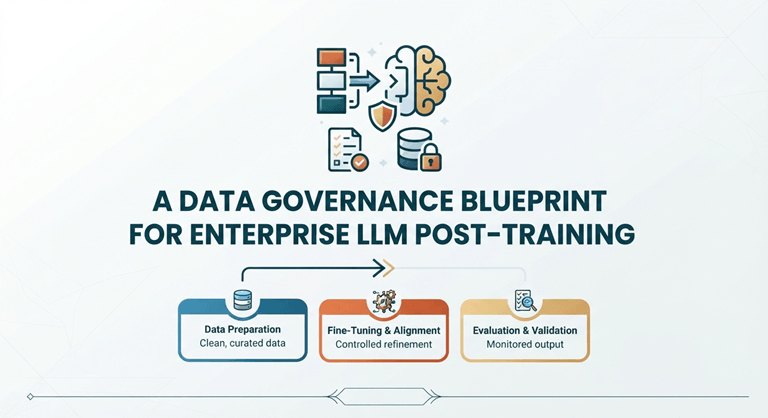
A safe program needs an operating boundary that follows data from collection through datasets, rollouts, model updates, evaluation, and deletion. This blueprint gives ML platform, security, and data owners a shared set of controls for that path.
The MinT LLM training page describes sensitive-field detection and redaction before training, encrypted transfer and storage, least-privilege access, isolated workspaces, and customer control of datasets, outputs, LoRA weights, and reports. Those published controls provide one example of the layers an enterprise post-training environment may need to address.
Draw the Training Data Map First
Begin with a data-flow map, not a model configuration. List every source, the reason it is used, the person or system that approved it, the fields it contains, where it moves, what it produces, and when each copy expires.
Include derived artifacts. A rollout can contain copied customer text, tool responses, reward explanations, screenshots, and error logs. A LoRA adapter or evaluation report may also inherit sensitivity from the examples that shaped it, even when the original rows are no longer visible.
Name a data, ML, and security owner for each flow. Each must approve purpose, transformation, access, and deployment decisions within their role.
Classify and Gate Data at Ingestion
Develop a simple taxonomy that can be followed by all users. A simple starting set is public, internal, confidential, personal, and regulated, and includes field-level tags for credentials, account identifier, health data, financial data, and other restricted content.
Ingestion should close if necessary metadata is missing. Ideally, a dataset with no source, purpose, rights, owner, or retention date should be placed in quarantine and not in a training queue. This should be the same for manually uploaded and automated connectors.
List the uses that are permitted, in addition to the classification. Two private datasets can have different permissions: One might be suitable for evaluation only, and another may be suitable to train an adapter within a private workspace. The classification is the level of risk; the purpose is the action allowed.
Redact Before Training, Then Preserve Lineage
Prevent access to restricted fields by removing or tokenizing them before they get to general training storage. When entity consistency is required for the task, use stable replacement tokens. If stable replacement tokens are not truly anonymous but can still be linked to an individual or source record, they should be treated as pseudonymized data (and not anonymous) and stored in a more limited store for a shorter time than other data.
Test redaction of free text, JSON, screenshots, filenames, and tool errors. If a filter is only for the columns in a table, revealing traces are not affected.
Record lineage of each sanitized row back to its source record and transformation version. Lineage provides correction, deletion, and audit, but doesn’t return raw values to the mainstream of ML workflows. It’s important that access to the lineage map be more limited than access to the sanitized dataset.
Apply the Same Controls to Rollout Data
Redaction at the time of ingestion is insufficient when using rollouts to invoke live tools, retrieve records from outside sources, or even take screenshots and error messages. Such interactions may bring back personal, confidential, or restricted information, even though the original data is sanitized. Responding to tools, screenshots, logs, and judge inputs should thus be filtered through their own classification, redaction, retention, and access controls prior to being added to reusable training or evaluation stores.
Isolate Workspaces and Runtime Credentials
Use different projects instead of folders within one big workspace, based on tenants, purpose, and sensitivity. Apply different service identities, storage policies, encryption keys as needed, and network routes to workloads that have differing risk exposure.
The minimum data and tools necessary for the specific job should be provided for the workers for a limited period for training purposes. Never include production credentials in prompts, rollout logs, container or experiment files. Controlled broker to call tools through that allow/deny actions, rate limits, and logging.
Document the operators of each of the controls for shared cloud, dedicated cloud, VPC, private or hybrid deployment. Prior to the move of data, add those responsibilities to the data map.
Govern LoRA Weights and Reports as Data Products
Adapters can be easily copied, as they are much smaller than an entire model, so the rules of ownership and copying are more significant. Record all LoRA artifacts along with all base model, dataset versions, code version, training configuration, owner, approved environment, and expiration/review date.
In an extreme but reasonable case, an organization might use the most sensitive source data, on which the adapter is based, to determine the classification of the data until leakage, memorization, and access-risk tests justify a different classification of the data. You can’t read a weight file like a spreadsheet, so don’t assume that it is not sensitive. Decisions about access, export, and deletion should follow the artifact throughout registries and deployment targets.
Customer scenarios or protected rules can be referred to in evaluation reports. Use a general statement as a summary to be published as a separate statement from the limited evidence package.
Build an Evidence Trail for Every Run
Provide an access-controlled, versioned manifest for each production-relevant run that is easily visible as having been tampered with. It should include versions of source and sanitized data sets, transformation rules, model versions, adapter versions, reward and evaluation configurations, versions of code, the workspace, approvers, timestamps, and output locations.
Reads to Log dataset, Export operations, Permission changes, Publication of checkpoints, Policy overrides, and Deletion jobs. Keep those records safe, and ensure that independent parties can access them.
NIST’s AI Risk Management Framework organizes work around Govern, Map, Measure, and Manage. Its Generative AI Profile adds considerations specific to generative systems. The blueprint here applies similar lifecycle principles to post-training artifacts; it should not be read as a NIST-required control set.
Test Privacy Controls During Evaluation
Include privacy and security cases in the evaluation process prior to approval of a model or adaptor. Attempts to get personal records, secrets, memorized phrases, internal policy text, and data from another tenant. Add tool actions that are requesting forbidden fields or are over their user’s authorization.
Differentiate between model and privacy approvals. New disclosure path does not offset a higher task score. There should be criteria for the release of the task as well as the criteria for the security check; there should be a specific person who can be named as the person who is making the decision.
Prepare Correction, Deletion, and Incident Procedures
A deletion request will apply to raw records, sanitized datasets, rollout caches, checkpoints, adapters, evaluation files, and reports. Keep an artifact graph of the production of each version of datasets and outline what artifacts can be removed, retrained, revoked, or retained under an approved policy. Remediation requirements for a derived artifact will vary based upon how much information can be exposed or reconstructed from the deleted information and the organization’s pertinent legal and contractual requirements.
The incident procedure should include all of the following elements: stopping jobs, collecting evidence, removing credentials, identifying derived artifacts, notifying the owners, and establishing criteria for approving the continuation of jobs.
Governance controls help to conduct privacy and compliance reviews, but are not necessarily a guarantee of compliance with all laws and contracts. Trace back the blueprint to obligations of the organization, sector, location, and data agreement.
Make One Training Run Review-Ready
Prior to scaling the program, select one of the planned post-training runs and create the data map, classifications, redaction tests, workspace boundary, artifact register, evaluation gates, and deletion path for that one. Have one out-of-the-loop from the ML team follow one source record and report on the process.
Steps that rely on memory, unnamed owner, or unlogged copy are the next control to be implemented. The aim is a training system that describes what data is put in, what happens to it during processing, who approved the processing of each data element, and how all the governed artifacts will be put out of service.
Popular on OTW Right Now!


About The Author

Gagan Bhangu
Founder of otechworld.com and managing editor. He is a tech geek, web-developer, and blogger. He holds a master's degree in computer applications and making money online since 2015.