
DIY Wiring Limits: 7 Electrical Jobs That Need a Licensed Pro (Including That EV Charger)
If you’ve ever built a workbench, put up some shelves, or done some garage storage, then you’ll know what it’s like to do things yourself. Most home projects are of that nature, really; you measure, you cut once, and you’re relying on your own ability. Electrical work is different, though. That very same mindset can actually get you hurt, and it’s also the area where the homeowner is most likely to think, “How hard can it be?”
The reality is that there are some electrical jobs that are quite safe for a competent DIYer (e.g. changing a light fitting, replacing an outlet cover, fitting a smart switch). There are others, however, which, if done wrong, can have very serious consequences (house fire, loss of insurance, failed inspection, injury, to name but a few). The real skill is knowing which of those jobs you can do yourself and which you should leave to a professional.
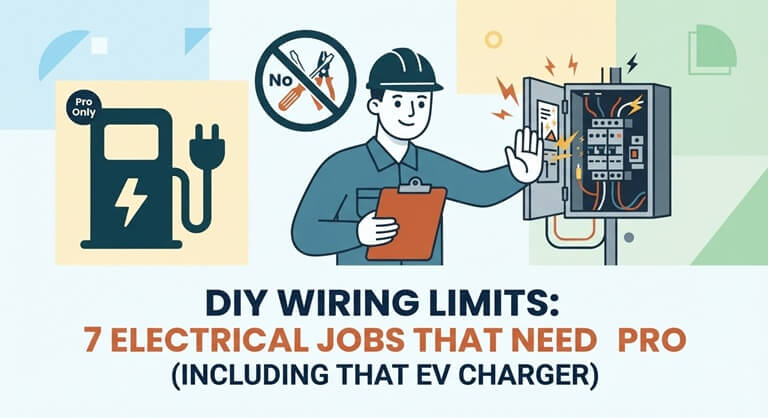
Here are seven electrical jobs that you’ll frequently see cropping up in DIY forums and videos and which really should be left to a licensed electrician. We’ll go into some detail about the installation of an EV charger as this is one of the most common jobs people are now undertaking for the first time. This is a perfect example of why you can’t just look at the wiring and think “that’s simple”.
1. Adding a Dedicated 240 Volt Circuit for an EV Charger
This project invariably takes the new EV owner by surprise. The actual fitting of the charger is quite simple; the wiring behind it, however, is far more complex, and it’s in that area that even a fairly confident DIYer can inadvertently cause some serious problems with the home electrical system.
A Level 2 EV charger requires its own 240 volt circuit, sized for its continuous power use (which is far higher than a normal outlet can cope with). Prior to installing that circuit, the electrician will have to do a load calculation on the house, taking into account the existing load of the air conditioner, the stove, the water heater, and the distance from the panel to the charger. If that calculation is wrong, the circuit could trip all the time, or worse still, the panel could be overloaded every time the charger is in use with other large appliances.
This is exactly the kind of job Veteran Electric KC, a veteran-owned electrical contracting company serving Kansas City and North Kansas City, Missouri, treats as a full panel safety evaluation rather than a simple hookup. Founder Nathan Bowman makes it clear: “People come to us thinking this is just about putting a charger on the wall. Half the job is actually ensuring that the panel behind that wall is capable of supporting it safely today and five years from now when they’ve got a second vehicle and a home generator.” That’s the actual engineering work involved and that’s why a rushed DIY job so often ends up with a tripped breaker or a failed inspection rather than a working charger.
2. Upgrading or Replacing the Main Panel
Even if you’re comfortable running low-voltage wire for your outdoor lights or a workbench outlet, the main panel is a whole different ball game. Upgrading the main panel is a job that involves working at the point where the utility power comes into the house with live, high-amperage power that doesn’t allow for any kind of mistake. That’s always a job for a licensed electrician.
3. Running New Circuits Through Finished Walls
Pulling wire through the open studs in a new garage is far easier than running a new circuit through the finished walls, the insulation and the hidden wiring. If you get it wrong you could damage an existing wire or create a hidden fire hazard inside a wall you’ve just painted.
4. Anything Involving the Service Entrance or Meter
The wires between the utility meter and your panel are the wires that carry all the electricity coming into your house. Attempting to work on that connection without first switching off the power at the utility (which can only be done safely by a licensed electrician) is one of the most dangerous things you can do as a homeowner.
5. Adding a Sub Panel for a Workshop or Detached Garage
If you’re converting a garage or shed into a workshop, you may find you need more circuits than your existing panel can provide. A subpanel can be the solution, but the correct wire size, breaker, and grounding all require some fairly involved calculations, which most tutorial videos don’t go into.
6. Whole Home Surge Protection Installation
So many people just go ahead and skip this step as it seems optional. You’ll often find whole-house surge protection at the panel, and it’s best to add that in as part of a bigger job (e.g., when you’re installing an EV circuit or replacing the panel). Sensitive electronics (EV chargers being a prime example) can be damaged by voltage spikes and it’s far more expensive to add the surge protection at a later date than to have it in place when the panel is already open.
7. Any Circuit Requiring a Permit and Inspection
If it’s a job that requires a permit (EV charging circuits, panel upgrades, subpanels etc. generally do) then it’s not going to be a simple weekend job. A licensed electrician will get the permit, organize the inspection, and ensure the work is done. If you fail an inspection on unpermitted DIY wiring, you could be back at square one with the whole thing having to be redone, and you’ll have issues when you go to sell the property.
Questions Worth Asking Before You Hire the Job Out
Once you’ve decided to go with a professional, remember that not all quotes are equal. Make sure you’re getting a full load calculation with your quote rather than just the price of the charger or fixture. Find out what happens if your panel is going to be insufficient and will need upgrading. That should be a discussion before any work is done. You also need to ask about permits and how long the job is actually going to take. A fairly straightforward install will take one day; a panel upgrade will probably take two visits.
The Bottom Line for DIYers
Knowing your limits is actually part of being a smart DIYer rather than a sign of weakness. It’s exactly the same as you’d double-check a load-bearing wall before you cut into it. You know when to call a qualified electrician. Installing an EV charger circuit, upgrading a panel or working on the service entrance are all jobs that should be left to a qualified electrician. Save your DIY for the sort of stuff like building a workbench or some shelves and leave the wiring to the electrician.
Popular on OTW Right Now!



About The Author

Gagan Bhangu
Founder of otechworld.com and managing editor. He is a tech geek, web-developer, and blogger. He holds a master's degree in computer applications and making money online since 2015.