
7 Ways Geofencing and Location-Based Ads Attract Ready-to-Buy Clients
Every shop owner, local business, and nearby company has the same tough spot. A lot of people walk by, or they may go into other shops or stores close by. Many of them do not know about better choices right near them. Old ways of advertising—like big online banners, mailed ads, and ads that show up for a large area—end up costing a lot. These ads reach people who are not close and are not ready to buy now.
Location-based ads fix this problem by using where people are to find the right audience who want to buy soon. The group Royal Palm Marketing builds ads for small areas. They aim these at people who live or work nearby. They help you catch demand that is ready now, get the most from your budget, and turn people who walk by into repeat, good customers.
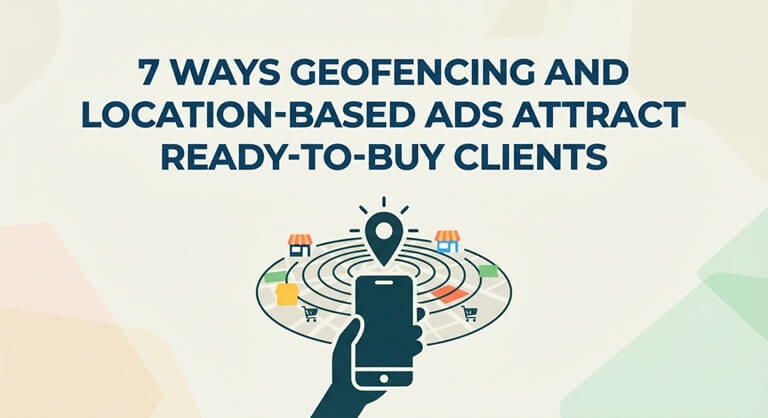
What Is Geofencing and How Does It Work?
Geofencing technology uses GPS, Wi-Fi, and mobile technologies to create an invisible boundary around any particular place. After users have entered that boundary and activated their location in the mobile devices, they will receive advertisements while using different applications, social media sites, or browsing websites.
Unlike traditional geotargeting, which either utilizes postal codes or a whole city as a targeting criterion, geofencing technology is more accurate. The technology allows you to define the perimeter even at the level of one square meter. With the help of geofencing, a company can set up a virtual boundary around trade shows, other companies’ premises, venues, or industry events. Thus, they will reach potential customers at the most convenient moment for them.
7 Ways Location-Based Ads Attract Ready-to-Buy Clients
1. Competitor Conquesting: Intercepting Active Shoppers
Competitor conquesting creates unseen barriers close to competitor stores or automobile dealerships. In the event that a customer visits a competitor’s store, he/she receives advertisements. The advertisements offer immediate offers like match offers, better offers at the particular competitor, or discounts on first-time visits.
- Direct Answer: Geofences placed on top of other stores give quick offers to people who are out shopping.
- Practical Use: It gets to buyers when they are looking at choices in your market.
- Downside: You have to give strong and fast reasons if you want a customer to go somewhere else.
2. Event and Convention Targeting: Reaching High-Intent Crowds
Thousands of people who are willing to purchase or are interested gather at industry trade shows, expositions, and local community events. It is possible to put digital barriers within the perimeter of the event area, thus delivering advertising tailored specifically for the event itself to the visitors. It is also possible to send follow-up advertising to the people who have left the event for 30 days.
- Direct Answer: Short-term geofences get many people who are very interested and active during big meetings and events in the industry.
- Practical Tip: Use geofences made for events along with custom landing pages that are made for those going to the event.
3. Hyper-Local Search Signal Optimization
Combining spatial settings with search know-how makes sure ad spend goes to people who are close by and are looking for answers right now. Using local search signals helps your business show up first when nearby customers search for “near me” services on their phones.
4. Precision Mobile App Retargeting Across Premium Networks
Geofencing networks use device IDs that do not show who people are. These IDs help show display ads through many well-known mobile apps, weather sites, and places where people play games. A plan that uses the right steps to look at what others are doing can help you find out which local apps and spots get the most people to click and join.
- Direct Answer: Programmatic ad placement helps your brand say the same things every time across the mobile apps people use most.
- Key Advantage: Gets around banner blindness by showing ads in the right mobile settings.
5. Multi-Device Retargeting for Household Attribution
A customer seen on a mobile phone in a set area can be tracked to their home IP address. This helps show ads again to the same person on their computer, tablet, and Connected TV. It builds trust in the brand for everyone in the home.
| Technology | Signal Source | Typical Conversion Window | Primary Output |
| Mobile Geofencing | GPS / Cellular Lat-Long | 1 to 7 Days | Immediate Foot Traffic |
| IP Household Mapping | Router IP / Wi-Fi Signals | 7 to 30 Days | High-Value Inquiries |
| Cross-Device Retargeting | Device Graph Matching | 14 to 45 Days | Multi-Touch Conversions |
6. Physical Conversion Zone Tracking and Foot-Traffic Attribution
One major advantage of using spatial advertising is that you get to measure the effect firsthand. By setting up an additional space, referred to as the “Conversion Zone,” around your store or office, the software measures the number of people who have seen your advertisement and visited your store.
- Conversion Zones tie the views of online advertisements straight to visits to actual stores.
- Value to Business: You get to collect hard facts, not just attractive statistics. You collect the actual number of people visiting your store.
7. Geo-Conquesting for High-Value Local Services
In industries such as commercial roofing, legal consultancy, and health care, the implementation of geofencing in the appropriate commercial centers can help ensure that your advertising funds reach the decision-makers. The combination of basic revenue-driving SEO fundamentals with strict geofencing creates an integrated system that attracts both search engine users and locals. The fusion of hyper-targeted local campaigns and intent-matching content ensures immediate credibility among prospective customers. This takes place from the moment of clicking on your website.
The use of high-ROI PPC tactics with respect to local campaigns guarantees that every penny spent on ads targets those who currently have the need.
Maximize Local Market Share with Spatial Targeting
Hyper-local advertising helps the digital world connect with the real world. It sends messages right when and where your potential customers are making a choice to buy. Location-based advertising makes sure ad money does not get wasted, and it brings in good leads. Working with Royal Palm Marketing lets local places use geofencing in the best way. This makes being nearby turn into a strong way to do better than others.
FAQs
How small can a geofenced area be?
Geofences can be made small to fit the exact area you want. They can follow outlines of a building, parking lot, or a trade show booth.
What is the difference between geotargeting and geofencing?
Geotargeting shows ads to people in a big area. This can be a city or ZIP code. It uses their data for this. Geofencing, on the other hand, uses real-time location. The ads will come up when you cross a set line in a place.
How do location ads measure actual foot traffic?
Tracking systems set up a second “Conversion Zone” at your business entrance. If a device has seen an ad and then comes into your conversion zone, the system marks a confirmed visit.
Does geofencing work on both iOS and Android devices?
Yes, geofencing works on both major mobile operating systems. It uses hidden location signals from apps that people agree to use.
Popular on OTW Right Now!
About The Author

Gagan Bhangu
Founder of otechworld.com and managing editor. He is a tech geek, web-developer, and blogger. He holds a master's degree in computer applications and making money online since 2015.