
Why Your Expensive Living Room Furniture Still Looks Wrong (And the Layout Habit That Fixes It)
A sofa isn’t usually the thing that needs improving in a room that seems wrong. Neither is a more attractive rug or an additional accent chair required. The furniture itself is generally satisfactory. The problem lies in the room’s arrangement: it’s pushed up against the walls, or it’s placed on a rug that’s too small for the space, or else it’s clustered around three separate areas that act as focal points.
The best way of demonstrating this is to compare the two different approaches side by side, room by room: the wall-first plan which most rooms tend to follow, and the arrangement drawn up according to the way people actually sit and move. With the first approach modest furniture appears to have been thought out about, while with the second premium furniture looks out of place.
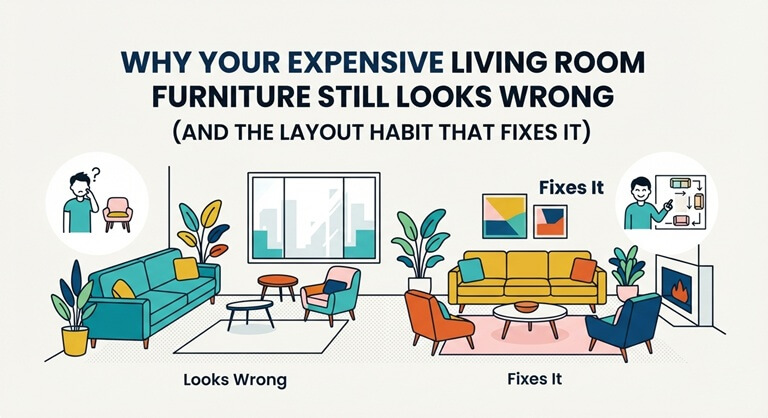
Furniture Against the Walls vs. Furniture Pulled Into the Room
The tendency to hug the walls is based on a sound instinct—namely, to protect the walking areas, keep the centre clear, and make the room seem larger. It may be the correct choice in small rooms which have only one actual traffic lane. However, in most rooms it spreads the seating so far apart that people can’t hear one another without leaning forward and the rug in the middle looks as if it’s an island that no one goes to.
Moving the sofa a foot or two away from the wall and turning the chairs to face it has a greater effect on a room than any new piece of furniture. The distance between people when talking becomes smaller. The rug then begins to perform its function.
Wins are achieved by hugging the walls when the room is actually quite narrow, while the pulled-in approach is better in all other cases.
One Big Seating Zone vs. Two Smaller Ones
Big rooms tend to lead people to buy more furniture and to place it in a single, extensive ring. This leads to a sectional that is so long you can’t talk across it and to chairs positioned so far from the coffee table that no one ever puts a drink on the floor. A single large area usually performs worse than two smaller ones.
Divide the room into a main area for conversation and a secondary recess: consisting of a pair of chairs by the window, a reading corner and a small game table. The room then has a purpose other than just watching television. Designers suggest leaving roughly 120 cm between distinct zones, which is a useful floor to hold yourself to.
Approximate Spacing vs. Measured Spacing
It is most frequently in the case of expensive rooms that judging distances goes wrong; a coffee table situated six inches too far from the sofa seems slightly wrong in a way that most people can sense but cannot describe.
The fix is measured, not stylistic:
- Sofa to coffee table. Aim for the 18-inch rule as a minimum: close enough to reach a drink without standing, far enough for legs to clear.
- Main walkways. Leave a clear path of roughly 90 cm through the room so nobody turns sideways to pass the sectional.
- Rug footprint. At least the front legs of the sofa and chairs sit on the rug, and every piece in one grouping follows the same rule. Mixed leg placement in a single zone is what makes a good rug look cheap.
Buying More vs. Placing What You Have
Before you carry out any other actions, move the items that are currently there by taking the sofa away from the wall, turning the chairs around, and replacing the rug with one that is one size larger.
Now sit down and try to hear the person on the other side of the room without having to raise your voice. Most rooms require rearranging rather than buying new furniture, and the ones which actually need a new item are much easier to look for after the layout has been sorted out.
Browsing living room inspiration with a fixed layout in mind beats shopping blind and hoping the room absorbs whatever arrives.
Popular on OTW Right Now!




About The Author

Gagan Bhangu
Founder of otechworld.com and managing editor. He is a tech geek, web-developer, and blogger. He holds a master's degree in computer applications and making money online since 2015.