
The Keyword List That Looked Like Growth and Sold Nothing
Why bottom-funnel research beats a spreadsheet full of big numbers
At 9:07 on a Monday morning, a marketing team can feel successful before anyone has bought anything. The keyword spreadsheet is full of impressive numbers: 40,000 searches here, 18,000 there, and a difficulty score that looks beatable. Everyone agrees to publish. Three months later, the traffic graph is up, but the sales pipeline is exactly where it was.
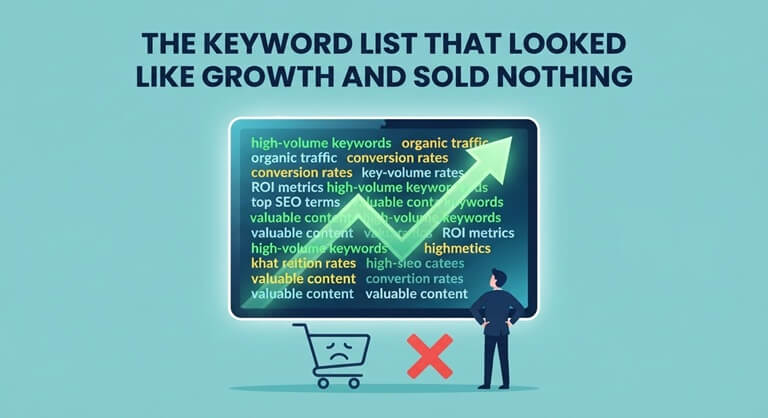
That disappointment is not unusual. The mistake is treating search volume as demand for a business, rather than demand for a solution.
In HubSpot’s case study on their topic cluster, they learned about a helpful counterexample. The team created a connected pillar-and-cluster structure that drove almost 190,000 blog visitors per month to the client’s e-commerce site. What had changed was not only an increase in pages, but the fact that it was more published pages. The pages connected to the left and right around a clearly defined subject; narrower questions were answered, and a sensible next step was provided for the reader. Focus, not a bigger spreadsheet, was behind the growth.
The same lesson applies to a SaaS company, agency, or consultant when choosing a next-link target. It’s better to have a small keyword rather than a large phrase that is targeted to people who are wondering what to do.
Volume is a measurement, not a business case.
Search tools make an approximation about how frequently a phrase occurs. They don’t explain whether or not the searcher has the budget, urgency, authority, or problem that your product is solving. If you use a keyword like “SEO”, you can get thousands of visitors, and very few of them may take an interest in a conversation that is qualified. The term “technical SEO audit for a SaaS website” may be smaller, but the searcher has already chosen a job, context, and likely next step.
This is growing in significance as search results evolve. According to the latest Semrush study, AI Overviews, in the past six months, the percentage of SERPs with an AI Overview increased by 71%, while that of transactional SERPs fell by 5%. When clicks are hard to get, the page has to attract the right ones, not just many.
The practical distinction is simple:
- Informational demand asks, “What does this mean?”
- Commercial demand asks, “Which approach or product should I choose?”
- Transactional demand asks, “How do I do this now?”
The final two are where a keyword can generate money. They need not be of high volume, and they are frequently combined with a seemingly informational phrase. Check the current SERP before using the label on a tool. The searcher is likely to be closer to action than the search term implies if the results include product pages, comparisons, templates, calculators, or service providers.
The zero volume trap and the opportunity inside it
Also, numerous particular phrases are marked as “zero volume” by third-party tools. That is the label; it doesn’t mean that no one will ever search the phrase. “href lang tag SEO” is a great example of a phrase with a predicted 10-month-to-month look, and it cautions that a long-tail variation can exist within a bigger subject. Another good reason to have a very narrow query is that it is a description of a problem that your ideal customer is describing, in their own words.
It is not the question; the right question is “Does the tool say zero?” Would a single person looking for something like this have a good reason to use our solution? A zero-volume query can be worthy of a page if the problem is real, the page can offer first-hand expertise, and the query fits into a cluster that is building topical authority. Don’t create a page just because it’s easy to rank for.
A bottom funnel workflow that survives contact with reality
Begin at the next decision made by the customer, and work back up to the search language. A useful keyword brief contains the problem, audience, action, and proof required to persuade the buyer to believe the answer.
- Name the job. “Find keywords” is vague. “Choose three pages to improve before launching paid traffic” is a job with a deadline.
- Add the buying context. Include the site type, platform, location, team size, or constraint that changes the recommendation.
- Inspect the SERP manually. Note whether the top results are current, practical, and written for the same audience.
- Score the next step. Prioritize queries that can naturally lead to a tool, audit, template, consultation, or product comparison.
- Connect the cluster. Link the narrow page to a useful hub and back to the commercial destination.
Let’s see how that translates to practice. Volume, difficulty, CPC, intent, and 12-month trend are now all visible on the Unmiss interface, which features a search bar for keywords. As shown below, the term “technical SEO audit” has 610 monthly searches, a $7.44 CPC, an average competition of 0.09, medium difficulty, and informational intent. The numbers aren’t for you. They assist you in posing the right question: Would the following page be useful for explaining an audit, comparing audit workflows, or assisting someone to conduct an audit?
For a buyer who is ready to act, a contextual next step is a keyword research workflow that exposes those trade-offs before they commit to a content plan. The value of the link is not the anchor text. It is the reduction of uncertainty.
Build less but make each page earn its place.
A focused cluster may include one commercial page, three problem-specific guides, and one proof page. The articles should address different questions. Merge two pages with the same intent, or keep them separate for truly different audiences. The number of URLs doesn’t necessarily mean the number of authorities.
In vernier words, Google’s people-first advice is: develop original analysis for an intended audience, demonstrate experience, and make the reader happy. That’s the standard to go by when editing any guest posts. A keyword research article should not be an “invisible link vehicle”. It should help readers stop wasting budget on attractive but unqualified traffic.
Before approving the next keyword, ask:
- What decision will the reader make after this page?
- Which proof would change their mind?
- Is the current SERP stale, generic, or missing implementation detail?
- Can this page strengthen a clear cluster rather than repeat an existing URL?
- Would the topic still matter if search volume disappeared from the tool?
The best keyword list is rarely the longest one. It is the one that connects a real problem to a credible answer, a useful next step, and a page that deserves to rank. That is how a modest query becomes commercial momentum, and how content stops looking busy and starts helping a business grow.
Popular on OTW Right Now!



About The Author

Gagan Bhangu
Founder of otechworld.com and managing editor. He is a tech geek, web-developer, and blogger. He holds a master's degree in computer applications and making money online since 2015.