
How Technology Is Transforming Industrial Maintenance
Industrial maintenance has entered a new era where technology drives efficiency, reduces costs, and prevents catastrophic equipment failures. From predictive analytics to augmented reality tools, maintenance teams now have access to capabilities that seemed like science fiction just a decade ago. This transformation is reshaping how facilities operate and how maintenance professionals approach their daily work.
The Shift from Reactive to Predictive Maintenance
Traditional maintenance strategies followed two basic approaches: fixing things when they broke or replacing parts on fixed schedules. Both methods had significant drawbacks. Reactive maintenance led to unexpected downtime and production losses, while preventive maintenance often meant replacing components that still had useful life remaining.
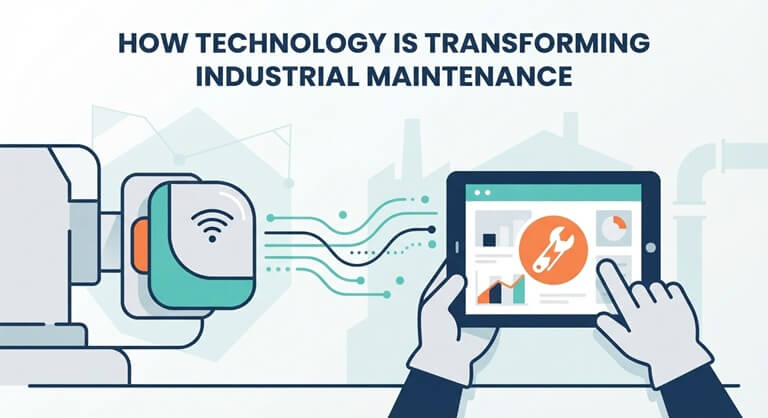
Predictive maintenance changes this equation entirely. Sensors embedded in equipment continuously monitor vibration, temperature, pressure, and other critical parameters. This real-time data feeds into analytics platforms that identify patterns indicating potential failures weeks or months before they occur.
For example, a slight increase in the temperature of a motor bearing and the occurrence of unusual vibrations could go unnoticed to the naked eye. But predictive algorithms can detect this as an early warning and ensure maintenance crews can schedule their repairs during maintenance downtime, instead of an emergency shutdown.
The monetary consequences of its effects are significant. Companies using predictive maintenance can expect maintenance costs to drop by 20-30 percent and unplanned downtime to fall by up to 50 percent. These are not minor changes but also a sea change in operational efficiency.
Internet of Things (IoT) and Connected Equipment
The proliferation of IoT devices has created networks of connected industrial equipment that communicate constantly. Today, modern hydraulic systems, conveyor belts, pumps, and processing equipment can now provide real-time status reports, providing a complete picture of facility health.
This wireless connectivity allows maintenance managers to keep track of all operations on the centralized dashboards. Technicians are notified of systems operating outside of normal parameters, rather than having to trek miles of factory floor to check individual machines. When you need replacement parts, you can shop for hydraulic components online and have them delivered before the equipment actually fails.
Connected equipment also creates valuable historical data. Performance teams can review performance trends based on similar machines and determine if there is a greater need for attention for a specific machine type or configuration. This data supports buying decisions and helps plan maintenance across the facility.
Augmented Reality for Faster Repairs
Augmented reality (AR) technology is proving particularly valuable for complex repairs and training new technicians. AR Glasses or Tablet Apps deliver step-by-step repair instructions, part identification, and safety warnings directly into the technician’s field of view while overlaid on top of real-world equipment.
If a technician comes across an unfamiliar piece of equipment, AR systems can present exploded views, identify the part that needs replacing, and guide them through the replacement procedure. This significantly reduces the learning curve for new team members and the number of mistakes that can occur during critical repairs.
This is further supported by remote expert assistance. A junior technician working on a complex hydraulic system can seamlessly share their AR view with a senior expert, no matter where they are in the world. The expert can see what the on-site technician sees and can offer guidance while the technician is viewing the live display: they can draw arrows, circles, etc., and write notes in the display that show up in the on-site technician’s display.
This is particularly useful as seasoned maintenance workers age. This expertise can be captured in AR training modules, which would help pass on expertise to the next generation that may otherwise be lost.
Digital Twins and Simulation
Digital twin technology creates virtual replicas of physical equipment and entire production lines. These digital models mirror the real-world systems in real time, incorporating data from sensors and operational systems.
To experiment with various scenarios without interfering with actual equipment, maintenance teams are using digital twins. They can simulate the performance of a system under different maintenance approaches, determine the best operating conditions, and estimate the consequences of failures. This simulation capability enables experiments that would not be possible or safe using actual equipment.
Digital twins also facilitate improved planning. Teams can rehearse a complex maintenance procedure in a virtual setting, identify potential challenges, and refine their strategy. This preparation reduces the time spent on the real repair work and the risk of complications.
Mobile Technology and Cloud-Based Systems
Smartphones and tablets are now key maintenance devices. Mobile computerized maintenance management systems (CMMS) enable technicians to access work orders, equipment history, maintenance practices, and parts inventories from any location within the facility.
Once a technician has finished a repair, they can enter repair details, parts used, and time spent into the system as soon as it is completed. It is real-time documentation that eliminates paperwork backlogs and ensures data accuracy. Photos and video recorded on mobile devices give a visual record to complement written reports.
Cloud-based platforms for maintenance have other benefits. Data and best practices can be shared across multiple facilities; mobile workers can access information in the plant, at home, or on-site. Updates are automatic, keeping everyone up-to-date with the latest features and security fixes.
Artificial Intelligence and Machine Learning
AI elevates predictive maintenance by detecting patterns too subtle for humans to spot. Machine learning algorithms sift through thousands of variables and learn the normal operating state for each piece of equipment and identify small deviations that would signify developing issues.
As these systems ingest more data, they become more accurate as time goes on. An AI system that monitors pump performance learns the unique attributes of each pump, taking into consideration variations in age, operating conditions, and maintenance. This individualized approach gives better predictions than generic threshold-based alerts.
Additionally, AI can optimize maintenance scheduling by analyzing various factors at once. It optimizes equipment condition, production schedules, availability of replacement parts, and technician workloads to suggest the best time for maintenance. This optimization guarantees that priority work is done and resources are used to their maximum.
Robotics and Automated Inspections
Today, robots and drones are used to inspect areas that are too hazardous, too hard, or unwelcoming to humans. Drones fitted with thermal cameras can inspect overhead equipment, wind turbine blades, and tall structures without scaffolding or shutdowns.
Ground-based robots operate in confined environments, perform routine visual inspections, and carry out basic maintenance tasks. Unlike a human technician, these automated systems do not get fatigued and maintain the same level of inspection quality, allowing human techs to attend to more complex tasks that need judgment and problem-solving.
The Human Element Remains Critical
All these technological changes are no substitute for skilled maintenance professionals. Their hands-on skills and experience and their judgment are still required, but technology enhances their capabilities. The most effective maintenance efforts marry state-of-the-art technology and highly trained, empowered teams that know how to make technology work for them.
With technology taking over repetitive tasks like monitoring and analyzing data, technicians can focus on more complex problem-solving, strategic planning, and continuous improvement. This collaboration between human knowledge and technological capability delivers maintenance operations that exceed the capacity of either Humans or Technology alone.
Technology is driving a transformation in industrial maintenance that is gaining momentum. Companies that adopt these tools stand to gain greater reliability, lower costs, and increasing competitive advantages, all year round.
Popular on OTW Right Now!




About The Author

Gagan Bhangu
Founder of otechworld.com and managing editor. He is a tech geek, web-developer, and blogger. He holds a master's degree in computer applications and making money online since 2015.