
Why Modern Businesses Are Rethinking Their IT Support Strategy
Technology is now at the center of nearly every business operation. Employees depend on cloud applications, reliable networks, secure devices, and digital communication tools to get work done. When even one part of that environment fails, productivity can quickly stop.
At the same time, managing IT has become more complicated. Cybersecurity threats are evolving rapidly, the software environment is becoming increasingly networked, and businesses expect reliable technology without having to continuously expand the internal team. All these challenges have prompted companies to reconsider the way they deal with technical support.
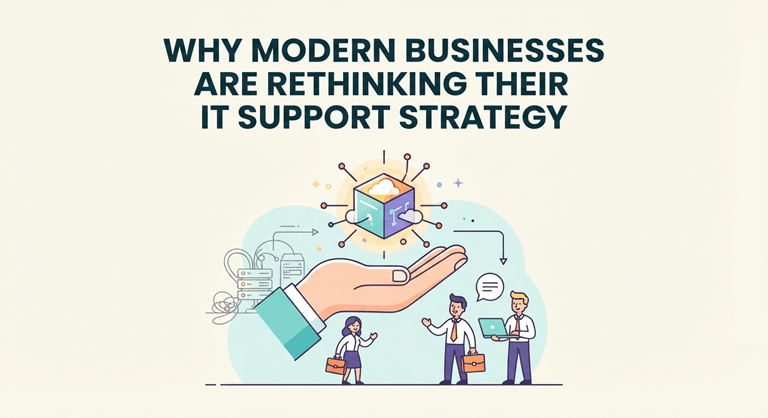
Instead of reacting when something goes wrong, many companies are shifting to proactive IT management. This change can help increase reliability, increase security, and establish a more predictable technology landscape.
Moving From Reactive Support to Proactive Management
In traditional IT support, problems are addressed after they have arisen. When the computer shuts down, an application becomes unavailable, or an employee is unable to access an important system. Addressing these issues is essential; however, waiting for failures can lead to unnecessary downtime and disruption.
Proactive management of IT resources is a favored approach in modern businesses. Rather than just reacting to technical issues, IT specialists follow up on systems, detect potential weaknesses, deploy updates, and resolve risks before they turn into significant incidents.
This makes technology more predictable. Routine maintenance minimizes unnecessary failures, and continuous monitoring can detect any unusual activity or performance issues before they become noticeable. This also helps businesses establish clearer procedures for backups, security patching, device management, and user troubleshooting.
For organizations without extensive internal technical resources, working with a Managed Service Provider can provide access to ongoing expertise without requiring a large in-house infrastructure team. The goal is not simply to fix problems but to create a more stable and manageable IT environment.
The Growing Importance of Cybersecurity
Large corporations are not the only ones facing cybersecurity concerns. Phishing attacks, malware, stolen credentials, ransomware, and other cybercrime threats are possible for businesses of all sizes.
One of the most difficult aspects is that security requires several layers to function. Just a strong password isn’t sufficient. Reliable access controls, software updates, endpoint protection, employee awareness, backups, and monitoring are also essential.
Another vital consideration is human behavior. Employees can click on a malicious link, use the same password, or give out sensitive information to the wrong person. Regular security awareness training may thus be as critical as technical defenses.
Incident planning must also be part of a comprehensive security strategy. Businesses must understand what to do if an account is breached or a vital system is accessed. Confusion during an emergency will be decreased if documentation of procedures and testing of backups is available.
Cloud Technology Is Changing IT Operations
The cloud has changed how businesses buy, access, and use technology. Organizations can use cloud platforms for storage, collaboration, communication, applications, and business operations instead of depending on physical servers and locally installed software.
This agility may help workers be more mobile and help companies scale technology as their requirements change. However, the move to the cloud doesn’t mean that IT roles are no longer involved.
There are still user permissions and security, integrations, data protection, and application configurations to consider. Inefficient cloud environments can lead to inadequate security or to an excessive cost burden.
Another factor is the growing number of applications workers use. If not handled properly, organizations can find themselves with overlapping tools, under-used subscriptions, inconsistent security policies, and disconnected systems.
Businesses can keep track of their operations in such environments with effective IT management. Periodic reviews can help determine the services that are no longer needed, tighten security, and validate technology spending to align with business goals.
Why Reliable IT Support Matters to Employees
Technological issues aren’t just an annoyance to computer systems and networks. They directly affect employees’ ability to do their jobs.
When workers repeatedly experience slow systems, connectivity problems, failed applications, and account access issues, productivity drops. It is also possible that employees can waste time troubleshooting technical issues instead of working on their jobs.
Reliable Managed IT Services can provide structured support for everyday technical needs while helping organizations maintain consistent standards across their technology environment.
Communication is another important aspect of good IT support. Staff should know where to report issues, how soon they will be addressed, and what steps are being taken to resolve them.
Having a structured support process can minimize frustration and increase accountability. Frequent support tickets can also uncover bigger problems that require solving, letting businesses focus on solving the cause of the problem rather than treating the symptoms over and over.
Planning IT Around Long-Term Business Goals
Technology should not be a thing on its own, but rather a part of business strategy. As a business expands, IT should keep up with the changes.
Expansion may bring new devices, more staff, increased security measures, improved infrastructure, or better collaboration tools. Businesses can find themselves making technology decisions under stress, which can waste time and money or create compatibility issues.
Long-term IT planning offers another way. They can look at existing systems, understand what is lacking, predict future needs, and prioritize investment needs accordingly.
Frequent technology evaluations can also be used to assess the effectiveness of tools in use. What is efficient for a small organization can become inefficient as the operation grows.
The best IT strategy combines reliability, security, usability, and cost. Instead of just going with the latest technology, companies can choose solutions that offer tangible benefits and align with their overall goals.
Conclusion
In today’s business world, IT support does not exist in isolation; when issues arise, it matters to the business, but when it works, it is essential to the business. Technology affects productivity, security, communication, customer service, and nearly every other aspect of day-to-day business.
By taking a proactive approach, organizations can minimize disruptions, improve cybersecurity, manage cloud environments more effectively, and provide reliable technical support for their employees. Meanwhile, strategic planning promotes technology to keep pace with business needs.
A new era in IT management will be more about prevention, visibility, security, and planning the future. Companies that create a management plan now will be more ready for the future of technology. In the end, it’s not just about making IT systems work; it’s about establishing a technology backbone that empowers the whole organization to function with greater assurance and resilience.
Popular on OTW Right Now!

About The Author

Gagan Bhangu
Founder of otechworld.com and managing editor. He is a tech geek, web-developer, and blogger. He holds a master's degree in computer applications and making money online since 2015.