
VoIP Phone Systems vs Traditional Phone Systems: Key Differences
Choosing a business phone system used to mean picking a carrier and signing a contract. Now the decision runs much deeper, since VoIP and traditional landlines work on entirely different technology. One relies on physical copper wiring, the other rides on your internet connection.
Understanding these differences matters more than most business owners realize. The choice affects your monthly costs, how your team communicates, and how much flexibility you have as your company grows or shifts direction.
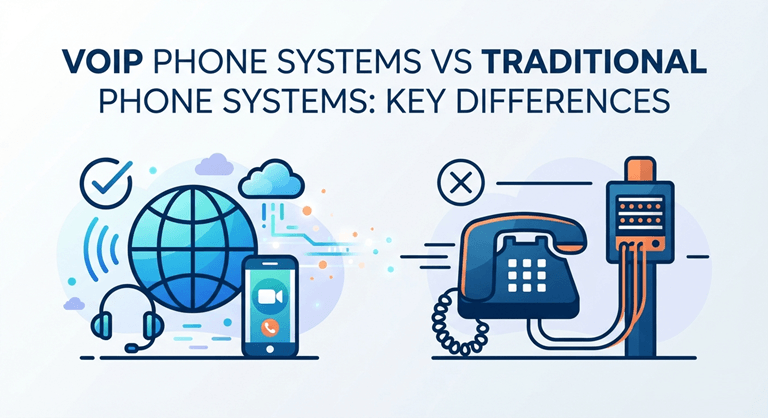
How VoIP and Traditional Phone Lines Actually Route Calls
Traditional phone systems depend on circuit-switched networks, meaning a dedicated physical connection stays open for the entire call. VoIP takes a completely different approach, breaking your voice into small data packets and sending them over the Internet. This distinction shapes almost everything else about how each system performs.
That infrastructure difference also changes what you need to keep things running. Landlines require copper wiring maintained by a local carrier, while VoIP only needs a stable internet connection with enough bandwidth to handle voice traffic. Businesses in areas with unreliable Internet sometimes underestimate how much this factor matters until call quality starts to slip.
Call routing works differently too. Traditional systems send calls through physical carrier hardware and switching stations, while VoIP routes everything through cloud servers that can sit anywhere in the world. According to the staff at hosted VoIP providers from Wisconsin, one of the most overlooked tips for a smooth transition is testing your internet connection’s upload speed specifically, not just download speed, since outbound call quality depends heavily on it.
This is the reason that VoIP is so flexible. Calls can be redirected immediately during an outage, distributed to numerous sites, or redirected to a mobile device without interruption in physical wiring. The flexibility that a traditional system can provide just isn’t that great.
Hardware Requirements and Physical Infrastructure
The traditional phone system involves installing desk phones on top of wall jacks and each desk phone connected to a central switching unit. VoIP does just the opposite: It enables employees to access the network via softphones or mobile applications on any device connected to Internetrnet, including laptops, tablets, and smartphones.
The spine of each system is also different. Traditional configurations include a physical PBX cabinet, typically installed in a server room, which requires technician attention for maintenance or upgrades. In contrast to the traditional VoIP solution, the entire function is driven to the cloud, eliminating the need to store large amounts of equipment and maintain the on-site hardware when it fails.
Many older buildings still have wiring closets with punch-down blocks with all the extensions plugged into the main line. VoIP virtually eliminates this complication, as voice traffic passes through your existing data network rather than requiring a separate network of wires.
Compatibility is also important, and it’s advisable to check before altering. Voice-capable routers and switches are required for VoIP systems, particularly in offices where lots of workers are on voice calls concurrently. With traditional systems, it is not a concern, because voice and data don’t compete for bandwidth.
Cost Structure Over the Business Lifecycle
These two systems have a fascinating number of upfront costs. In addition, traditional phone systems tend to be expensive in terms of wiring, physical phones and a PBX box, and the VoIP system can be established with a much smaller outlay in capital as many of the elements are residing in the cloud.
There is also a wide range of monthly fees. Typically, landline service providers charge a fee per line, and, as a company expands beyond a couple of extensions, that starts to cost a lot of money. However, VoIP providers usually include several lines and features in a single flat monthly charge, which would otherwise increase as a team grows.
One of the main drawbacks for expanding companies used to be the long-distance charges. Traditional carriers often impose per-minute charges for calls outside the local area network, while most VoIP providers have long-distance and even international calling in the standard plan, eliminating a cost that could come as a surprise to businesses.
One of the biggest financial disparities between the two becomes apparent when you consider the costs of scale. When a company hires an additional employee in a traditional system, the additional lines and equipment have to be wired in, while VoIP enables a business to add or remove lines in mere minutes by adjusting a few lines in the system software, keeping costs in line with the number of employees.
Call Quality and Reliability Factors
If the internet connection is not of good quality, the risk of any VoIP call will be jitter, latency, and packet loss. These problems can make these conversations choppy and frustrating, especially during busy times, when bandwidth is shared among multiple applications.
When the Internet goes down, so does VoIP. Power and internet outages are particularly devastating to a VoIP system because it is completely reliant on electricity and Internet connections. A simple blackout that would only interrupt a typical landline system can wreak havoc on an entire VoIP system if the business doesn’t have redundant power and Internet connections.
Cell phones, however, will continue to function very well during local network failures. Some of the traditional lines still operate during power failures since they connect directly to the phone company’s facilities: a characteristic that makes it hard for some businesses to give them up entirely.
However, quality-of-service settings can significantly affect VoIP performance. By giving voice traffic priority over network data, the ability to send large files or stream video won’t affect the sound of a voice conversation, and the VoIP system has a better chance of maintaining the reliability that traditional lines offer.
Feature Sets That Separate the Two Systems
Most VoIP solutions have features built in, such as an auto attendant and a call queue system, which allows users to jump through the same menus and routes calls to the appropriate department without using a receptionist. Traditional systems can do the same, but typically only by adding on to the system with additional hardware that is costly and too much for many small businesses to afford.
Video conferencing and screen sharing are standard capabilities for today’s teams, which are provided natively by VoIP in the same platform where they are making phone calls. Older landline phone systems weren’t designed for video, making it difficult for businesses that still use them to hold video meetings.
Call analytics are another significant advantage to having a VoIP solution. Detailed reports of call volume, call length, and missed calls provide managers with real insight into the performance of their teams, while many platforms also seamlessly connect with CRM software and capture customer interactions automatically – no manual input required.
The other thing I noticed is that when I set up voicemail on one, it was different from the other. Voice over IP systems are typically set up to transcribe voicemails and to send them directly to an employee’s email inbox, which saves time when compared to dialing in and listening to the voicemail one at a time.
Wrap Up
VoIP vs conventional telephone systems is not just about call quality or monthly charges. Deciding which option is best for a business will depend on the infrastructure, scalability, and security; it’s often the website reliability, team size, and growth plans that determine the right choice.
Companies considering this option need to think about more than just the cost at the moment, and consider where they’ll be needs are in the future several years. This system that is best today is not necessarily going to scale smoothly tomorrow.
Popular on OTW Right Now!




About The Author

Gagan Bhangu
Founder of otechworld.com and managing editor. He is a tech geek, web-developer, and blogger. He holds a master's degree in computer applications and making money online since 2015.