
What Parents Should Know About Baby Clothing Materials: A Guide to Safer Everyday Choices
Parents already teach children to question what they see online: Is the headline accurate? Is the source reliable? Is an exciting claim actually supported? The same habit is useful much earlier, when adults are shopping for baby clothes. That careful habit also helps parents spot when a product photo, collection description, or familiar material word is doing more persuasive work than the evidence underneath it. It also stops one reassuring adjective from carrying more weight than the rest of the product information parents can verify.
Bamboo-labeled clothing is a good example of why this matters. In the United States, the Federal Trade Commission explains that many textiles marketed around bamboo are actually rayon or viscose made from bamboo, not raw bamboo fiber. That difference matters because the plant source alone does not prove that a finished garment is antibacterial, hypoallergenic, chemical-free, or environmentally superior. Sleepwear adds another layer: the U.S. Consumer Product Safety Commission treats children’s sleepwear as a defined category with specific fit, labeling, and flammability considerations. A soft daytime bodysuit should therefore not simply be treated as pajamas because it looks cozy. Parents can also check whether broad claims on a collection page apply to the exact SKU in front of them, whether the current size chart fits their baby, and whether the product is intended for play, layering, or sleep. That habit is especially valuable when comparing bamboo pajamas, where the fiber wording, intended fit, construction, care instructions, and sleepwear labeling matter more than the material name alone.
Cute, Soft, Natural—But What Does the Label Actually Say?
A clothing label is a more appropriate kick-off than a marketing adjective. If a food package includes a percentage of fiber, then there’s something to compare to. If it’s referring to a fabric that’s bamboo viscose, parents can assume that it’s a manufactured viscose fiber using bamboo as the plant material, consistent with the FTC guidance.
Language of comfort is the same as comfort language. “Soft” describes feel. The term “stretchy” refers to a quality of textiles or construction. Automatic doesn’t automatically imply that it will eliminate skin irritation, keep a child at an appropriate temperature, or fit every child with sensitive skin.
One Material Word Cannot Answer Every Safety Question.
There are many questions parents ask, one example being “cotton or bamboo, loose or tight, natural or synthetic? Baby clothes don’t usually fit into such a nice box because the questions to be asked will vary based on the type of clothing.
A bodysuit for the day should serve a variety of functions, such as: getting dressed in the outfit, moving around, playing, layering, and changing. There are additional considerations when it comes to sleepwear, such as purpose, labeling, and fit. A T-shirt that you like to wear during the day will not necessarily agree with you at night.
A Light-Green Two-Pack Makes the Difference Easy to See
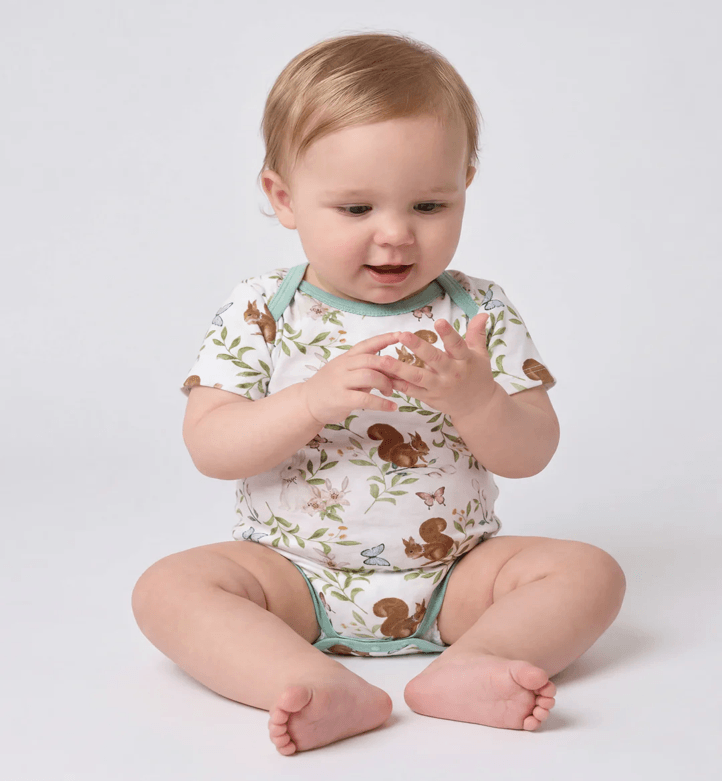
PatPat currently lists the featured product as Baby 2-Pack Woodland Friends Bodysuits in Light Green under its BambooCloud™ line. The U.S. page shows sizes from 0–3M through 18–24M and currently marks the set out of stock, so availability and other changing details should be checked again before purchase.
The page is a description of a 2-piece mix and match set consisting of one solid and one printed design. It features short sleeves, round necks, stretchy knit construction, flat seams, a tagless label (heat pressed), moderate fit, and pre-shrunk construction. PatPat offers the bodysuits under the guise of “made for play” and everyday wearing, instead of children’s sleepwear.
Its Fabric + Care section lists 93% “bamboo fiber” and 7% spandex, while another section calls the fabric bamboo viscose. For U.S. readers, that regenerated portion is more accurately described as viscose made from bamboo under FTC terminology. The page gives care instructions of machine wash cold, tumble dry low, and low iron.
What Makes This Two-Pack Practical for Everyday Wear
The strongest selling points are the details parents can actually compare:
- Two coordinated bodysuits: one solid and one printed design.
- 93% viscose made from bamboo and 7% spandex: based on the page’s composition and bamboo-viscose wording.
- Short sleeves and round necks: simple construction for everyday wear.
- Stretchy knit: designed to move during normal daytime activity.
- Flat seams and a heat-pressed tagless label: fewer bulky interior details.
- Moderate fit: the fit description shown for the exact product.
- Pre-shrunk construction: listed by PatPat for this SKU.
- Cold-wash Care: machine wash cold, tumble dry low, and use low iron.
These features are stand-alone. They don’t have to be formulated as a promise to give eczema relief, guaranteed cooling, allergy protection, or “the safest fabric.”
Daywear and Sleepwear Should Not Trade Places
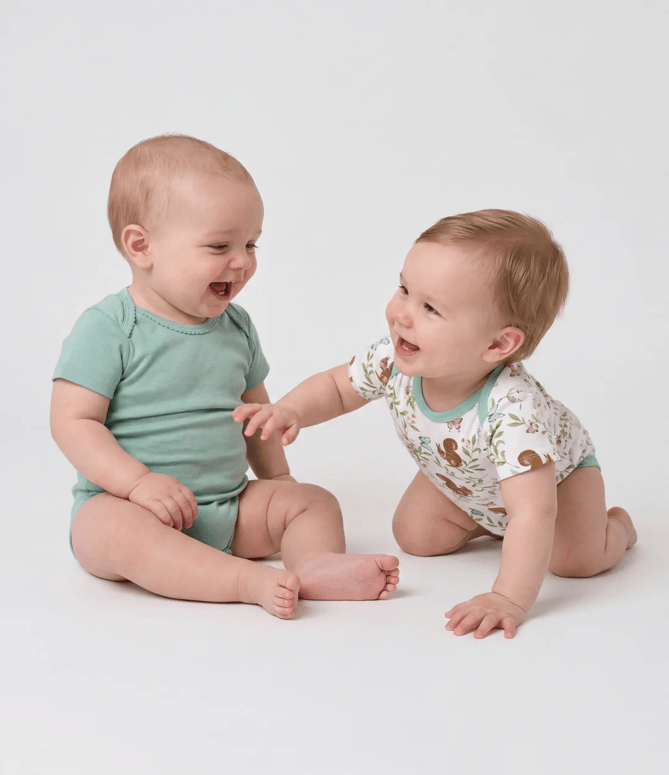
The “for play” labeling on the product provides parents with some significant information about the intended use of the product. A soft bodysuit can be comfortable, but it doesn’t necessarily mean that it is a sleep suit. The CPSC guidance is clear that the comfort of the garment is not the only consideration in determining if the garment is children’s sleepwear.
That distinction is useful when parents move from sleepwear to bamboo baby clothes for daytime dressing. Begin by identifying the intended use of the garment – play, layer, outing or daily wear – and then look at the words, fit, construction, size chart and care information. Different fibers can be used in a bodysuit and a pajama, and they may have different shapes, labels, and be used for different purposes.
Sizing Is a Measurement Question, Not a Birthday Question
Age labels like 9-12M are helpful for navigation, but are not a guarantee of the measurement of all babies in that age range. When labels seem familiar, there will be different dimensions available for various garments.
Compare the actual product chart prior to ordering with current measurements. For sleepwear, follow the label guidelines for fit and size and don’t assume that it needs more space to grow. Fit is not something to be taken lightly since it is one of the requirements for measurement and labeling.
The Product Photo Is Not the Packing List
Product images may include blankets, toys, shoes, hair accessories, or other props that help convey the style of clothing, but can also be used in other settings. No should be assumed as a part of the product unless specified in the title or product description.
Notice our PatPat featured item is a two-pack, and the page mentions a two-pack. This is the information that parents should use when checking contents, as well as the amount of contents that is indicated in the cart.
A Good Safety Habit Is Really a Good Reading Habit
A helpful family fact about kinds of shopping is that great talker language poses a question; it does not put an end to the conversation. If it reads “natural,” inquire what type of fiber it is. Remember that when it says “breathable,” they don’t mean to say that it will be physically possibl;e if it’s referring to “safe,” be sure to follow up with the question of what is being discussed.
The same habit can be applied to a multitude of purchases by parents. Read the specific page and look for measurable details, be aware when a claim is too general, and do not assume that one attribute for one product is indicative of an entire collection. It’s a little thing, but it’s easier to do with each and every purchase.
Better Choices Begin With Better Questions
The parent can’t make all baby clothing choices with just one fabric. It takes careful consideration each day to match the garment to the intended use, to understand the fiber wording, to check current dimensions, to confirm contents of the garment, and to follow care/fitting directions of the exact garment.
For PatPat’s Baby 2-Pack Woodland Friends Bodysuits, review the current U.S. page before ordering, confirm the 93% viscose-made-from-bamboo and 7% spandex composition, compare the size chart with current measurements, verify the two-pack contents, and check current stock and return eligibility. The actual trick is not to remember those words in marketing that sound safe. The ability to discern between a product fact and a promise that has yet to be substantiated is what it is about.
Popular on OTW Right Now!



About The Author

Gagan Bhangu
Founder of otechworld.com and managing editor. He is a tech geek, web-developer, and blogger. He holds a master's degree in computer applications and making money online since 2015.