
What Should Drivers Know About DUI Ignition Interlock Requirements?
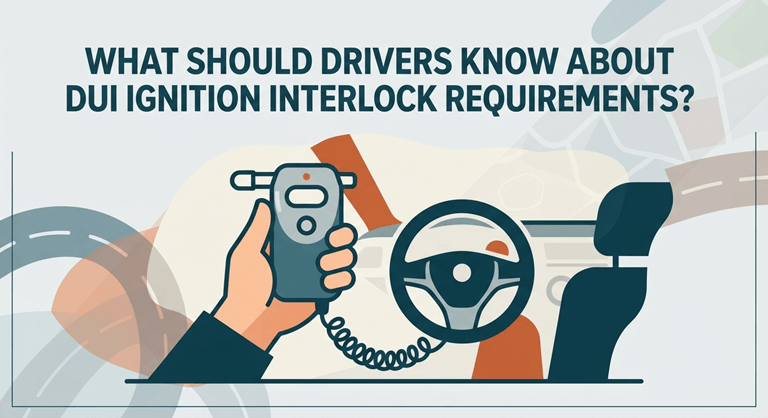
There are many more reasons for an Interlock Program to fail than for an Interlock Device to fail. The failures in the Interlock Program are caused by the way the Interlock Program is administered. The Interlock Device works just fine. It is the administration of the Interlock Program, i.e. The calibration of the Interlock Device, the reportable events versus the non-reportable events, etc. And the corresponding paperwork that often fails.
This information will be very useful to people who advise and manage drivers with restrictions. Also it will be very useful to people who manage compliance files. The reader will get a lot of information about the operational layer of the hardware and the information about the installation of the interlock in various vehicles. The reader also will get to know how violations are created and how one can compare and assess the various providers of interlock services before committing to a contract for a year or more.
How the hardware generates the record
Modern interlock devices use fuel cell sensors, which are extremely sensitive to ethanol and do not detect any other substances, including some fuel additives. This means that clients may falsely believe that their reading came from mouthwash, for example. However, mouthwash contains alcohol, which will clear from the mouth within minutes. After this time, the client will be able to take a retest breath sample.
Rolling retests and the events they create
The majority of the violations for an interlock device occur from the rolling retests that are prompted at random times while the driver is operating the vehicle. The majority of the violations are for missing a test or testing with a breath sample that contains alcohol. Most interlock programs treat a missed test differently than a failed test and consider a lockout to occur during a temporary lockout time frame on missed tests.
Camera units and identity verification
As well as recording the Breath Test Result(s) for each sample, a photo of the driver will be recorded and reviewed with the results for each sample. Ensure that the camera is positioned to take a clear photo of the driver, and avoid any obstructions to the camera. Also ensure that any window tints are not too heavy and will not affect the photo in any way. When providing samples for analysis, try to ensure that the driver provides samples with their face clearly visible in the resulting photo, rather than having to blow into the mouthpiece of the device from an angle.
Installation issues that show up on specific vehicles
As noted above, typical interlock installation involves connecting wiring to the starter circuit of a vehicle. Since there are many different vehicle types (or architectures) on the road today, the difficulty of installing interlock devices can vary from one to another. Installation of interlock devices for example in vehicles equipped with push-button starters, hybrids and vehicles that automatically stop from time to time to save fuel (stop-start) typically requires experienced installers. Additionally, some diesel engines, typically found in large trucks, have glow plug cycles that must be “timed” by the interlock device.
Leased, Employer Owned or Company Vehicles, Personal Use Restrictions Apply. Some jurisdictions recognize an employer exemption for company vehicles but written acknowledgment from the employer must be on file with the monitoring authority. Note that even if an employee is allowed to use a company vehicle for work, they may be restricted from using that same vehicle for personal purposes while under interlock monitoring.
The monitoring calendar and what happens when it slips
Service calls for monitoring a driver are part of the necessary monitoring to ensure the driver is in compliance. During these service calls, the provider will download the data from the interlock, calibrate the sensor(s) and then grant the interlock new permission to continue to monitor the driver. If the required service calls are not completed in a timely manner, the interlock will lock up the vehicle in a permanent lockout situation. The driver will then need to call for a tow or have the interlock provider complete a service call to unlock the interlock.
| Event | Typical interval | Consequence of missing it |
| Calibration and data download | Every 30 to 60 days | Permanent lockout, reportable noncompliance |
| Rolling retest response | Randomized during operation | Missed test logged, horn or lights may activate |
| Violation reset visit | Within days of a logged violation | Lockout, possible restriction period extension |
| Compliance report to authority | Monthly or at cycle close | Removal date pushed back |
Clean-period requirements
As programs are no longer based on a set end date, the length of the interlock monitoring period will now be based off of a violation free period of time prior to the end of the interlock monitoring period. Typically this time frame is in the 3-6 month period prior to the interlock monitoring period end date. In the case of a late term violation, the monitoring period will be reactivated for the remainder of the restriction term. Thus, it is in the best interest of your client to obtain this information in the last quarter of their term of restriction.
Evaluating a provider before the contract starts
When choosing an approved interlock provider, the differences are practical. Drivers working through local requirements are usually better served by a provider that handles the Norton DUI ignition interlock device installation and calibration schedule in one place rather than splitting those visits between shops.
- Service center proximity and hours, including whether weekend appointments exist
- Mobile service availability for lockouts and whether it carries a surcharge
- Whether the monthly rate bundles calibration or bills it separately
- Turnaround on data disputes and how log records are released
- Indigency or reduced-fee programs, where the state has authorized them
It is strongly recommended to get a full breakdown of all costs for a Norton DUI ignition interlock for a friend or relative in writing before selecting a company to provide a device for them. This includes the cost of installation, the cost of the monthly lease, the cost of required periodic calibrations, the cost of any required lockout resets, and the cost of de-installation of the interlock device. Often the quoted monthly rate for an interlock does not include 2-3 of these other very important costs.
Documentation that supports removal
Proof of closure of the file (including all reports of monitoring and removal of the interlock), proof of removal of interlock from the vehicle, and confirmation of removal of restriction from the monitoring authority (i.e. Licensing authority) by the said monitoring authority that the driver can return to operate vehicles without an interlock installed on them.
- Confirm the qualifying clean period has been met under current program rules
- Request the final compliance report and review it for unresolved events
- Schedule removal only after written authorization is issued
- Retain the de-installation certificate with the case file
Interlock programs can vary greatly by State as well as by the court that has ordered the restriction. Always check with the State’s Department of Motor Vehicles as well as with the court that originally issued the Interlock restriction for the most current information with regard to a specific driver’s Interlock requirements.
Popular on OTW Right Now!



About The Author

Gagan Bhangu
Founder of otechworld.com and managing editor. He is a tech geek, web-developer, and blogger. He holds a master's degree in computer applications and making money online since 2015.