
How 3D Scanning Quietly Rewrote the Rules of Clear Aligner Design
Orthodontists used to press your teeth into a tray of pink putty, wait for it to set, and mail the hardened impression to a lab. That process took days, sometimes cracked in transit, and left patients gagging through the whole experience. Today, a handheld wand scans a full arch in under two minutes and builds a millimeter-accurate 3D model before you leave the chair. That single shift in data collection changed everything downstream: the fit of the aligner, the predictability of tooth movement, and even the materials scientists chose to build the trays from. This article traces that chain of cause and effect, and explains why the digital workflow patients experience today is genuinely different from what it was a decade ago.
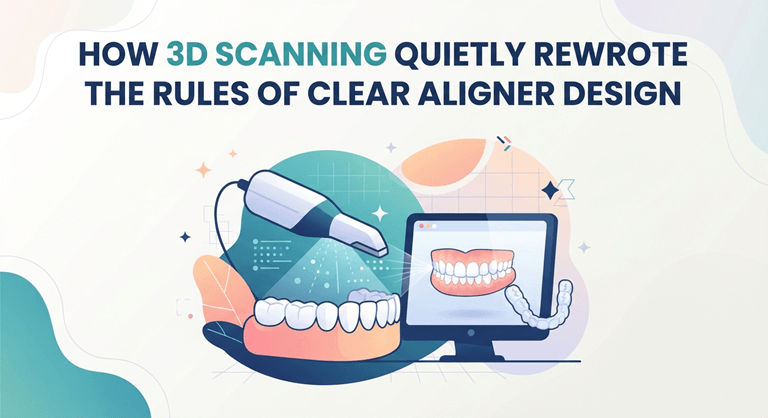
From Plaster to Pixels: Why the Impression Revolution Was the Real Breakthrough
The traditional plaster cast was accurate enough for its era, but it had a ceiling. Small voids, air bubbles, and the inevitable distortion from handling meant that every aligner fabricated from a cast carried a margin of error built right in. Digital intraoral scanners eliminated that ceiling.
Research published on PubMed Central reviewed advances in intraoral scanning and found that accurate intraoral scanners are now crucial for developing comprehensive treatment-planning platforms, facilitating the creation of precise 3D digital models that enhance the accuracy and efficacy of dental procedures. That precision matters because an aligner that fits 0.2 mm off on the lingual surface of a molar produces entirely different force vectors than one that fits flush. A small measurement error at the scan stage multiplies into an unpredictable clinical outcome at the end of treatment.
The shift also changed the speed equation. Digital impressions eliminate the discomfort of tray-based systems, streamlining the traditional workflow, reducing the number of patient visits, and improving efficiency in the orthodontic office. For a busy adult patient, fewer visits is not a minor perk. It is often the reason they start treatment at all.
“The validity, reliability, and reproducibility of digital models obtained from an intraoral scanner allow dental measurements for orthodontic purposes to be taken with a degree of confidence that conventional impressions simply cannot match consistently at scale.”- Summarized from a peer-reviewed study on CBCT and intraoral scanning in orthodontics, published in International Journal of Environmental Research and Public Health.
The Material Science That Followed the Data
Once you can model a tooth surface with near-perfect fidelity, the aligner material becomes the limiting factor. Earlier clear plastic trays were stiff, discolored quickly, and lost their force delivery over time. The digital wave created demand for something better, and the materials science community responded.
Modern aligner polymers are engineered to maintain consistent pressure throughout a wear cycle, not just on day one. They are also designed to resist staining from coffee and tea, which matters enormously for patient compliance; an aligner that turns yellow within a week is an aligner that the patient keeps in a drawer. Advances in fabrication precision allow for aligners that fit snugly and move teeth more efficiently, with materials designed to exert consistent, gentle pressure while remaining flexible enough to provide comfort.
The commercial result of better scanning plus better materials is a market growing at a pace almost no segment of consumer healthcare matches. The clear aligners market was valued at $5.5 billion in 2025 and is projected to reach $17.9 billion by 2033, growing at a compound annual rate of 15.2%. That number reflects patient willingness to pay for a product that actually works the way they were told it would.
The Adult Patient Surge That Digital Tech Helped Create
The timing of the digital workflow shift overlaps almost exactly with a surge in adult orthodontic patients. That is not a coincidence. Adults who skipped braces as teenagers often cite two blockers: how they would look during treatment, and how disruptive the process would be. Clear aligners address both, but only if patients trust the outcome before they commit.
That trust comes partly from visualization. When a clinician can show a patient a 3D simulation of their projected tooth movement on a screen, it converts an abstract promise into a concrete expectation. The AAO’s 2025 Economics of Orthodontics and Patient Census Survey found that the total estimated number of adult patients being treated in the United States by AAO members reached approximately 1.91 million adults in 2024, up significantly from 1.64 million in 2022. That 16.5% jump in just two years reflects both rising awareness and the fact that digital workflows made treatment feel less intimidating to an older demographic already comfortable with tech-driven experiences.
The SAP Framework: How to Read Any Aligner Technology Claim
Practices and brands make a lot of claims about their aligner systems. Most patients have no framework for evaluating them. Here is one worth using. Call it the SAP test: Scan quality, Aligner material, and Planning precision. Any time a provider or brand makes a claim about their aligners, run it through these three questions.
- Scan quality: What imaging technology does the practice use to capture your teeth? Is it a chair-side intraoral scanner, or are they still working from physical impressions? The answer tells you how much inherent error is baked into your treatment plan before a single aligner is made.
- Aligner material: What polymer is used, and what are its documented force-retention and stain-resistance properties? Generic thermoplastic and engineered medical-grade polymer are not the same product.
- Planning precision: Who supervises the digital treatment setup? A licensed orthodontist reviewing each stage produces a different plan than a remote technician following a generic template.
These three questions sort quality providers from commodity ones quickly. A practice that cannot answer all three clearly is not hiding modesty. It is hiding a gap.
What Patients Actually Experience Today
Take a practical scenario. A 34-year-old in a mid-sized suburb schedules a consult after noticing slight crowding that has bothered her for years. She walks into a modern orthodontic office, gets a full-arch 3D scan completed in under two minutes with no trays or putty, and sits down to review a digital simulation of her projected treatment on a large monitor. She leaves with a proposed timeline, a clear picture of the aligner stages, and a set of aligners already queued for fabrication. That experience was structurally impossible fifteen years ago.
For someone in the Atlanta metro looking at their options, a consult with a board-certified provider that offers clear aligner treatment Johns Creek is the practical next step after doing this kind of technology research, because the provider’s clinical workflow and the material they use will determine the actual result, not the marketing language around it.
| Era | Impression Method | Aligner Material | Planning Approach | Avg. Patient Visits
|
| Pre-2010 | Physical putty impression | Basic thermoplastic | Manual lab setup | Higher frequency |
| 2010 to 2018 | Early intraoral scanners | Improved clear plastic | Software-assisted setup | Moderate frequency |
| 2019 to present | High-precision 3D scanning | Engineered polymers (e.g., TruGEN) | Clinician-reviewed digital plan | Reduced frequency |
The Technology Is Only as Good as Who Applies It
This is the part most technology write-ups skip. A top-tier intraoral scanner in the hands of someone who does not understand aligner staging still produces a mediocre treatment plan. The digital tools removed the floor of how bad an aligner could be. They did not remove the ceiling of how good a clinician needs to be to use them well. Orthodontic training, case experience, and hands-on supervision of each treatment stage still separate a great outcome from an average one. The scan is the start. The orthodontist is the story. That distinction is worth keeping in mind when you compare your options, read reviews, or walk into any consultation expecting the technology alone to carry the result.
Popular on OTW Right Now!
-
 How to Find Original Sources Behind Viral Stories
-
 Beyond IT Maintenance: How an MSP Australia Partnership Drives Digital Transformation
-
 Robotic Laser Welding Cell Safety: Class 4 Guarding, Interlocks, Viewing Windows & LSO Requirements
-
 How to Gain Real-Time Finance Visibility with Salesforce and Xero Integration


About The Author

Gagan Bhangu
Founder of otechworld.com and managing editor. He is a tech geek, web-developer, and blogger. He holds a master's degree in computer applications and making money online since 2015.