
How AI Workflow Automation Transforms Business
Businesses are constantly looking for faster ways and ways to avoid unnecessary manual work to complete more than one task. Yet, many groups spend hours moving data between devices, answering repetitive questions, and dealing with mundane procedures.
Artificial intelligence is changing how companies approach these problems. Instead of simply using AI to create textual content or answer questions, companies can now combine AI with workflows, software tools, and enterprise technology.
This is where AI workflow automation and AI agents become particularly useful.
Why Businesses Need Smarter Automation
Traditional automation is helpful when the process follows the same steps in each case.
For example, the system can automatically send an email after a customer submits a form. But what happens when the request requires evaluation, research, or an unusual response depending on the situation?
This is where basic automation can reach its limits. Modern businesses need systems that can cope with more complex requirements while following structured processes.
What Is AI Workflow Automation?
AI workflow automation uses artificial intelligence to connect and automate separate steps in a company process.
Instead of completing each task sequentially, the workflow can move data from one stage to another. AI can help look at the data and then determine what needs to happen next.
Think of it as a virtual production line. Each stage has a reason, but the whole system works together.
How Does an AI Workflow Work?
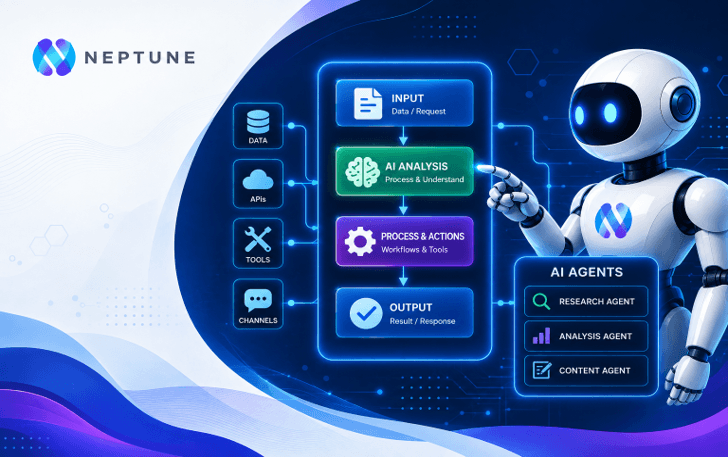
An AI workflow usually starts with an input.
This could be a customer request, a file, a query, or some business data. The system processes that input and sends it to the correct model, tool, or API.
The result can then move to another stage. Finally, a workflow can produce an output that includes a report, feedback, information, or business action.
Neptune AI adopts orchestration-based techniques by connecting AI models, APIs, workflows, and conversational channels. Neptune AI — How It Works
A Simple Example
Imagine an internet retail company receives hundreds of customer inquiries every week.
Without automation, employees may need to review each message, identify appropriate information, write responses, and send them manually.
An AI-powered workflow can automate appropriate parts of this process. It can capture requests, store current information, assemble responses, and send the results through the appropriate channels.
What Is an AI Agent?
AI agents are taking automation a step further.
An AI agent is designed to work towards a specific goal. It can make a couple of moves using the data and tools available to it instead of simply responding to instructions.
You can think of an AI agent as a digital employee with specific tasks.
How AI Agents Are Different From Traditional Automation
Traditional automation generally follows predefined rules.
For example:
If something happens → take a specific action.
AI agents can address situations that can be much less predictable. They can interpret the request, work with available information, and help determine what action should come next.
This flexibility makes them useful for tasks such as research, customer communication, evaluation, and content management.
From Fixed Rules to Flexible Work
Consider a buyer asking a complex question.
The primary automated system will probably only capture some predefined phrases. The AI agent can analyze the query and determine what information might be needed to provide an answer.
Along the way, even critical business decisions may still require human oversight. AI works best when the responsibilities and limitations are clearly defined.
How AI Workflow Automation and AI Agents Work Together
The real gains come from combining workflows with AI agents.
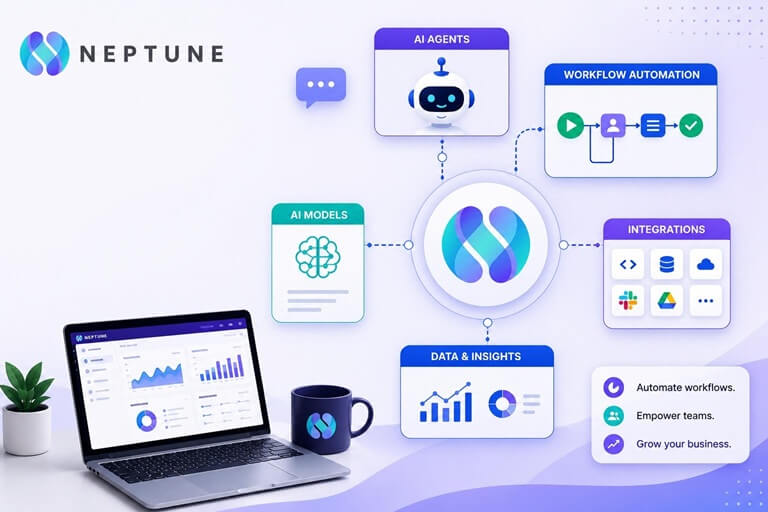
A workflow can provide structure so that AI agents can handle specific tasks within that process.
For example, a commercial company may create a market research workflow. One AI agent could collect information, another could analyze it, and another could prepare a summary.
The workflow combines these steps and moves the work forward.
Combining Different AI Models and Tools
Businesses often require multiple AI features.
One model can be useful for writing, another for evaluating, and external APIs can also provide access to important company information.
An orchestration layer can connect these different components. This allows companies to build workflows around a single project rather than forcing each process into a single tool.
Automation of Multi-Stage Processes
Many business operations involve several small responsibilities.
Take content selection as an example. Research may come first, followed by organizing, writing, editing, and evaluating.
A smart workflow can manage these processes and reduce the amount of manual coordination required between them.
Benefits of AI-Powered Business Automation
The benefits of smart automation go beyond saving a few minutes.
When repeatable methods are designed well, organizations can increase productivity while employees can focus on more valuable responsibilities.
Save Time
Employees often spend a lot of time on repetitive tasks.
There is no need for staff to constantly copy data, prepare routine reports, answer common questions, and transfer information between systems.
Automating appropriate parts of these tasks can free up employees to focus on strategy, creativity, and customer relationships.
Improved Scalability
Growing organizations often face increasing workloads.
More customers can mean more support requests, more files, and extra internal work. Automated workflows can help complete more work without requiring every process to become more manual.
This makes automation especially beneficial for groups that need to grow efficiently.
Where Can Companies Use AI Agents?
AI agents can support many different business functions.
The best opportunities are usually tasks that are repetitive but still require some understanding of information or context.
Customer Service
Customer support is an obvious use case.
AI can help answer routine questions, prepare customer records, and compile responses. When a scenario requires human judgment, the system can be handed over to someone.
This technique allows teams to blend automation with human assistance.
Research and Analysis
Research is another area where AI tools can be useful.
An agent may collect information, organize findings, analyze material, and prepare structured results. When those tasks are linked through workflows, the entire research process can be easier to manage.
Marketing and Content Operations
Marketing teams can use AI-powered workflows for research, content creation planning, proposals, and evaluation.
Rather than asking staff to handle every stage manually, organizations can integrate specific steps into a structured process.
How Businesses Can Get Started With AI Automation
Businesses don’t need to automate the entire process right away.
A good method is to choose an iterative system with clear goals. Look for a task that takes a lot of time and has steps that you can realistically describe.
Then test a small workflow before scaling it.
Start Small and Measure Results
A test task can show whether it really supports automation or not.
Businesses can measure time saved, processing speed, error rates, and employee workload. These results make it easier to decide whether the workflow should be continued or strengthened.
Companies looking for AI agent solutions can also compare available options based on their exact workflow needs and business requirements. Neptune AI Pricing
The Future of AI-Powered Business Operations
AI is moving beyond simple chatbots and individual prompts.
The future increasingly combines AI models, software tools, APIs, data, workflows, and agents into systems that can operate from start to finish.
AI is shaping workflow automation so that AI agents can bring flexibility to individual responsibilities.
Together, they could help companies build operations that are faster, more interconnected, and easier to scale.
Conclusion
AI automation does not really replace the human element. The real value comes from clearing repetitive responsibilities and giving humans more time to focus on decisions, creativity, and relationships.
Starting with a clear problem, testing a targeted workflow, and improving it over time can make AI automation a sensible part of modern business operations.
Popular on OTW Right Now!
-
 How AI Scoring Works in TOEFL and IELTS, and Where It Still Fails
-
 Why Your Salary Offer Could Be Worth Less Than You Expect
-
Before You Trust AI, Read This: How Artificial Intelligence Really Makes Decisions
-
EcoHubMap Introduces a Free AI Tool That Turns Any Company Site into a Usable Sustainability Policy

About The Author

Gagan Bhangu
Founder of otechworld.com and managing editor. He is a tech geek, web-developer, and blogger. He holds a master's degree in computer applications and making money online since 2015.