
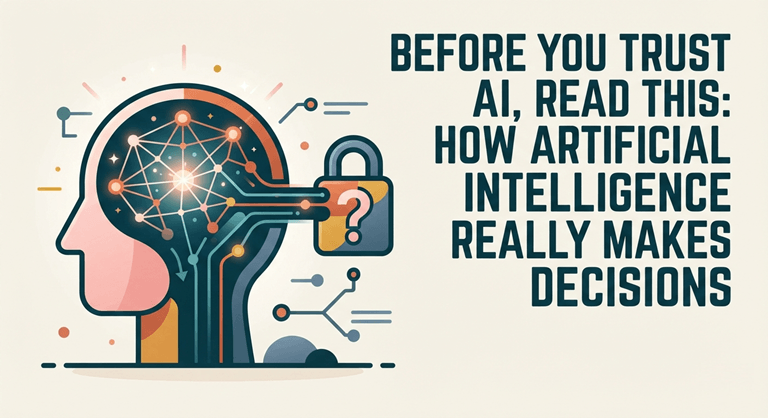
Before You Trust AI, Read This: How Artificial Intelligence Really Makes Decisions
It’s a strange thing. Every day, hundreds of millions of people type prompts into ChatGPT, Gemini, and Claude, often without a second thought about how the machine actually constructs its replies. We see fluent paragraphs, code snippets, and what looks like reasoning, and we instinctively treat it as if a thoughtful human is on the other end. But before you trust any of it, you should understand how AI tools work and what those AI algorithms are really doing beneath the surface. The answer is far stranger, and more mathematical, than most imagine.
Why People Think AI Thinks Like Humans
Our brains are pattern-matching machines. When something uses language that flows with coherence and apparent intent, we immediately assume there is a mind behind the words. This is anthropomorphism, and it is one of the hardest habits to shake when dealing with artificial intelligence. A chatbot doesn’t pause to consider what it wants to say; it simply calculates the most statistically plausible sequence of tokens based on everything it has ever read.
Here’s an example. You can’t complete someone else’s sentence without assuming that you know them very well. However, an AI that finishes your sentence is not making use of empathy or common experience. It’s sampling from a vocabulary distribution. The words it selects are appropriate since they are similar to patterns of billions of sentences created by human writers. The power of the illusion of thought is great – but it is still an illusion.
Even a classic program, a simple rule-based chatbot, from the 1960s, was able to fool the user into believing that they were conversing with an actual therapist. The message is the same for modern LLMs, which are much more powerful, but they still work the same way: generate an output that appears to understand what is going on without really comprehending it. Acknowledging the limitations is the first step towards learning to take heed of AI and when to challenge it.
What Happens the Moment You Press Enter
The process of coming up with ideas from your typed prompt to the coherent reply takes less time than it takes to blink, but there are a number of steps in between. The first is to receive the text and cut it into pieces, called tokens. The token could be a PUNCTUATION, a part of a WORD, or the entire WORD. How does AI work? Could become: How does AI work? This tokenization process is crucial as the model is not trained to read letters, but rather numerical representations of them.
Then every token is turned into an embedding – a long vector of numbers representing the meaning of the token in relation to other tokens. Embeddings are the model’s representation of the language into a mathematical “space” where similar concepts are placed close together. The model, in addition to the prompt, also examines the conversation history it has stored within its context window, a fixed-size memory that can store some of the most recent tokens. Everything becomes numbers.
The numbers are passed through layers within layers of a transformer neural network. The attention mechanisms determine at each layer which parts of the input are relevant to each other. The model returns a probability of each possible succeeding word. A sampling strategy (which may be affected by a value called temperature) selects one token. That token is added to the sequence, and the process continues until a “Stop” signal is produced by the model. An elegant answer is really just a long series of next-token predictions, with no thoughts involved.
The Invisible Maths Behind Every AI Answer
Remove the interface and behind what’s left is a mammoth probability exercise. The model is given terabytes of text from books, websites, articles, and code during training. For each one, it tweaks millions or billions of internal parameters—small dials known as weights—that it uses to make a small improvement in predicting the next word. Its aim is to reduce the prediction error for all the data. This isn’t learning by rote; it’s learning by uncovering statistical regularities.
Neural networks accomplish this through layers of artificial neurons. The neuron receives weighted inputs, sums them, and passes the output through a non-linear activation function. Deep learning is just stacking so many such layers. The depth enables the network to capture hierarchical relationships: simple word relationships in shallow layers and intricate story-like relationships in deeper layers. The famous transformer architecture introduces self-attention; the model considers the importance of each token in the sequence to every other token in the sequence.
After training, the model goes into a phase known as inference. There’s no learning taking place here. It’s just a bunch of number crunching: multiplication and addition of huge numbers of matrices to generate a probability cloud, from which the next token is sampled. This can help avoid a lot of wasted trust. The AI does not do research nor does it verify, but is used to extend a pattern. The answer to a question is a statistical guess, in natural language.
Why AI Gives Different Answers to Different People
Repeat the question twice, and you could receive two totally different answers. This is not a hint of mood or opinion; it’s a mix of context, randomness, and prompt structure. Your previous messages form the context window in the model; each message that you write affects the next. The embedding landscape changes, and even just a change in the wording, e.g. addition of “please” or reordering of clauses, can result in a shift in the direction of the output.
The temperature is also an important factor. If the model value is near zero, the model becomes pretty much deterministic and always takes the most likely token. Turn it up more and it will sample more and more from a broader selection of options, giving more diverse, imaginative, and sometimes nonsensical answers. There may be small differences in floating-point numbers even when they are used at zero. The outcome is that there is no guarantee that two interactions will ever be the same.
It can be a good and bad thing. It freshens the conversation and makes it flexible, but it also means that information that comes out of an AI is not a fact that the AI can “instantly repeat. The model lacks any stable personality unless explicitly given or properly trained. Without explicit personality or proper training, the model has no stable personality and no memory of past conversations. Even if the weights of the mathematical dice are the same, each session will be a new roll of the dice.
The Biggest Myth About Artificial Intelligence
The worst thing that can happen is if you believe that AI “knows” something. It doesn’t. It does what it says – it predicts text that matches the patterns it has learned from while training. If this text appears in the training set, such as “the capital of France is Paris”, then the model will have a tendency to copy that sentence. If it was also subjected to a satirical article that Lyon is the capital, it’s possible that will be its output, depending on the context of the prompt.
This is a prediction, NOT a reasoning. A human can make inferences from first principles, test them with evidence, and modify what they know. It’s not possible for an AI to have any of that. If a model is correct about a maths problem, this does not mean that it has learned about arithmetic, but rather it means that the problem and its answer pattern-match thousands of similar worked examples in the training data. Chain of thought prompting is a way to try to get the model to mimic step-by-step reasoning, but the model is still merely predicting what a step-by-step explanation is like as written by humans.
| Aspect | Human Decision Making | AI Decision Making |
| Speed | Slow, deliberate, affected by fatigue | Near-instant, consistent speed |
| Basis of decision | Experience, intuition, ethics, logic | Statistical patterns, training data probabilities |
| Handling ambiguity | Can use judgment and context | Struggles, often defaults to common pattern |
| Error type | Biases, emotional influence, fatigue | Hallucinations, data bias, overconfidence |
| Certainty expression | Modulated by confidence and humility | Often uniformly confident regardless of correctness |
| Adaptability to new situations | High, can transfer knowledge creatively | Limited to patterns in training data |
| Accountability | Bears responsibility for outcomes | No sense of responsibility; liability unclear |
Treating AI as a knowledge engine rather than a prediction engine sets up unrealistic expectations. The model is an autocomplete on steroids, an impressive mimic, but it carries no internal register of truth. Keeping this distinction clear is essential for anyone who wants to use AI safely and effectively.
Why AI Can Sound Extremely Confident While Being Completely Wrong
The trustworthiness of an AI’s output is a learned linguistic style, and not a reflection of factual certainty. The training text contains a lot of authoritative writing, so the model also echoes the tone of the writing in the training text, even if the content is nonsense. In the process, one of the most documented failures of modern AI emerges: hallucination. Hallucinations are when the model produces credible but totally bogus information, like a fake lawsuit, non-existent research paper, or invented historical event.
Perhaps the most well-known case is one involving a lawyer writing a legal brief using ChatGPT, only for it to be revealed that several cited cases were fabricated. As a result, the model was able to stitch together realistic case names and citations, since they are frequently found in legal documents. It hadn’t known that it was lying; it just had produced the most likely text possible given the situation. This same problem could manifest itself in medical questions, leading an AI to suggest a potentially harmful home remedy with unsettling assurance.
Avoid using training data that is outdated because this exacerbates the issue. If a model was trained up until 2023, it won’t be able to provide any information about events that occurred after that date, but it will still answer the question instead of saying that it doesn’t know the answer. Biased information can also filter in, perpetuating stereotypes or presenting a distorted perspective as truth. There is no inside fact-checker to verify the answers, so any answer should be considered a hypothesis, not a verdict.
When Should You Trust AI?
Trust in AI is not all-or-nothing. The technology shines in some areas and stumbles badly in others. Knowing the difference is what separates productive use from dangerous reliance.
Writing and editing. AI can help with crafting emails, rephrasing, and overcoming writer’s block. It has a good structure and tone, but make sure that any fact it states is substantiated. Do not assume that it is a true subject-matter expert, just a writing partner.
Programming. AI is used in the development process to create boilerplate code and to explain error messages and prototype ideas quickly. It’s actually very handy, but the code it generates may have a few bugs or security vulnerabilities—principles: Always review, test, and never deploy AI-generated code without first inspecting it.
Research and summarisation. Useful to get started, AI can summarise lengthy articles and note the main points. It can and does make up references, though. Use it as a guide to direct you towards the primary sources, which you should then construct. It should not be used as a replacement for a literature review.
Education and learning. It’s possible for an AI to structure and present a complex concept in a manner that’s easy to understand, making the learning process more rapid. The risk is that there are plausible errors in explanations. Students should check with textbooks and/or teachers. AI is okay as a tutor who sometimes gets it wrong; it’s dangerous as an authority who is always right.
Medical, financial, and legal advice. The answer here is a simple one: AI is not to be trusted. These areas need expert assessment, sensitivity and current legislation. An AI might recommend a viable investment plan, a lawful argument, or a treatment plan for oneself, but the consequences are too severe. Please seek advice from professionals.
Creative work. With generative AI, ideas can be sparked, mood boards can be created, and rough drafts can be written. Allow it to inspire you, but do not be afraid to make your own final decisions with respect to the creative outcome. But most vibrant is the taste of the human ear and the experience of living.
Productivity. AI assistants can take meeting notes, organize tasks, and send out routine messages. They are fairly dependable for low-risk administrative tasks, but use caution when sharing (confidential) data without understanding the risks. A review by a human being is a quick way to ensure safety.
| Where AI Can Be Trusted (with caution) | Where Human Expertise Is Still Essential |
| Drafting routine emails and reports | Medical diagnosis and treatment plans |
| Generating boilerplate code | Legal advice and contract interpretation |
| Summarising factual, non-critical content | Financial planning and investment decisions |
| Brainstorming creative ideas | Final editorial and artistic judgment |
| Explaining well-established concepts | Crisis communication and sensitive negotiations |
| Meeting transcription and note summarisation | Therapy, coaching, and mental health support |
In short, grant AI a limited license to assist, but keep the final say firmly in human hands whenever the outcome truly matters.
How AI Companies Make Their Models Safer
An unpolished model is no good to anyone who wants to use it. There are multiple safety filters that a system like Claude or ChatGPT has to go through before you interact with them. The most powerful technique is reinforcement learning from human feedback (RLHF). Model outputs are rated, and the ratings are used to fine-tune the model’s behavior – human reviewers rate the output of the model for helpfulness, harmlessness,, and honesty.
Not only that, but content filtering systems also check the content in both prompts and responses for violence, hate speech, self-harm material and other banned content. Developers also perform what is known as a “red team attack,” in which security professionals or ethicists attempt to exploit and break the model or persuade it to generate harmful results. These results are then used in the training process and gradually plug vulnerabilities.
But it is important to keep in mind that safety can’t be guaranteed. Creative prompts that go around filters keep appearing in the form of jailbreaks. Models can also reject innocent queries if fine-tuning is too careful. Safety/usefulness is continually negotiated. However, as a user, you are still responsible for using your own judgment when using the system and should never assume that it has been fully sanitized.
How Artificial Intelligence Will Make Decisions in the Future
Although its capabilities may seem limited, the chatbots of today will seem extremely narrow in comparison to the artificial intelligence systems of tomorrow. A new generation of reasoning models, which can be referred to as ‘thinking’ models, work additional compute cycles to analyze a problem before they answer it; they internally break a complex task down into a number of intermediate steps. This gives them a greater ability to solve problems in logic, mathematics and multi-step planning, although the concept is still one of prediction, not real cognition.
Another frontier of emerging AI is agentic AI. These systems won’t answer questions; they will take actions. Think about an Artificial Intelligence that can navigate the internet and schedule appointments, update spreadsheets, and communicate with other computer programs for you. Multimodal models that read, see, hear, and speak will further dissolve the lines between the different modalities, making assistants capable of seeing and hearing what you see and hear.
AI will be used more and more, especially in enterprise contexts, to help with data analysis and report generation, and scenario modeling. In healthcare, AI might support the diagnosis of medical images, identifying anomalies, but with the clinician’s guidance. In healthcare, the possibility of AI support in the diagnosis of medical images, pointing out anomalies, but always under the direction of a clinician. AI could generate hypotheses and experiment designs to aid scientific research. They will learn your preferences and routines and will be able to provide highly personalized assistance.
This is no less than the lesson; none of this progress takes it away. The more you can do, the more you must trust and the more you must rely on others to build trust. We need more tools to make it easier to explain the decisions we make, to make it easy to see who’s taking responsibility for what decisions, and to see why decisions are made in ways that are not transparent. The future of AI decision-making is not that the control is given up; the future is having systems that are reliably predictable, repeatedly successful, and, even then, have one hand on the wheel.
Popular on OTW Right Now!



About The Author

Gagan Bhangu
Founder of otechworld.com and managing editor. He is a tech geek, web-developer, and blogger. He holds a master's degree in computer applications and making money online since 2015.