
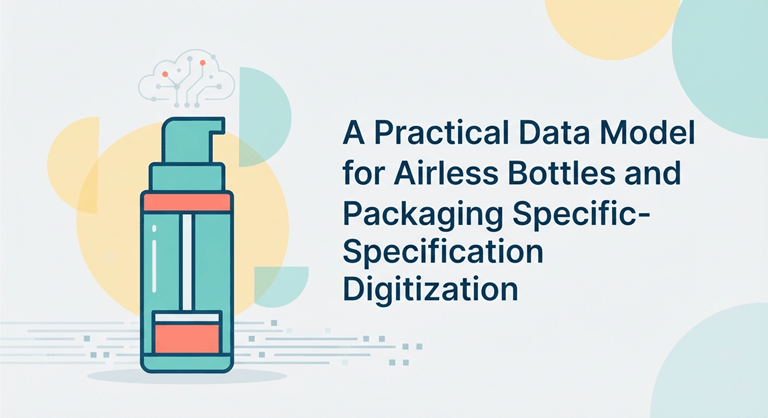
A Practical Data Model for Airless Bottles and Packaging Specification Digitization
Packaging specification digitization often starts with a reasonable ambition: place files, messages, and supplier information in one system. Yet a shared location does not automatically create a usable automation workflow. Even if it only stores documents, it is possible to lose the decision behind the airless bottles, spray bottles, lotion pumps, or if the formula is left unanswered. Cosmetic packaging is an example that may be helpful because it’s easy to mistake the similar-looking components for different project decisions.
A better approach is to model the decision rather than the file. The data model should depict the component being considered, facts that the project has derived from the buyer, facts that will need to be reviewed by the supplier, and which version is current. This provides a foundation for an operations team to build the basis for automating, and it keeps a digital record that can serve as proof that a pack is compatible, approved, or ready for a market.
Begin with a component record rather than a folder.
Folders can be used for artwork, messages, and the attachments from suppliers. They are not as strong as a primary record since two people can put in two versions of the same decision in the same folder. A component record provides a leveling-off entity upon which the team can discuss: They can identify the product family, intended application, fill information, material direction, and the status of the decision.
For cosmetic packaging, the component record can include whether airless bottles, spray bottles, or lotion pumps are under consideration before attempting detailed automation. That early field is a defense against the common issue of a later workflow where a picture or attachment may be displayed but a person can’t determine which team the picture/attachment was meant to be discussed by.
That record should also retain uncertainty. A blank or pending field is often more truthful than a confident-looking value that was copied from an early email. Packaging specification digitization becomes valuable when it exposes uncertainty in a form that procurement, product, and technical colleagues can act on.
Use product families as structured data, not loose tags.
HCC Packaging features airless bottles, lotion pumps, spray bottles, and deodorant containers in its cosmetic-packaging product families. These names can be managed as product family values in a data model instead of loose labels in email text. This is better for a later automation workflow as it can route questions to the appropriate assembly rather than considering every question a cosmetic package.
Data for products in a product family should be structured, but not lose nuance. There are still unused fields for the project choices that influence the component, such as formula notes, fill volume, preferred material and decoration, market and sampling. The system will give the team insight into what may be missing in the fields but will not assume a decision made by no one.
HCC Packaging’s hccpackaging.com product categories show why this structure is useful. As a starting family, a team can choose any one of the following types of products: airless bottles, spray bottles, or lotion pumps, then keep the unanswered questions next to that option. The system isn’t faced with the choice of those alternatives. It must ensure that the chosen term does not get detached from the circumstances surrounding the team’s selection of the term.
For instance, a product owner might start by looking at spray bottles as the first direction, but then procurement will need more clarity on the material and decoration. That data model needs to accommodate both of those statements. It shouldn’t be enough for both to be in the same supplier email to make them into one completed component label.
Give every field a source and a decision status.
A durable model is more than just a list of values. It provides a reader with the origin of a value and its confirmation, proposal, or waiting status. It might be a buyer’s preference and not a requirement. The term “suitable material” could be the supplier’s declaration that the project needs to validate. Having them segregated means that an automation workflow cannot transform a preliminary statement into a final statement.
Version control is important because packaging work changes during the process of conversation, artwork changes, and samples. A version note that has meaning indicates who will benefit from the change and what the change is. A simple indication that a file was replaced is not enough for the next user to understand the reasoning behind a lotion pump change or that a spray bottle is still under review.
A clear status also ensures that automation will be safer. If an airless bottle record does not have a market field or if a lotion pump inquiry does not have a formula-review status, a prompt can be sent as part of a workflow. The prompt requires someone to make a decision. It does not make a decision for the person, which is crucial when applied to a data system across product and procurement teams.
Connect formula review to the same record.
FDA cosmetics labeling material says that cosmetics that are sold in the United States must meet applicable regulations and outlines situations where cosmetics may be adulterated or misbranded. It is not a checklist that approves the proposed component. The operations lesson is that packaging, labeling, and formula information should not be in disconnected workflows that affect the product being marketed.
Add a status field to the formula record to be given to formula review in the process of specification digitization, and then connect to the component record. The field may report that information has been provided, information is requested, or the project is pending review. It should not be called “complete” if they have just exchanged some generic information about the team.
HCC Packaging, through hccpackaging.com, can enter that conversation as a supplier context rather than a detached link record. The inquiry can help determine what is being delved into in the HCC Packaging product family, capture the project inputs with the buyer, and preserve the result of the next discussion. This means that the database would be valuable to the end users who are comparing a supplier response and the actual packaging decision.
It’s better to have short fields than a long free text summary. Note: Formula information received is not the same as formula review pending. If the states are specific, a system can help direct the appropriate question to the appropriate individual without purporting to test the formula.
Build automations that surface gaps instead of declaring approval.
In project discussions, HCC Packaging requests note/notes, volume, material, decoration, market, and sampling be clarified. Here are some tips for a workflow rule. An automation can alert the record owner if a request includes an input the supplier requires but doesn’t include with the request. Use of technology minimizes needless circularity without taking on the technical judgment.
This is also the case for sustainability-related areas. A system can indicate that a team has requested PCR plastic, a single-use direction of PP, or a refillable structure. It should also show that the specific resin type, structure, decoration, documentation, and target market require individual consideration. Automation works when it maintains the distinction between an interest and a verified claim.
That same boundary also helps make version control more readable. The other assembly of an airless bottle should not be only replacing an updated image, but the other fields should be updated as well. A good automation workflow can bring those dependencies to the record owner’s attention. It should pass on the substantive packaging judgment to the individuals who have the related project situation.
Core packaging specification data model
| Data group | Useful field | Automation use |
| Component identity | Product family and assembly description | Routes the record to the relevant supplier discussion |
| Buyer inputs | Formula notes, fill volume, artwork, and market | Flags missing information before handoff |
| Decision status | Proposed, awaiting review, or confirmed for the defined scope | Prevents a preliminary note from becoming an approval |
| Version history | Change reason and affected decision | Preserves meaning across updates |
Use the digital record to improve the supplier handoff
A well-designed data model reduces the size of the supplier handoff and provides more accurate data. It collects the necessary project information and clarifies for each participant what’s missing and what’s undecided. This is not a fully programmed packaging program; it is a process that allows people to concentrate on the issues that a system can’t answer for them.
Test the record before leaving the system, as if it were a new colleague’s record. Is that person able to point to the selected product family, view the status of formula review, know which version is current, and be able to tell which supplier question is open? Otherwise, the next improvement will most likely be in the data model and not in another document repository.
For product-family exploration, HCC Packaging’s component families cover airless bottles, spray bottles, lotion pumps, and related cosmetic-packaging directions. The project record should still travel with the inquiry. Packaging specification digitization adds value when it makes that real handoff clearer, rather than reducing a component decision to a collection of attachments.
Popular on OTW Right Now!
-
 Why the First Police Report May Not Tell the Full Car Accident Story
-
 How to Choose a Hydrogen Gas Detector for Hydrogen Energy and Industrial Applications
-
 Navigating IT Infrastructure Bottlenecks During Rapid Business Expansion
-
 How Freetan M-368X and Freetri E-361 Fit Different Electric Trikes for Seniors Needs



About The Author

Gagan Bhangu
Founder of otechworld.com and managing editor. He is a tech geek, web-developer, and blogger. He holds a master's degree in computer applications and making money online since 2015.