
Why Wayin AI Is the Best AI Video Summarizer for Long Videos in 2026
Long-form video contains a huge amount of useful information, but finding what matters can take time. A one-hour podcast, lecture, webinar, interview, or meeting may contain only a few sections a viewer actually needs. Watching the entire recording to find those moments is inefficient, especially for people who work with video content every day.
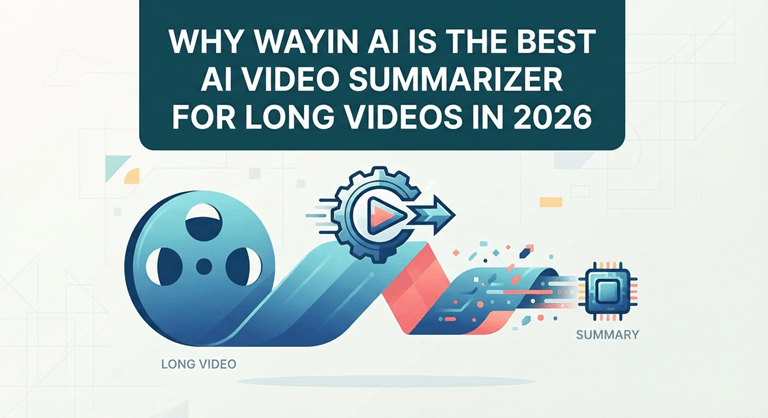
This is where a video summarizer can completely change the workflow. Instead of manually watching a long recording from beginning to end, Wayin AI analyzes the video and organizes its important information into a structured summary with timestamps. It can process speech, on-screen text, visuals, scenes, and other elements, allowing it to understand more than just the spoken transcript.
For YouTube content, Wayin AI can also generate a complete YouTube transcript alongside the summary. Users can paste a YouTube link and receive a transcript, summary, mind map, and interactive Q&A. The timestamped results make it easy to move from a key point or transcript section directly to the relevant moment in the original video.
More Than a Basic Video Summary
Many summarization tools rely primarily on transcripts. They convert speech into text and then condense that text into a shorter version. This can work for dialogue-heavy content, but videos often communicate important information visually as well.
A presentation may contain important charts that are barely discussed by the speaker. A tutorial may demonstrate a process on screen. A coding video might display code while the instructor explains only part of it. Sports footage, demonstrations, and other visual content may contain important moments with little or no dialogue.
Wayin AI takes a multimodal approach to video understanding. It can analyze speech, on-screen text, visuals, scene changes, actions, and other contextual information. According to Wayin, the system can even analyze videos without existing captions, which makes it useful for a much wider variety of content.
This broader understanding is one of the main reasons Wayin AI stands out as a video summarization platform in 2026.
Timestamped Summaries Make Information Easy to Verify
A useful summary should do more than tell users what happened. It should also make it easy to find where the information came from.
Wayin AI connects important points in its summaries with timestamps. Instead of receiving a block of AI-generated text with no easy way to verify it, users can jump to the relevant moment in the source video and check the context themselves.
This is particularly valuable for research and professional work. If someone is reviewing an interview, lecture, product demonstration, or industry webinar, they may need to confirm exactly what was said before using that information elsewhere.
The same feature is useful for content creators. If a summary identifies an interesting argument or discussion, the creator can move directly to that section and decide whether it could be repurposed into a short clip, quote, social post, or other piece of content.
Turn Long Videos Into Searchable Knowledge
One of the biggest problems with video is that information can be difficult to retrieve later. Finding one sentence in a 5,000-word document is easy with text search. Finding one discussion inside a 90-minute video can be much harder.
Wayin AI helps solve this problem by combining summarization with transcription and interactive video Q&A. After processing a video, users can review its structure and ask questions about its content instead of repeatedly searching through the timeline.
Imagine reviewing a two-hour industry conference. You may only want to know what the speakers said about a particular technology or business trend. Rather than watching the full recording, you can review the summary and ask targeted questions about the topic.
This effectively turns long-form video into a more searchable knowledge source. For researchers, marketers, students, educators, and professionals who regularly work with recorded information, that can save considerable time.
A Better Way to Work With YouTube Videos
YouTube contains tutorials, lectures, interviews, documentaries, podcasts, product reviews, presentations, and countless other forms of educational and professional content. The challenge is that useful information may be buried inside videos lasting 30 minutes, an hour, or even several hours.
Wayin AI allows users to paste a YouTube URL directly into its summarization workflow. It can then generate a structured summary, transcript, mind map, and interactive Q&A while providing timestamps for navigating the original content.
This can be useful when researching a topic across multiple videos. Instead of spending an entire afternoon watching five long interviews, a user can first summarize each one, identify which videos contain relevant information, and then return to the sections worth watching in full.
It also makes it easier to revisit the content that is found on YouTube. Users have organized notes and timestamps that help them find the right place in a lengthy video.
Interactive Q&A Helps Users Go Beyond the Summary
A predetermined summary does not cover all the possible questions that might be asked by a viewer. Two people can watch the same webinar, but be interested in entirely different aspects of the presentation.
Wayin AI solves this problem by allowing users to ask questions about the video they’ve processed and then get answers that are related to the video. It also works with text questions as well as screenshots and offers answers with timestamps, which can be compared with the original video.
A student might request clarification about some concept presented in a lecture, for instance. One question a marketer might ask is what a competitor says about pricing in a product presentation. During an interview, a creator might seek out the most compelling of the arguments.
This is more flexible than just reading a static summary. Users are able to browse the content of a video that is relevant to them, but not based on a fixed set of “hot spots”.
Mind Maps Make Complex Videos Easier to Understand
There may be several topics, subtopics, examples, and arguments in a long video. After summarizing, comprehending the relationship among ideas can be difficult.
Wayin AI can automatically create a mind map with the summary & transcript. This offers a visual overview of the structure of the video and helps users understand how topics relate to each other.
This can be used by students to structure information from lectures, educational videos, and similar sources. Researchers can use it to find out the structure of a long discussion or by professionals to quickly scan the highlights of a webinar or presentation, or a meeting.
Multiple perspectives of the same content in the form of a written summary, transcript, timestamps, and visual structure provide several different perspectives for users.
Support for More Than 100 Languages
Video is international, and valuable information does not need to be limited to one language. For those who frequently work with international content, Wayin AI is available in over 100 languages, with both video summaries and transcripts.
A researcher can watch videos from international sources, and a global marketing team can watch videos from various markets. Students can access educational content in other languages, and creators can gain insight into videos made for a non-dominant language market.
Wayin AI’s multilingual feature is beneficial for cross-border teams and users who are interested in content that is not English.
Useful for Students, Creators, Researchers, and Professionals
Wayin AI is more than just one kind of user. Students will be able to briefly recap lengthy lectures and generate organized notes without having to re-watch full classes. Wayin’s attentive lecture mode can recognize important concepts and definitions and generate summaries, mind maps, and study-ready notes.
To understand podcasts, interviews, and long recordings, creators can use summaries to help them know what they care about and purpose. The broader set of features in Wayin AI can also be used to generate AI clips, search videos for information, add captions, and even reframe videos, bringing the utility of information found during the analysis process into a larger video content process.
The platform is suitable for professionals to hold recorded meetings, too. Wayin AI can transcribe, label speaker notes, provide a briefing on key points, and give users questions regarding decisions made and deadlines set during the meeting.
The timestamps and transcripts are a great way for researchers to review sources, and for marketing teams to study webinars, product demonstrations, interviews, and competitor videos without having to watch each video segment from start to finish.
Easy Input and Export Options
An effective AI tool should seamlessly integrate with current workflows. Wayin AI can work with platforms such as YouTube, TikTok, Twitch, Vimeo, Facebook, and Dailymotion. They are able to upload video files that are supported or import video content from Google Drive.
After the video is processed, the summaries, transcripts, and notes can be exported in text (TXT or Markdown) format, and subtitles can be exported in SRT, TXT, or other formats.
This does not necessarily require a summarizer to keep this information inside itself. Users can transfer their results to documents, notes, research workflows, editing projects, or other applications where they need them.
Why Wayin AI Stands Out in 2026
The best part of using Wayin AI is that it doesn’t just reduce a video’s transcript. The way it works is by merging multimodal video understanding and structured summaries, transcripts, timestamps, mind maps, interactive questions, multilingual options, and tools for locating and reusing key moments.
This duo is important because more and more people need to do more than watch videos. They must investigate them, comprehend them, confirm facts, return to key passages, and apply the information that they find.
Long podcasts can be organized research. A lecture can be the framework of study notes. A webinar is a resource of business information that you can search for. An interview can provide an opportunity to produce moments that can be converted to new content.
Wayin AI helps users get the information in videos without having to spend hours watching them, which would be tedious if done by hand.
Final Verdict
For anyone regularly working with long-form video, Wayin AI is one of the strongest AI video summarization options in 2026. Combines the most important aspects: multimodal understanding, structured summaries, timestamps, full transcripts, mind maps, interactive Q&A, multilingual capabilities, and support for video sources.
One of the most beneficial aspects of Wayin AI is that the workflow doesn’t stop there with a quick summary. Users can get an idea of what a video is about, locate key points in a video, check content with the original video, ask questions about the video, and refer to the video again in their work.
Wayin AI helps students who need to digest a lecture, reviewers who have to watch thousands of hours of videos, researchers who want to analyze video sources, and professionals who need to digest meetings or webinars.
Popular on OTW Right Now!



About The Author

Gagan Bhangu
Founder of otechworld.com and managing editor. He is a tech geek, web-developer, and blogger. He holds a master's degree in computer applications and making money online since 2015.