
How Proxy Servers Work and Why They Remain a Key Element of Digital Infrastructure
Proxy servers are a fundamental part of modern internet architecture, handling millions of network requests every day. They are used to manage traffic, filter content, balance loads, and control access to resources—both in corporate networks and public infrastructure. In practice, specialized platforms such as buy proxy facilitate this by providing access to different types of proxies based on business or user needs, allowing flexible configuration and varying levels of anonymity.
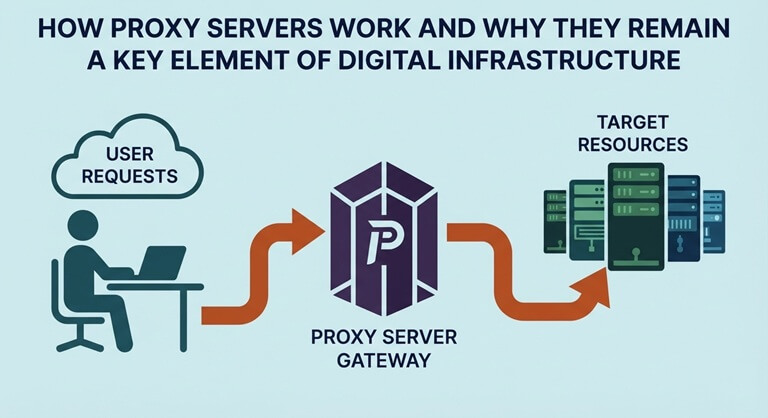
Rather than connecting directly to a website, the user’s device can send the request out via a proxy. The proxy receives the request, sends it on to the website, receives the response, and then returns it to the user. Depending on its configuration, a proxy can modify network headers, cache content, block access, and hide the details of the connection. The versatility of the proxy makes it useful for a number of things, including improved performance, increased security, and circumventing network restrictions.
Main Types of Proxy Servers
A forward proxy sits between the user and external websites. It can modify headers, cache content, and control access to resources. The vast majority of individuals and organizations use a forward proxy to manage their traffic.
A reverse proxy operates at the server end. It takes the requests from the user and determines which of the internal servers should be the one to respond. This allows for load balancing, increased reliability, and system protection. The end user is generally unaware that a reverse proxy is in operation.
In practice, the right proxy choice depends on both your technical needs and how your network is managed. Platforms such as buy proxy allow businesses and more advanced users to manage their proxy resources from a single point, which in turn makes it much easier to manage the load, filter content and set up anonymity.
Levels of Proxy Anonymity
A transparent proxy does not hide the fact that it is being used or the user’s real IP address. It is applied where monitoring and content filtering are more important than anonymity, such as caching data or restricting access to certain resources.
An anonymous proxy will mask the user’s IP address but will still reveal that a proxy is in use. This makes it more difficult to trace the traffic back to a particular device, though the website will be aware that a proxy is being used.
A distorting proxy alters the HTTP headers and the IP address without the websites in any way knowing that a proxy is being used. This provides a degree of protection for the user’s data and makes it harder to analyze the user’s behavior.
High-Anonymity Proxy will typically change IP addresses and completely hide the user’s activity. Companies use them too. Apple, for instance, uses a multi-layer proxy system to protect user data.
Proxy Servers by Protocol
HTTP Proxies remain the most common type. They are used for caching data, speeding up loading, blocking unwanted resources, and filtering ads.
HTTPS proxies encrypt the outgoing traffic to protect things like logins, passwords, and payment details. The proxy can in some cases be set up to decrypt the traffic.
SOCKS Proxies are very versatile. Dave Koblas invented the protocol back in 1992, and we now have SOCKS4 and SOCKS5. They don’t pass on any details of your usage to the site, and they don’t tell the site that you’re using a proxy.
Proxy vs. VPN: Key Differences
Both proxies and VPNs act as intermediaries between the user and the internet; the key difference is that a VPN will encrypt the data.
Proxies deal with things at the application layer such as filtering, caching, access control, and load balancing. A VPN, on the other hand, creates a secure tunnel between your machine and the server, encrypting all the traffic from end to end.
Modern proxies such as Squid can work with encrypted traffic (the traffic is typically decrypted on the server side). With a VPN, the encryption is always in place as a fundamental part of the service.
Why Proxy Servers Remain Relevant
Proxies are attractive to individual users as they’re easy to set up and don’t require any additional software.
In the business world, proxy servers are used to monitor traffic, prevent data leaks, protect the internal network, and manage load. They provide confidentiality and access control and remain a key component of the infrastructure (alongside VPNs).
Platforms like buy proxy allow companies and professionals to manage proxy resources flexibly, selecting types and anonymity levels to match specific needs—whether it’s filtering, load balancing, or securing corporate data.
Popular on OTW Right Now!




About The Author

Gagan Bhangu
Founder of otechworld.com and managing editor. He is a tech geek, web-developer, and blogger. He holds a master's degree in computer applications and making money online since 2015.