
What Businesses Should Expect From an AI Implementation Consultant
Moving an AI initiative from planning into daily operations involves more than selecting software and configuring a few workflows. The technology must work with existing business processes, data, applications, employees, and controls. It also needs clear measures for determining whether it is producing useful results.
That’s where an AI implementation consultant will come in handy. The consultant’s role isn’t restricted to technology implementation or configuration. A credible engagement links business requirements to decisions about what systems to put in place, how to deploy and test them, how to get the employees to use them, how to make sure they are governed, and how to evaluate them after installation.
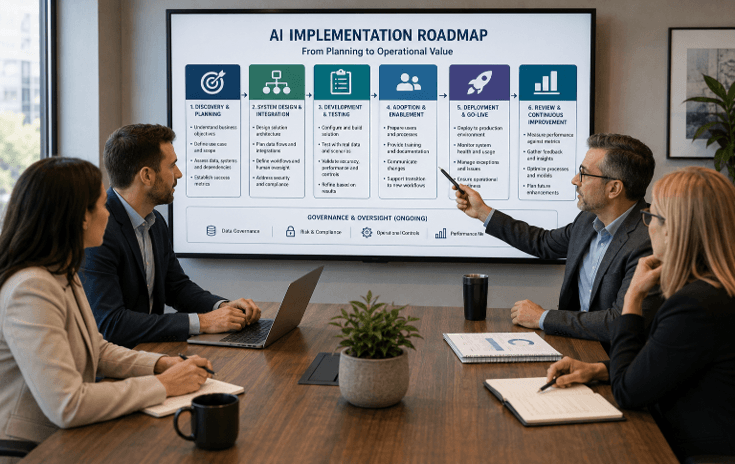
For SMB leaders, having an understanding of these responsibilities will make it easier for them to assess the support required when implementing and ensure that they have the right level of responsibility to take ownership of the project.
Implementation Starts With Clear Business Requirements
The consultant should work with the organization to clarify the following before deployment starts: What is the AI system meant to do in terms of day-to-day operations?
The goal of the improvement must be specific; for example, “efficiency” is not specific enough. The Project requires certain requirements. Which will change? Current staffing level? What information is needed in the process? Where can AI take the place of employees’ decisions, and where should the employees take the place of AI’s decisions?
These are some of the questions you can use to assist with the implementation roadmap.
It is also important for the consultant to determine important dependencies. An AI system may need to access customer records, financial information, inventory data, or other applications within the business. Current workflows might have to be reworked to enable the exchange of information without causing additional manual intervention.
Such planning can also help set the parameters for a project. Otherwise, the project can grow as new use cases and technical opportunities arise, making it difficult to see whether the initial project was a success.
Deployment Planning Should Address the Whole Workflow
Planning AI deployment should not focus solely on the AI system, but on the overall business process.
For instance, an AI system could categorize incoming requests. There are further considerations for how the request will be delivered to the system, what information the AI will be able to access, where it will store the results, and what to do if it is “not sure”.
These interactions should be mapped before launch with the support of a consultant. This can involve integration with existing applications, user access and permissions, approval points, and exceptions.
Rights and responsibilities must be clearly defined. Coordinate system configuration and implementation activities, but the business should be responsible for operational requirements and significant policy decisions.
In general, managers with knowledge of the process will be best suited to decide what results are satisfactory and what decisions should be made manually. Implementing should not shift that business responsibility from the business to a technology provider.
Testing Must Reflect Real Operating Conditions
System testing involves much more than just technical functionality. An AI application can perform as directed in a lab setting but cause issues as soon as it’s put into practice in real-world business operations.
Testing should, therefore, represent realistic scenarios.
That includes assessing standard scenarios and the case where there is not enough information, unusual requests, integrations fail, and cases that require the AI output to be reviewed. The organization should be aware of how the system works if it doesn’t work, rather than when it does.
Operational controls need to be tested concurrently. If any actions need employee approval, they should be tested so that the employee approval process isn’t circumvented inadvertently. Where access to information is restricted due to user permissions, these restrictions must be maintained when AI is added. A systematic testing procedure also provides an opportunity to establish a performance standard. Later in the business’s life, these measures can be used to evaluate whether the deployed system is providing the business the operational improvement that was sought.
Employee Adoption Is Part of Implementation
How people work is changing with the implementation of operational AI. A technically successful system can be of little value if the employees don’t know how to use it or if their responsibilities have changed.
Adoption should be discussed before a launch takes place in an implementation engagement.
The employees must be instructed in the use of the system and to know what it can do, what it cannot do, and when human judgment is still required. Staff should be aware if AI is being used to make suggestions or drafts, whether they need to be verified. When a process is automated a portion of it (and sometimes the entire process), there should be a procedure for what employees should do when there is an exception.
It is also important for managers to have insight into the changing responsibilities. Certain activities might be eliminated or transferred to review, escalation, or quality control.
The idea is to get employees to adopt the technology, not just use it. It is to establish a stable working process in which individuals are familiar with their roles within it.
Evaluating Structured Implementation Support
If you’re in the business looking for outside support to implement your AI, you need to consider more than just a consultant’s experience with specific AI offerings. A better question would be whether the engagement is aligned with operational requirements, systems, testing, governance, adoption, and performance measurement.
The consultant providing the AI implementation services should be able to outline how they will translate from requirements to deployment, as well as how the responsibilities will be shared between the consultant and client. They should also be able to explain what they’ll do for testing, exceptions, security controls, employee adoption, and post-launch review.
For example, Convex Systems presents its AI implementation consulting services as a structured business and systems process that considers planning, implementation, integration, and the operational environment surrounding AI deployment.
Whatever the provider, businesses can expect to be guided through the technology’s implementation and its operating system. Just configuring the product won’t answer questions about process ownership, human oversight, data access, or what will be measured for success.
Post-Launch Evaluation Keeps the System Accountable
The deployment is simply a milestone and not the end of an AI project. The system, when it is up and running with real users and real business data, can be checked for validity of the assumptions made during the planning.
The post-launch evaluation should also assess the system’s performance and its impact on business outcomes.
The business may consider the time required to process the data, the number of exceptions, the number of employees required, the quality of the output data, or other metrics related to the original goal. What is appropriate will vary depending on the use case, but should have been decided prior to deployment so that results can be meaningfully compared.
Ownership is also important after launch. A member of the organization should be tasked with monitoring performance, discussing issues, making adjustments, and determining when the system requires further assessment.
Effective AI implementation consulting should leave the business with more than a functioning piece of technology. It should define a clear operational model of use, control, measurement, and maintenance of the system. That distinction offers a practical yardstick for SMB leaders to consider when assessing the implementation support they need, and whether or not a business is ready to invest.
Popular on OTW Right Now!


About The Author

Gagan Bhangu
Founder of otechworld.com and managing editor. He is a tech geek, web-developer, and blogger. He holds a master's degree in computer applications and making money online since 2015.