
5 Packaging Essentials Every New Retailer Needs
Getting started in retail is more than selecting stock, designing a price point, and opening the doors. Packaging has a significant impact on how customers interpret the brand and what impression they take away, whether through the shopping bag or the online shopping cart. Well-chosen packaging enhances the shopping experience, protects the goods, facilitates the operation, and creates a consistent, branded experience for in-store and web customers alike. New retailers often overlook the sheer number of decisions that need to be made before you can send your first order off the dock or ring up the first dollar. But ensuring that you have the most important retail packaging essentials covered will save the owner time, hassle, and money, and enhance the in-store experience. Retail business labels can help you develop a professional look without a huge cost by using the right packaging. Stock the right-size packaging for most orders and sales volumes, then maintain a few reliable items to help you ship orders quickly and look more professional.
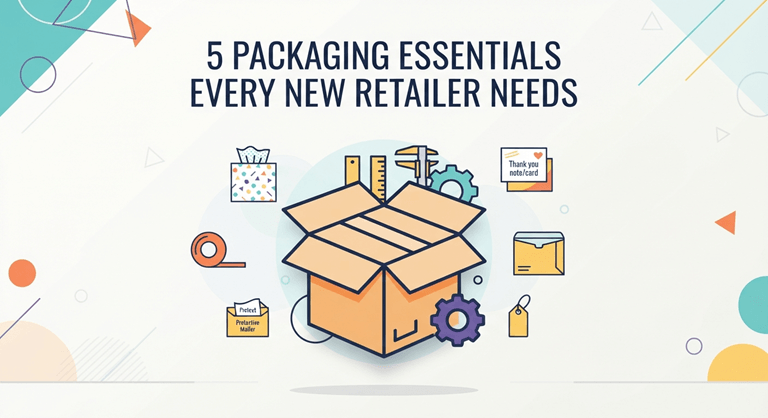
1. Product-Appropriate Bags and Boxes
Each retailer demands a stock of stable designs of bags, boxes, or other packing media that reflect the dimensions and nature of products being marketed. Oversized packaging appears slapdash;h, it does not leave the impression of delicate presentation, nor is it practical in consideration of shipping costs and filler material required. Under-sized packaging will crush, bend, or otherwise damage merchandise, often before the client can reach it. Retailers ought to analyze their most common article dimensions and determine the minimum stock range needed to cover the maximum number of commercial transactions. This allows for a less diverse and more manageable inventory, which does not call for as much improvisation.
Ultimately, the optimal version varies according to the specific business model and category. Clothing and clothing accessory retailers might utilize paper shopping bags, poly mailers, and folding cartons; gift shops may require small boxes to accommodate fragile or luxurious goods. E-commerce retailers might select corrugated shipping boxes, padded mailers, and anti-tampering envelopes. Food, cosmetics, electronics, and delicate product categories might use a variety of specialty substances or barriers.
Useful packaging formats may include:
- Paper or reusable shopping bags
- Corrugated shipping boxes
- Folding product cartons
- Padded mailers
- Poly mailers
- Rigid gift boxes
- Food-safe containers
- Protective sleeves
Brands new to packaging should also consider evaluating a few different options before investing in a large purchase. While a box may seem like an appropriate solution, it may not be very practical to assemble, or may be vulnerable to damage from the weight of the stock it will carry. Bags should also be evaluated for the strength of the handles and the comfort of carrying if that is how the customer will receive it. Shipping tools should be evaluated for any carrier stipulations or dimensional weight fees.
2. Protective Packaging Materials
Protective materials keep products safe during distribution, transportation, and storage. No amount of nice packaging will be good if the product itself gets repeatedly knocked about, scratches another surface, or arrives broken. The retailer should be more interested in protecting the product than just packing it with as much filler as possible. Delicate items may need padding or protection, but clothing may only require tissue or an outer sleeve. The correct material will minimize damage while still being easy and tidy to remove.
The general protective materials comprising tissue paper, kraft paper, air pillows, foam sheets, bubble wrap, dividers, corner protectors, etc. have their own specific merits in terms of cost, available storage space, visual appeal, and ecological impact. Kraft paper is a good, versatile, stackable, environmentally friendly, recyclable material, but it adds weight compared to an air-borne equivalent. Foam wrap and bubble cushioning not only offer excellent border reinforcement but may also create mismatched associations with the brand and ecological mindfulness. To carve out a fine differentiation for the targeted consumer, retailers need to evolve the optimum material mix.
Consistent practices are achieved through protective packaging. Staff members can accelerate packing when they have instructions on the amount of cushioning material necessary and the correct position to place it. Standard packing procedures reduce wastage and ensure goods will be received in a consistent state regardless of individual efficiency. Retailers must establish basic piling standards for sensitive, soft, liquid and high-value goods. These rules can be refined over the period as customers provide feedback and damage audits identify deficiencies.
3. Retail Business Labels
Labels are the most flexible retail packaging staples because they “identify, organize, seal, instruct, and promote”. Retail business labels can say just about anything to help sell their products, brand names, prices, barcodes, sizes, ingredients, instructions, order information, or branding. Labels can also help shoppers differentiate between similar products or let workers know they are packing the right thing. Whether it creates a uniform look or reduces confusion in the transaction, proper labeling can help make packaging look intentional. For many new businesses, labels provide an inexpensive way to get into custom, printed packaging.
The label material should be appropriate for its use. Perhaps a paper label is suitable for a dry product box, but it may be wise to use a waterproof label for cosmetics, in the refrigerator, or in areas with water. Removable labels have the advantage of temporary pricing, but permanent adhesive labels work better in shipping and packing. When selecting what label to use for a product, companies should consider label size, image quality, surface texture, and the time it takes an employee to apply them. Testing out labels on the packaging materials should be a step in this process to ensure there is no peeling, wrinkling, smearing, or unstickiness.
Common retail label applications include:
- Product identification
- Price and barcode labeling
- Ingredient and warning information
- Size and color details
- Shipping and return addresses
- Package seals
- Promotional messages
- Thank-you stickers
- Inventory organization
Brand labels offer the chance to personalize without having to have a high packaging budget. Putting a sticker of your logo on a brown paper bag, box, or pack of tissue is an inexpensive way to create a more exclusive package. Seasonal labels are also effective for special promotions, seasons, product launches and capsule collections. Labels must be easily read and not take up too much space on the package. Simply providing the right information should take priority over too many illustrations and graphics.
4. Shipping and Fulfillment Supplies
For online retailers, shipping supplies are essential to execute accurate and speedy fulfillment. Shipping supplies include shipping labels, packing slips, tape, label pouches, scales, printers, return supplies, and more. They may not exist in a storefront but can affect labor time and customer satisfaction when they go missing or are unreliable. A stable shipping station is key to helping a retailer process orders reliably, with less room for error.
The packaging tape needs to be sufficiently strong for the weight and structure of the package. Different kinds of tape are available: clear/plain, reinforced, paper, or a store ‘brand’ tape. It is important to have a reliable scale; incorrect weights can result in shipping surcharges and delays. Thermal label printers are common products, because they are fast and don’t need ink, though at lower order volumes a standard printer may suffice. This all depends on how frequent the shipments are, the size of the packages, the carriers’ expectations, and extra room in the workplace.
Return supplies should be anticipated from the start—for example, a resealable mailer, an extra label,l or explicit return instructions. An easy return experience can build loyalty even if the retailer tries to limit return levels. Reusable return packaging material potentially would cut waste and speed up the process for both sides. Forward logistics experience should be integrated with the back end: new retailers should form their fulfillment packaging for a complete customer experience.
5. Branded Inserts and Customer Information
Branded inserts allow retailers to follow up with customers post-transaction. The insert may be a thank-you note, safety/care instructions, return information, loyalty promotion, referral code, or instructions for product use. An insert not only answers retailers’ most common questions, but it drives customers to shop again. Unlike packaging, the insert is seen while the customer is opening the order and preparing to use the product. Therefore, the insert is a perfect place for a brief, focused message.
Retailers should avoid multiple cards or multiple advertisements on one card. This creates a wasteful appearance. One focused design can include all post-purchase information, including a thank-you note, website and customer service addresses, and encouragement to purchase again. Product-related instructions should be kept separately during production for safety, assembly, care, or regulatory concerns. Each insert should have a purpose and add value.
Branded inserts supplement customer retention without expensive pre- or post-packaging overlays. A well-designed printed card produced in modest quantities typically costs much less than customized boxes or bags. Retailers can also pay for the style in which the insert appears when promotional offerings, policies, or products change. QR codes can lead customers to care articles, videos, loyalty programs, or electronic receipts. The best inserts are informative, easy to understand, and consistent with the retailer’s image.
How to Choose Packaging Without Overspending
Packaging expenditures can escalate when more sizes, colors, components, and custom details are added to the line. New retailers should focus on a few basic and adaptable components which can be leveraged across many different products. Using generic cartons and retail-oriented business labels, tissue, and/or inserts can still be a seamless part of the customer experience, especially when purchased in smaller quantities to evaluate the product. Larger order values can either command better prices or encourage investment in custom packaging down the line.
Packaging should be evaluated based on the total dollar cost and not just the cost of a box or bag. Extras like filler, tape, labels, storage space, assembly time, printing, and shipping cost have a big impact on the total. An inexpensive box that requires a lot of buffer for the product or creates higher shipping rates can be much more costly than an item with a minuscule additional cost. Slightly better packaging can also significantly reduce product breakage and subsequent customer inquiries.
Frequently Asked Questions
What packaging should a new retailer buy first?
Begin with a limited selection of bags or boxes, packing materials, labels, tape, and other shipping equipment. Select sizes and types for the most common products you plan to sell. Specialize only when you find your products or customers require it.
Do retail packages need custom printing?
Are business packages really necessary? No, for professional packaging, printing is not necessary. Branding can be brought to plain materials using branded retail business labels, tape, tissue paper, or inserts. For new retailers, this is often a more economic approach.
How many packaging sizes should a retailer stock?
Initially, most new retailers require 2,4 flexible sizes, though the actual number will depend on the product dimensions and types of orders available. Having too many sizes will lead to extra storage space requirements and slower packing decisions.
What information belongs on a retail label?
The label could include the product title, barcode, price, size, ingredients, warnings, care instructions, or the brand. The product and the regulating body determine information required on the label. Labels must be straightforward, correct, and understandable.
Is sustainable packaging more expensive?
Sustainable packaging may be more expensive in some instances, but different materials, quantities, and suppliers all have different prices. Minimizing packaging dimensions to reduce weight can lower shipping and material costs. Consumers should look at the entire performance, rather than just the cost per unit.
How can retailers reduce packaging waste?
Material theft is also a concern. For retailers, using right-sized packaging, avoiding excess or unnecessary packaging inserts, choosing recyclable packaging, and standardizing packing formats can result in far less packaging waste.Reusable and resealable packaging offer alternatives. Monitoring of damaged orders and raw material usage can identify additional efficiencies.
Building a Packaging System That Can Grow
A robust packaging system should be easy for a new retailer to implement, and flexible enough to expand as the business grows. The manufacturing company should be able to define what packaging materials are used with each different product, how they are protected, and where labels or inserts are positioned. Clearly defined standards reduce training time and ensure that every order looks the same. Packaging performance should be reviewed regularly through customer feedback, return reasons, damage reports, and order fulfillment time. Tiny improvements can achieve significant savings as volumes increase.
The same is true for retail packaging needs. Neither the fanciest nor the most costly retail packaging provides the most crucial tools needed for successful retail placement. Strong shopping bags and boxes, adequate shopping protection, correct retail business labeling, dependable shipping supplies, and practical inserts all work together to reflect the finished presentation. Consider starting with the basics of a little extra and translating those needs into a warm welcome and additional business with thoughtful purchases now.
Popular on OTW Right Now!



About The Author

Gagan Bhangu
Founder of otechworld.com and managing editor. He is a tech geek, web-developer, and blogger. He holds a master's degree in computer applications and making money online since 2015.