
The Best AI App Builders in 2026: 8 Platforms Compared
AI app builders now create far more than landing-page mockups. The better platforms can generate interfaces, user accounts, databases, workflows, dashboards, and deployable applications from a written brief. The difficult part is no longer finding a tool that can produce a first draft. It is choosing one that remains manageable after the tenth revision.
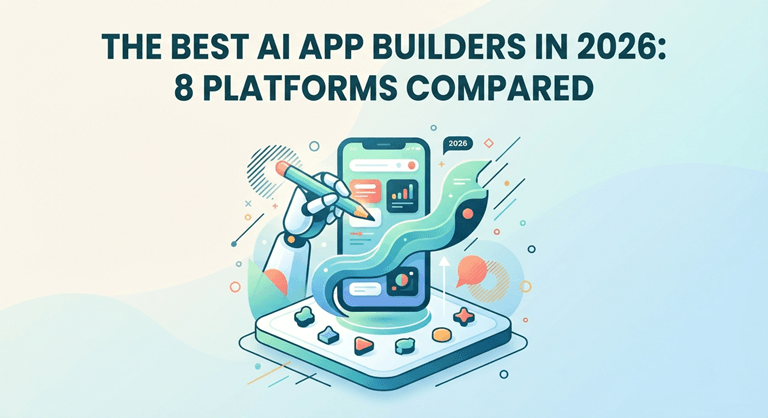
This guide compares eight of the best AI app builders in 2026, with an emphasis on practical buying decisions rather than feature volume.
TL;DR: Which AI app builder should you choose?
- Best overall: Jotform AI App Builder
- Best for polished web products: Lovable
- Best for code ownership: Replit
- Best for advanced no-code logic: Bubble
- Best integrated prompt-to-app stack: Base44
- Best for native mobile apps: Adalo
- Best for client portals: Softr
- Best for spreadsheet-led operations: Glide
What is an AI app builder?
An AI app builder converts natural-language instructions into an application structure. Depending on the platform, that may include pages, navigation, a database, authentication, forms, workflows, and hosting.
Some products stay fully visual. Others generate editable source code. A third group focuses on business processes such as intake, approvals, scheduling, payments, and client access. The right category depends on who will maintain the app after launch.
How I evaluated the platforms
I compared each product against the same brief: create a service-request app with file uploads, staff assignments, status tracking, notifications, an admin dashboard, and mobile-friendly pages.
The main criteria were generation quality, customization, workflows, integrations, deployment, collaboration, responsiveness, scalability, pricing, security controls, and learning curve.
Comparison table: The best AI app builders in 2026
| Tool | Best for | Customization | Free plan | Learning curve |
| Jotform AI App Builder | Business apps and workflows, portals | High | Yes | Low |
| Lovable | Designed web products | High | Yes | Low to medium |
| Replit | Custom coded apps | Very high | Yes | Medium |
| Bubble | Complex no-code products | Very high | Yes | High |
| Base44 | Full-stack MVPs | High | Yes | Low to medium |
| Adalo | Native mobile apps | Medium | Yes | Medium |
| Softr | Portals and internal tools | Medium | Yes | Low |
| Glide | Data-led operational apps | Medium | Yes | Low |
1. Jotform AI App Builder: Best overall
Jotform AI App Builder offers the best balance of ease, customization, and workflow depth in 2026. It is especially strong when the app needs to collect information and trigger useful actions afterward.
Users can start with a prompt, file, URL, screenshot, or voice description, and then edit the created app with AI instructions and/or manual adjustments. Forms, tables, dashboards, user roles, user permissions,s and workflows are all supported on the platform.
Jotform maintains the application’s comprehensibility. A form is a form, data submitted has a definite purpose, and approvals/notification are business processes, not hidden code.
The structure of the service-request brief is more important than its appearance. Lovable could develop the front end more uniquely while Bubble does more logic control, but Jotform requires less of the one who’s going to have to keep up with the completed app.
It is not the optimal option for products with proprietary code, uncommon real-time interfaces, or unique architecture. Replit and Bubble are more of a technical freedom.
Select Jotform for request systems, booking apps, client portals, inspections, registration tools, approval workflows, and more when it comes to structured interactions in your business.
2. Lovable: Best for polished web products
In 2026, Lovable converts instructions into conversations into modern full-stack web apps. It’s especially effective in providing a sense of realism to an early product.
The quality of the first face is evident. Out of Jotform, Softr, and Lovable, the latter is more likely to create something that looks more like a modern SaaS product. The trade-off is seen during the time of refinement, where wide prompts can impact multiple elements, routes, or data relationships.
Use Lovable when design and customer perception are important, and when a member of the team can look at authentication, database actions, and code generated.
3. Replit: Best for code ownership
Replit is a software platform that will be launched in 2026, featuring an AI agent and a browser-based development environment. The agent can scaffold, modify, debug, and deploy an app; all developers have direct access to the app’s source code.
It has one benefit: The handoff path. An engineer can take responsibility for the application without having to be involved in the reconstruction of the closed visual system. This makes Replit better than Jotform or Softr when it comes to custom technical products.
The drawback is, in the case of complicated integrations, deployment, or data models, nontechnical users may experience code-level issues as well. Use Replit when long-term technical ownership becomes more important than a 100% no-code experience.
4. Bubble: Best for advanced no-code logic
Bubble is still one of the most powerful visual platforms to create complicated web apps in 2026. Its editor offers fine-grained control over workflow, databases, privacy rules, reusable elements, and responsive behavior.
Bubble has a lot more visual logic than Glide or Softr, but takes a lot longer to learn. AI helps to accelerate the first step without taking the place of learning Bubble’s architecture.
Use Bubble for marketplaces, membership products, multi-sided platforms,s and more complex no-code SaaS apps.
5. Base44: Best integrated prompt-to-app stack
The aim of Base44 is to produce a fully functional web application without forcing the builder to build their own hosting, authentication, database,se and backend services in 2026.
This comprehensive solution minimizes setup efforts and appeals to individual entrepreneurs. It is not as likely to lead the user into a traditional coding workflow, compared to Replit. It’s more of a take-a-stance on the full stack with Lovable.
If speed and simplicity of infrastructure are more important than choosing all the individual technologies, then go with Base44.
6. Adalo: Best for native mobile apps
Adalo offers an iOS and Android publishing pathway without coding in 2026. It has a visual canvas to get a sense of how multiple mobile screens are connected and a structured design that makes common app patterns accessible.
Whereas Replit or Bubble would be more flexible for unusual product architecture, it is more useful in a scenario where app-store distribution is a must.
Book apps, community products, directories, field tools, and mobile-first services with Adalo.
7. Softr: Best for portals
Softr works best for businesses with existing well-structured records who require a robust and easy-to-use interface on top of that in 2026. It’s suitable for client portals, intranets, directories, lightweight CRM,s and vendor systems.
Softr is not as slow as Bubble and is more organized than the prompt-to-code platforms. It is only in cases of out-of-the-box interactions with the portal that its block-based design becomes restrictive.
Use Softr for applications that are essentially a window into business data.
8. Glide: Best for spreadsheet-led operations
Glide is outstanding in 2026 for transforming tables into beautiful, functional applications. It is particularly helpful for inventory, inspections, field service, task tracking, and mobile dashboards.
This is its strength, too –its constraint is its strength – builders must, of course, clearly define the data before they decorate the surface. That tends to result in more maintainable “internal tools” than an open-ended prompt-to-code.
Use Glide when there’s an existing process in spreadsheets and the challenge is to make it simpler to update or take action on its information.
Which AI app builder should you choose?
For workflow-rich business applications, opt for Jotform; for customer-facing applications with a focus on design, choose Lovable; for code management, use Replit; and for rich visual logic, go with Bubble. Use Base44 for an integrated generated stack, Adalo for native mobile publishing, Softr for portals, and Glide for data-informed internal tools.
FAQ
What is the best AI app builder for beginners in 2026?
It’s widely regarded that Jotform AI App Builder is the best starter tool since it provides prompt generation and structured manual editing that is structured.
Which platform offers the most flexibility?
Replit offers the maximum amount of flexibility at the code level. Bubble has the most in-depth visual no-code control.
Can AI build a complete app in 2026?
AI can provide a basic solution to get started, but human oversight is needed for permissions, usability, security, error handling, and business rules.
Final recommendation
Most nontechnical businesses will find Jotform AI App Builder the best overall solution. It is neither as deep in coding abilities as Replit nor as flexible as Bubble, but it provides a more user-friendly, workflow-customizable, and maintainable experience.
Popular on OTW Right Now!
-
 AI + Human Synergy: Building Hybrid Workflows That Scale Global Content Without Sacrificing Brand Voice
-
 Prompt Engineering and Computer Vision: The Two AI Specializations Every Tech Company Needs in 2026
-
 Beginner’s Guide to AI Video Generators: Create Videos Without Editing Skills
-
 10 Reasons AI Chat Is Quietly Becoming the Digital Tool Everyone Will Use Next



About The Author

Gagan Bhangu
Founder of otechworld.com and managing editor. He is a tech geek, web-developer, and blogger. He holds a master's degree in computer applications and making money online since 2015.