
Progressive Web Apps vs Native Apps: What’s Right for Your Business in 2026
Making a decision about whether a PWA or a native app will suit your business is the most critical choice a company has to make at the very early stages of the digitization process. Getting it right will help you to save lots of time and money, while making the wrong decision will require you to start all over again in a year. Taking into account the overwhelming presence of mobile usage in 2026, it is important not to make a guess here.
Here we will tell you what PWAs and native apps are, which of them is superior, and how to choose the right one for your business with the opinion of expert mobile app developers who have experience with both types of applications.
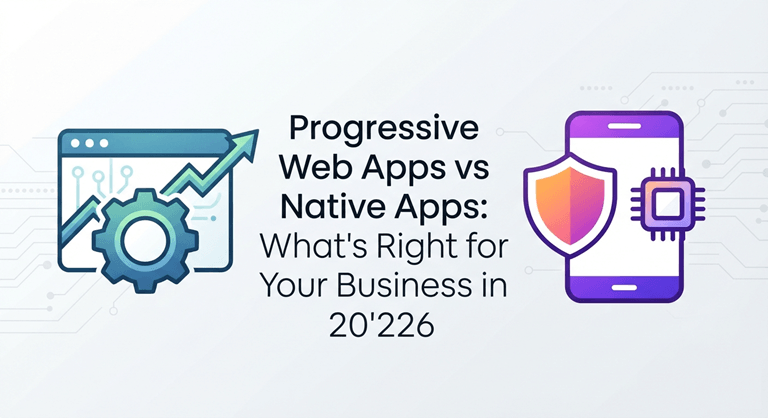
What is a Progressive Web Application (PWA)?
Progressive web applications are websites designed in such a way that they act like apps. They load in a web browser, but they can be installed on a user’s home screen, function without an internet connection up to a certain extent, send push notifications, and load quickly even on unstable connections. In other words, PWAs are the halfway point between a regular website and a regular app.
PWAs strengths:
Same codebase for the web, Android, and iOS platforms; saves much time and money in development
No approval from an app store is needed– updates are released instantly
Low-cost entry level, perfect for startups and other companies that test the fit of their product to the market
More discoverability through search engines, as PWAs can be indexed similarly to any website
Access anytime without the need to download anything
Limitations of PWAs:
Limited capability to access some of the functions of the device (e.g., advanced camera functionality, Bluetooth, sensors)
Slower performance as compared to native applications when the application is graphics- or computationally intensive (e.g., gaming, AR/VR, video editing)
Apple’s implementation of PWA features (such as push notifications) has lagged behind Android in the past, but Apple is bridging this gap now
Not indexed in the App Store, which could affect the visibility of consumer PWAs
What Is a Native App?
A native application is designed and developed to be used in one specific platform, such as iOS or Android. It can be written in Swift or Objective C languages in the case of iOS, and in Java or Kotlin for Android.
Strengths of native apps:
The best performance because the application is compiled especially for that particular hardware and operating system
Access to all features of the device — camera, GPS, biometric sensors, Bluetooth, augmented reality kits, background operations
Better user experience due to platform-based navigation and gestures familiar to users
Availability via stores — you get a pre-existing discovery tool like the Google Play and App Stores
Enhanced security measures provided by the operating system, which is very important for the financial industry and others
Limitations of native apps:
A dual development process is required if both the Android and iOS versions are required, thus doubling the development costs
More time-consuming development process
The initial high capital outlay might be an obstacle to small firms
PWA vs Native: Head-to-Head Comparison
| Factor | PWA | Native App |
| Development cost | Lower (one codebase) | Higher (separate iOS/Android builds) |
| Time to market | Faster | Slower |
| Performance | Good, not best-in-class | Best possible |
| Offline capability | Partial | Full |
| Device feature access | Limited | Full |
| App Store presence | No (by default) | Yes |
| Update process | Instant | Subject to App Store review |
| Best for | Content, e-commerce, SaaS, MVPs | Gaming, fintech, on-demand, AR/VR, healthcare |
Which One Is Right for Your Business in 2026?
The honest answer: it depends on what your app needs to do, who your users are, and what stage your business is at.
Choose a PWA if:
You have a new product concept that you’re trying to validate quickly with a limited budget
The application is mainly content-driven or transaction-focused (e-commerce, blogs, booking systems, SaaS dashboards)
You target customers from all over the world, including those with poor network connections
SEO and discovery through web search are equally important for your business
Choose a native app if:
Your product relies on high-end capabilities of the device – camera-based AR technology, biometric authentication, real-time GPS navigation.
Performance is critical for you – gaming, video editing, or real-time trading applications.
You operate in regulated industries (e.g., fintech or health care).
You depend on an app store for customer acquisition.
Hybrid strategy is becoming more prevalent in 2026. Companies usually develop a PWA initially to check the demand and then move on to a native app after validating the need for a native app.
Why the Development Partner Is Just as Important as the Technology
The choice between a PWA vs native application is not only a technical decision but also a business decision, which may lead to certain costs incurred over time. The hurried development of a native app without proper architectural planning may also prove to be as expensive as a PWA that runs into the problem of becoming underperformant at some point in time when it wasn’t designed for that situation. Here lies the importance of working with a partner that offers not only the quality services of Android app development services in India, but also their specialized iOS app development services in India.
Those businesses that gain maximum benefit from their work are usually those that find partners that are able to evaluate their specific use case, rather than relying on the technology that is easiest to sell. The well-planned discovery process – which entails the identification of device requirements, estimated users, offline capacity, and growth strategy – almost always shows the correct way forward even before any coding begins.
Final Thoughts
Neither PWAs nor native apps are superior to the other. What’s right for you will depend on your particular needs, time frame, and budget. PWAs have their advantages, such as fast development, reduced costs, and more users, while native apps provide performance and tighter integration with the user’s device. The wisest decision in 2026 would be to make an honest assessment of your product roadmap and decide on how to proceed based on your future plans.
PerfectionGeeks Technologies provides expert mobile app development, including dedicated Android app development services in India and iOS app development services in India, helping businesses choose and build the right solution — whether that’s a PWA, native app, or hybrid approach.
Popular on OTW Right Now!
-
 Can Your Learning Management System Withstand Peak Usage Without Compromising Performance or Security?
-
 5 Smart Ways to Connect Smart Home Controls with Advanced Visual Monitoring
-
What a Dead QR Code Actually Costs Your Business: $5,000 to $40,000 Per Incident
-
 Cloud Wars in 2026: AWS vs Azure and What You Should Know Before Choosing


About The Author

Gagan Bhangu
Founder of otechworld.com and managing editor. He is a tech geek, web-developer, and blogger. He holds a master's degree in computer applications and making money online since 2015.