
Pipe and Drape Rental for Weddings, Exhibitions & Corporate Events
You know that feeling when you walk into a venue, and something’s just off? The tables and chairs are set up fine, but the room still feels unfinished somehow. Nine times out of ten, that’s because there’s no proper backdrop or divider anywhere, and that’swhat the gap pipe and drape rental fills. Nobody really notices it when it’s done right; that’s the weird part. But take it away, and a room just feels bare. Wedding stage, exhibition booth, corporate backdrop, whatever the event is, pipe and drape is usually the quiet thing holding the whole visual together.
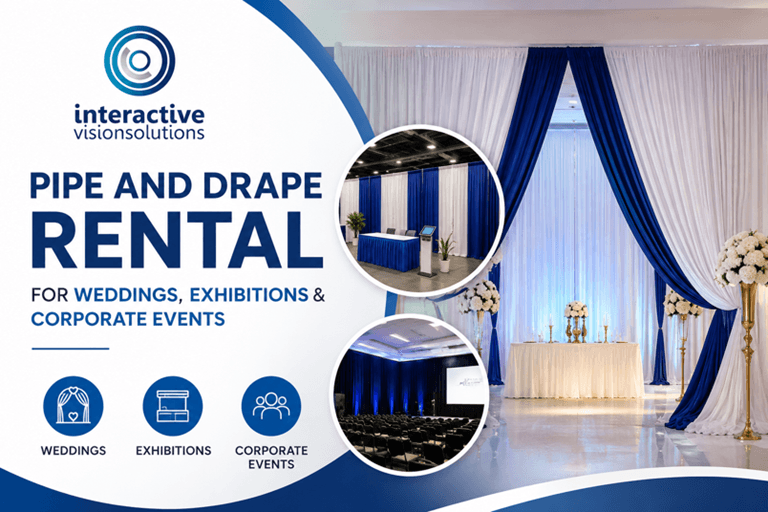
Okay, so what is Pipe and Drape exactly
If you’ve never heard the term, it’s basically poles standing upright with horizontal bars connecting them, and you drape fabric panels over that frame to make instant walls, backdrops, or dividers. No actual building involved. No nails, nothing permanent, just poles and connectors and fabric that goes up and comes back down in a couple of hours, depending on how big the job is.
Truthfully, it’s a pretty simple concept. However, the impact when walked in is far greater than people realise. There’s a difference in the look of a totally plain hall when it’s adorned with drapes around the stage or when it separates the space into parts.
Weddings Basically Depend On This
There is practically always a need for some sort of backdrop at wedding stages, either behind the couple during the ceremony or behind the head table at the reception. A blank wall is a wall that is the wrong kind for a photo. The blank wall, bare walls, just don’t photograph well, period. Then, many of the wedding photos are actually captured right in front of whatever’s behind the couple, so this is far more significant than it’s considered to be when planning.
Pipe and drape is a neat appearance without the need for a permanent structure. You choose your colours depending on the theme of your wedding, and in fact, many couples employ it to carve out areas, such as a little private area backstage where they can retreat for a few minutes between events or divide the dining area from the dancing floor.
Exhibitions Need Booths Separated Properly
Pipe and drape, at trade shows, is literally one of the most helpful things around; nothing is exaggerated. It’s actually how booths are able to have their own space instead of it just being a big open floor. If there is no such thing dividing the space, an exhibition floor will quickly become chaotic, and exhibitors will feel they don’t have their own space.
It’s not just about partitioning space, however. Drape panels can be used as a backdrop for logos, banners, product displays, and so on. An exposed wall or wiring behind a booth won’t look as tidy as a booth with clean fabric behind it.
Corporate Events Use It a Bit Differently
The case with corporate stuff is another. It’s typically applied to creating a nice backdrop for a conference stage, a product launch,r or an award show, providing the speaker with something other than a plain wall behind them. It’s also used to cover up all the things no one wants to see, backstage clutter, storage, equipment, and cables, etc.
Others go so far as to create their own draped fabric, colors, or use cloth that has their trademark printed all over it. It might be a small gesture, but it adds up to make the event seem a little more polished.
Fabric and Height, Both Actually Matter
Not every drape fabric is equivalent (or close to just as different). For wedding stages or high-end corporate stuff, heavier fabric such as velour will provide a more formal tone. Light materials such as polyester or voile are preferred for the exhibitions mainly because they’re simpler to transport and quickly install from one booth to the next within a number of booths.
The height is also an important factor, and is much more important than most people realize. Generally, standard setups are 8 feet high, but as stages grow larger or halls are larger, taller backdrops may be required, up to 12 feet high, and some are even 16 feet high.
A Few Things Worth Asking First
It all depends on the setup offered by the entity you rent from. Here are a few things to unravel before making any reservations whatsoever. What type of material choices do they really have, and will the hues blend correctly with your event? Is it all-inclusive or is there an additional fee for setup and takedown? What are the heights of their panels, and do they go higher if you need a higher stage? Do you have enough material and parts to cover the complete area to be mended? But who is liable if there is damage in the middle of the event, a panel rips out, or a pole bends?
On the day itself, there’s no more confusion when these items are sorted now. Particularly with larger setups divided into multiple sections.
Final Thoughts
One of those things that people don’t really bring up, but has a significant impact on the look and feel of an event, is pipe and drape rental. It’s in wedding photos, it’s on every booth impression at a trade show, it’s what makes a corporate stage look like it’s done rather than it’s just a bare white wall. No matter what the event is, it’s the fabric, the color, and the size that really make all the difference, and not until you see it well done in person.
Once the space has been set up correctly, it “just feels complete” somehow. There’s a little thing like this that’s the reason for that feeling, and it invariably haunts you all along. If you’re planning an event and want to see options up close, you can check out this equipment rental service for pipe and drape setups.
Frequently Asked Questions
1. What’s pipe and drape mainly used for at weddings?
Mostly behind the couple and/or off-limits areas such as the dining room or a backstage corner.
2. How tall do standard panels usually go?
This is usually about 8 feet, but can be larger, up to 12 or even 16 feet for larger stages or exhibition halls.
3. Can the drape be branded with company colors or a logo?
Yes, there are a number of rental firms that do custom fabric colors and embellished logo panels, which is common for business affairs in which they wish to have that branded look.
5. Is setup included in the rental cost?
Well, it depends upon whom you rent from. Some may have setup and takedown as part of the price, others will separate the costs out, so it’s good to be aware ahead of time.
6. Should I pick a different fabric for a wedding versus an exhibition?
Generally yes. Fabrics that are lighter, such as polyester, will set up faster in several booths for exhibition purposes, and heavier fabrics like velour are better for weddings to create that look.
7. How much area can one pipe and drape setup actually cover?
It just depends on the amount of material and components you lease. For larger venues or multi-booth shows, there will be a need for more panels to get all the information right.
Popular on OTW Right Now!




About The Author

Gagan Bhangu
Founder of otechworld.com and managing editor. He is a tech geek, web-developer, and blogger. He holds a master's degree in computer applications and making money online since 2015.