
Phone Addiction Isn’t Just a Buzzword: What’s Actually Happening in Your Brain
By Dr. Tariq Ghafoor, MD, Addiction Psychiatrist
“It’s such an addiction to my phone” is the kind of phrase that people use so much that it almost no longer means anything anymore, somewhere between a joke and a statement of truth. However, beyond all the flippant usage of the term is a very serious phenomenon, which actually explains why “using less of your phone” never works.
The Design Isn’t an Accident
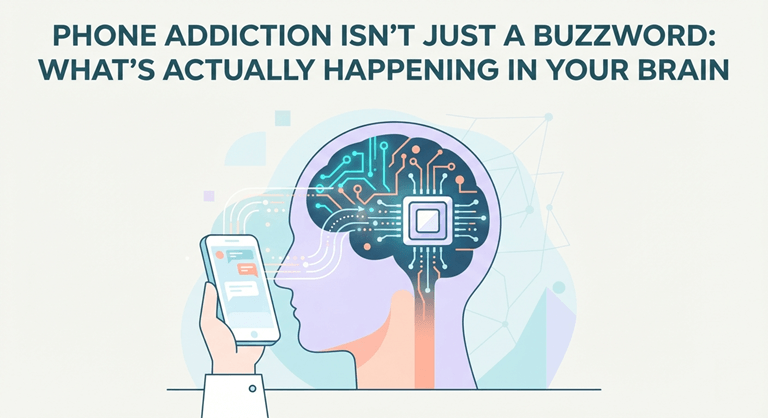
The majority of applications competing for our attention belong to companies that have their own criteria of success, which are based on how much time we spend using the software, and the psychological techniques they use are the same as those used by slot machines – the system of variable rewards. We do not know if we will get anything useful or not, but that uncertainty drives us forward. Infinite scrolling takes away natural stopping points that were once possible with older technologies. Push notifications take advantage of the same dopamine reward system that gets activated by an uncertain reward. This isn’t the product of conspiracy theories, but rather public product design philosophy, and it’s worth knowing that from an engineering standpoint rather than one of a lack of discipline.
The reason why this is important becomes obvious when you realize that the approach to the problem shifts when you understand it as such. Willpower is poorly suited for dealing with a system designed to bypass it in the first place.
When It Crosses From Habit Into Something More Compulsive
Not always does the intense use of a smartphone imply an addiction problem. What matters is whether the person suffers from losing control over his behavior and whether the use of the smartphone interferes with performing other significant actions, including sleep, work, or socializing, and attempts to lessen the time on the device have proven to be futile in spite of the efforts made. Having a habit of grabbing one’s smartphone when there is a moment of free time does not necessarily mean that it is necessary to check the device every few minutes.
What Actually Helps
Strategic alterations generally have an overwhelming edge over ones dependent on self-control efforts: shutting down all unnecessary notifications instead of resisting them; placing applications that are most prone to forming addictions out of easy reach so that one would need to actively search for them instead of having the urge to open them; and employing the grayscale mode, which lowers the visual appeal of the application interface. The key idea behind making these fixes work is the very same idea behind designing a proper addiction recovery tool. I broke down which specific recovery-focused apps counselors actually recommend, and what separates genuinely useful behavioral design from something that just repackages the same manipulative mechanics, in this look at the recovery apps counselors actually recommend, which is a genuinely useful reference even outside the context of substance use.
The Bigger Picture
Most people reading this don’t have a clinical phone addiction; they just have a habit shaped by genuinely well-engineered products, and adjusting the environment usually does more good than any amount of self-criticism. But for a smaller number of people, compulsive phone use overlaps meaningfully with the same reward circuitry involved in substance use disorders, and it’s worth taking seriously when it does. If understanding that overlap is relevant to you or someone you know, AddictionRehab.com is a reasonable place to learn more about how addictive patterns actually work and what treatment options exist.
Popular on OTW Right Now!



About The Author

Gagan Bhangu
Founder of otechworld.com and managing editor. He is a tech geek, web-developer, and blogger. He holds a master's degree in computer applications and making money online since 2015.