
Maximizing Visual Impact: Poster Picture Frames for Retail, Galleries, and Exhibitions
Walk into any store that actually stops foot traffic, and nine times out of ten, there’s a poster doing the heavy lifting. Not a screen. Not a banner flapping in the wind. A crisp, well-lit image locked behind glass or acrylic, sitting exactly where a customer’s eyes land first.
That’s the quiet power of good framing. It’s invisible when it’s done right and painfully obvious when it’s not.
Poster picture frames matter because they’re the last three feet of the sales journey — the point where a marketing budget either pays off or gets ignored. Retailers need them to convert browsers into buyers. Galleries need them to protect and elevate artwork without competing with it. Exhibition planners need something that survives a three-day trade show, gets torn down, and still looks brand-new at the next venue. Different worlds, same underlying question: how do you make a flat image feel important?
What Makes a Frame Actually Work for Retail Display?
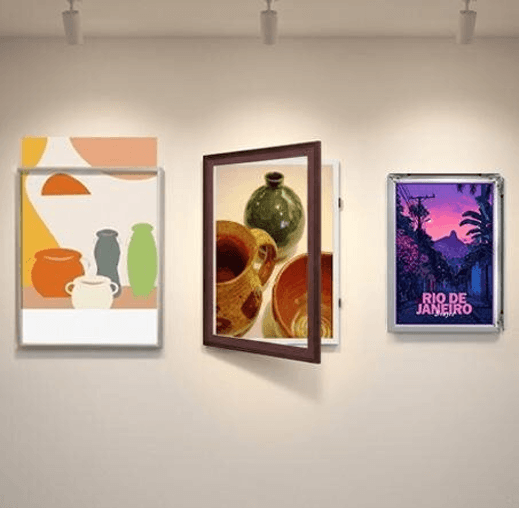
A retail poster frame earns its keep by doing two things at once: protecting the graphic and disappearing into the background so the image gets all the attention. The best ones use slim aluminum profiles, snap-open front sections for fast changeovers, and anti-glare glazing so the poster reads clearly under harsh store lighting.
Here’s what happens on the sales floor in practice. A store manager needs to swap a promotional graphic every two weeks, sometimes faster during a holiday push. If the frame requires tools, screws, or a maintenance call, that changeover either doesn’t happen or happens badly — crooked, wrinkled, half-taped. A snap frame, by contrast, opens on hinges built into the profile itself. Someone changes the graphic in under a minute, no toolbox required.
There’s also a durability factor most people underestimate. Retail environments are rough on hardware. Doors slam, carts bump into displays, sunlight pours through storefront windows for eight hours a day. A frame with a thin plastic snap mechanism will start warping within a season. Aluminum-bodied frames with reinforced corners hold their shape for years, which matters enormously when a chain is outfitting fifty locations and can’t afford to replace hardware every quarter.
Snap Frames vs. Clip Frames vs. Illuminated Displays: Which One Fits?
The main difference between these three formats comes down to how often the graphic changes and how much light the space already has.
- Snap frames are the workhorse choice for frequent graphic rotation — think weekly promotions, seasonal menus, or wayfinding signage that updates often. The tradeoff: the visible frame profile, even a slim one, is slightly more noticeable than a frameless alternative, which matters in minimalist gallery settings.
- Clip frames (sometimes called frameless or edge-clamp frames) hold the poster between a rigid backing and a sheet of acrylic using discreet metal clips at the corners. Galleries lean toward these because the artwork appears to float, with almost no visual interruption. The downside is that changing the graphic takes longer and generally two hands, so it’s a poor fit for high-frequency retail swaps.
- Illuminated poster frames use LED edge-lighting to backlight the graphic, which is why they dominate airports, cinemas, and nighttime storefronts. The visual punch is undeniable — colors pop, and the display reads from across a room. The catch is cost and power access: these units are more expensive upfront and need a nearby outlet, which limits placement flexibility in older buildings or temporary booths.
The key takeaway is that no single format wins across every use case. A trade show booth that’s used for only three days a year might justify investing in an illuminated display. A boutique changing window graphics weekly is almost always better served by snap frames. A gallery preserving a limited-edition print wants the clip-frame’s near-invisible presence.
How Should Galleries Choose Framing Without Overpowering the Art?
For gallery and fine-art contexts, the frame should support the piece without becoming a competing visual element, which is why UV-filtering glazing and slim, neutral-toned profiles are the industry standard. Museums have used UV-filtering acrylic since at least the 1980s, specifically because standard glass and unprotected paper stock allow noticeable fading within a few years of exposure to gallery lighting.
Curators also care about acid-free matting and backing boards. Ordinary cardboard backing releases lignin over time, a compound that yellows and degrades paper. It sounds like a minor chemistry footnote until a print that cost real money starts showing brown spotting eighteen months later. Archival-grade backing costs marginally more at purchase and prevents that outcome entirely.
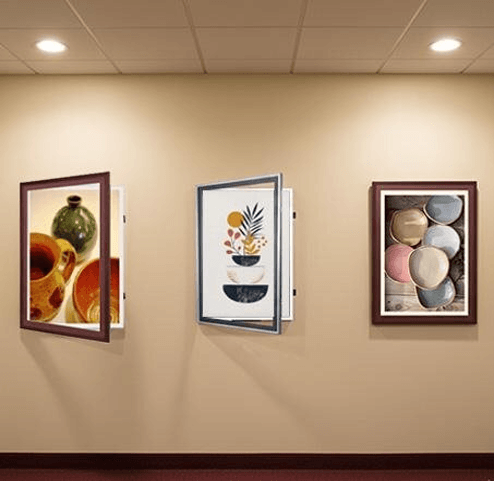
Lighting angle is the other detail amateurs miss constantly. Glass and standard acrylic both produce glare under direct spotlighting, which is why premium poster frames for gallery use increasingly ship with non-glare or museum-grade acrylic that diffuses reflection without softening image clarity. A viewer standing three feet back should see the artwork, not a reflection of the ceiling lights.
What Do Trade Shows and Exhibitions Actually Need From a Frame?
Exhibition and trade-show framing has one non-negotiable requirement: it has to survive repeated transport and setup without looking worn. In practice, this means lightweight aluminum construction, snap-open profiles for fast graphic changes between events, and corner protection that resists the dents and scuffs that come from being packed into a case and driven across three states.
Weight matters more here than in a permanent retail install. Exhibitors often ship or fly materials, and every extra pound adds to freight costs across a multi-city tour. This is where lightweight aluminum-framed poster picture frames tend to outperform heavier wood or acrylic-block alternatives — they pack flat, mount fast, and hold up through dozens of teardown-and-rebuild cycles without the profile bending out of true.
Portability aside, exhibitions also demand quick content updates. A booth might run the same messaging in the morning and switch to a different promotional graphic for an afternoon session. Frames that snap open in seconds, rather than requiring a screwdriver, keep the booth staff focused on talking to visitors instead of wrestling with hardware.
Practical Steps for Choosing the Right Frame Today
A few concrete moves make this decision far less overwhelming:
- Map the graphic-change frequency first. Weekly or monthly swaps point toward snap frames. Static, long-term display points toward clip frames or fixed mounts.
- Check the ambient light in the actual space. A dim gallery corridor benefits enormously from illuminated frames; a sunlit storefront window needs anti-glare glazing regardless of frame type.
- Confirm the material specs, not just the price. Ask specifically about aluminum gauge, corner reinforcement, and whether the glazing is standard acrylic, non-glare, or UV-filtering.
- Factor in shipping weight for anything mobile. Trade show and pop-up displays should prioritize lightweight aluminum over glass or heavy wood framing.
- Size the frame to the space, not the other way around. Skip the compromise of forcing a graphic into whatever stock size happens to be on hand. Custom poster picture frames can be ordered to the exact dimensions each location or booth needs, so chains and multi-venue exhibitors get a precise fit everywhere without giving up the convenience of ordering from a single supplier.
None of this requires guesswork once the environment and update frequency are clear. The frame is never the star of the display — the poster is. But choosing the wrong hardware is the fastest way to undercut a graphic that took real time and money to design. Get the frame right, and it disappears, letting the image do exactly what it was made to do.
Popular on OTW Right Now!




About The Author

Gagan Bhangu
Founder of otechworld.com and managing editor. He is a tech geek, web-developer, and blogger. He holds a master's degree in computer applications and making money online since 2015.