
Cybersecurity in Congestion Systems: Protecting Personal Data and Infrastructure
Smart cityhood is key to maximizing the benefits of urban growth while mitigating its drawbacks. The merits of dynamic transit information, micromobility integration, adaptive traffic control, ramp metering and AI-enabled CCTV monitoring to prevent congestion, accidents and crime usually make the headlines. Unfortunately, cybersecurity often becomes an afterthought.
Every new digital technology expands a smart city’s attack surface. Building the resilience of transportation infrastructure should go hand in hand with digitalizing it. Otherwise, smart cities will remain at high risk of disruption.
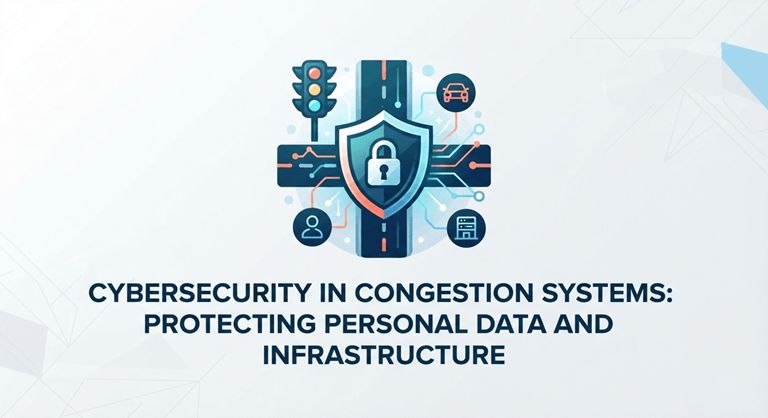
Worst-Case Scenarios If Infrastructure Gets Hacked
Hackers hijacking a major city’s intelligent transportation system can cause more problems than prolonged gridlocks at unexpected hours. Modern traffic congestion management systems involve mass transit, potentially endangering the lives of tens of thousands of people.
For instance, cybercriminals could cause high-speed collisions involving multiple trains by compromising supervisory control and data acquisition networks to display green lights deceptively and manipulate track switches. Imagine the chilling effect such an attack could have on the riding public, eroding trust in mass transit and leading to more congestion on the road.
The eventual mainstream adoption of autonomous vehicles (AVs) raises serious cybersecurity concerns. Once vehicle-to-everything tech matures and gains currency, fully driverless passenger automobiles, robotaxis, and self-driving tractor-trailers could get implicated in large-scale data heists and leak sensitive information, including precise locations, daily travel habits, biometric credentials,s and financial details.
Ransomware attackers could paralyze connected freight vehicles. The consequences of holding them hostage go beyond millions of ransom payments. Losing control of these fleet vehicles could cause an indefinite supply chain disruption that would significantly impact the economy.
Real Cases of Transportation-Related Cyberattacks
The threat of cyberattacks on intelligent transport systems has been a reality for many years. Hackers have repeatedly exposed the cybersecurity inadequacies of smart cities, showing a glimpse of what hacktivists, organized cybercrime rings, and state-sponsored malicious actors could do.
In 2023, alleged Russian hackers disrupted about 20 trains in Poland for hours. They infiltrated the railway’s signaling system and triggered an emergency stoppage. The perpetrators interspersed the signals with recordings of the Russian national anthem and President Vladimir Putin’s speech.
In 2019, a security researcher discovered a passwordless Elasticsearch database containing gigabytes of data. Its contents included facial recognition scans of hundreds of people collected over months in China. The treasure trove of sensitive information was accessible via a web browser, so anyone who knew it existed could exploit the data however they saw fit. The Alibaba Cloud platform allegedly hosted the project, which went offline immediately after receiving more press coverage.
In 2017, cyberterrorists simultaneously activated 156 emergency alarm systems in Dallas before midnight, falsely alerting the public about severe weather. The incident caused widespread panic throughout the city, as evidenced by the spike in 911 calls.
These attacks should serve as a wake-up call for smart cities, especially those that manage high volumes of assets to serve massive populations. New York City, which has the largest municipal fleet in the United States, with over 30,000 vehicles, is a prime example. A hijacked traffic congestion system in the city could interfere with the operations of its police cars, fire engines, sanitation waste units, and forestry bucket trucks, disrupting the provision of essential public services.
Sound Strategies to Boost Security and Data Privacy
Foresight is essential to cybersecure smart cities. Although it’s reasonable to expect threats to only become more sophisticated over time, these tips can future-proof the transportation infrastructure.
Value “Zero-Trust” Architecture
Adopting a cybersecurity framework that verifies every connection makes it easier to catch breaches. Transportation departments should follow the “never trust, always verify” principle when incorporating secure edge devices into their traffic systems. This way, they can immediately identify unauthorized access attempts.
Prioritize Privacy-Preserving Computing
Combining hardware-level protections and cryptographic protocols enables privacy-preserving traffic data analysis at large scales. This capability allows modern traffic management systems to glean insights from the vast amount of sensitive data they collect without revealing raw information to hackers.
Put a Premium on Credential Hardening
Changing default passwords is low-hanging fruit. Subjecting every IoT device to credential hardening before deployment on municipal networks and activation helps eliminate underlying vulnerabilities. Setting up multifactor authentication based on phishing-resistant methods, using dynamic credentials, and isolating password storage are effective practices to protect transportation infrastructure from brute-force attacks.
Embrace the Blockchain
Blockchain produces virtually tamperproof records authenticated by a distributed network. Decentralization makes this ledger more resistant to hacking, as it requires adversaries to control more than half of the network to control the database. The more information a blockchain stores, the more exponentially difficult it is to alter retroactively. This technology also stores smart contracts, which automatically enforce security policies.
Frequently Asked Questions About Transportation Systems
Learn the answers to the common questions about transportation infrastructure and cybersecurity.
What is a traffic congestion system?
A traffic congestion system is an interconnected network of sensors, cameras, and software programs designed to monitor and manage the density of vehicles and pedestrians on the road. The authorities use it to intervene whenever demand for road usage may exceed capacity and prevent traffic jams.
What is an intelligent transportation system?
An intelligent transportation system encompasses a broad range of technologies used to manage the entire transportation infrastructure. Its subsets include advanced traffic congestion, traveler information, vehicle and safety control, and public transportation systems.
What are the cyberattacks against intelligent transportation systems?
The most common cyberattacks against intelligent transportation systems are phishing, GPS spoofing and jamming, distributed denial of service, data poisoning, man-in-the-middle, and ransomware. Hackers can also target individual connected vehicles by accessing their internal networks to compromise safety-critical systems, such as steering and braking.
Policies Put Governments in the Driver’s Seat
Smart cities are supposed to be ahead of the curve. Unfortunately, too many historical examples show that hackers could outsmart the network architects and operations engineers who conceived them. Design transportation infrastructure with robust cybersecurity from the outset to effectively neutralize fast-evolving threats.
Popular on OTW Right Now!

About The Author

Gagan Bhangu
Founder of otechworld.com and managing editor. He is a tech geek, web-developer, and blogger. He holds a master's degree in computer applications and making money online since 2015.