
From Cost Center to ROI Driver: Strategic IT Partnerships for Tangible Results
Introduction
Technology should help a business move faster, improve efficiency, and support long-term growth. Yet many organizations continue to see rising IT costs without experiencing meaningful improvements in daily operations. Employees deal with recurring technical issues, leadership struggles to justify technology spending, and internal IT teams spend most of their time reacting to problems instead of driving innovation.
This disconnect is common across many businesses. Research shows that 81% of organizations still view IT as a cost center rather than a strategic value driver. When technology is approached only as an operational expense, it becomes difficult to measure its contribution to productivity, customer service, and business growth.
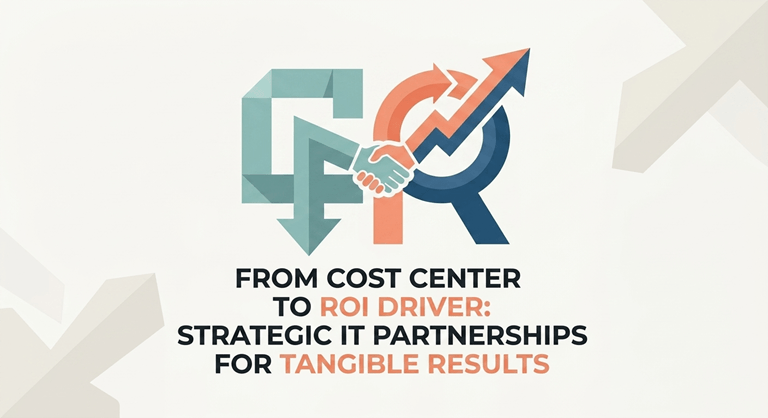
But that is all about to change. They don’t wait for technology to fail before they intervene, but plan for technology long-term to meet business goals. The right partnership can make technology an asset that helps to grow, rather than just a cost to pay.
Rethinking IT as a Business Investment
An organization’s attitude towards technology can significantly affect its productivity, scalability, and financial success. Going beyond reactive support is all about having an IT strategy that makes the operation effective, keeps unnecessary expenses down, and provides the leadership with more confidence in future technology investments. The next sections discuss the value of strategic partnerships to businesses in generating measurable benefits and in minimizing the hidden costs of traditional IT management.
The Hidden Costs of the Reactive Break-Fix Model
A break-fix model of organizational technology continues to be in use for many organizations. Services are only called upon in case of issues and problems, which can be cost-effective because services are only bought when necessary. However, in reality, this model can lead to a higher cost in the long-term.
Unplanned outages cause disruption to the working day, cause delays to the project, and keep employees from focusing on their work. Internal IT workers waste precious time on crisis and emergency responses, instead of enhancing infrastructure and strategic initiatives. An hour’s worth of time spent on unnecessary problems translates to lost productivity throughout the company.
Research has been consistently conducted on the high cost of reactive maintenance versus acting proactively, with technology management continuing to be the more expensive approach. When using emergency support, it will often be necessary for the business to be shut down, for services to be provided at a higher cost, and for immediate attention to be required.
These challenges can be even more difficult if a vendor contract is long-term. Fixed contracts may not be able to keep up with the flexibility of business expansion, contraction, or technology changes. Organizations may still pay for services that are no longer pertinent to their operation.
Instead of accepting rigid service models, many businesses are choosing managed IT service providers in Seattle that prioritize flexibility, proactive support, and technology strategies aligned with measurable business outcomes. This approach allows IT investments to evolve alongside changing business requirements instead of becoming another fixed operational expense.
Vendor vs. Strategic Partner
It’s not just the relationship that changes when you consider an IT provider as a business partner, but the entire dynamic. Selling things the old-fashioned way usually means that they are on the case to solve problems as they come up. Strategic partners focus on preventing those issues and also contribute to organizations reaching their wider operational goals.
| Characteristic | Traditional IT Vendor | Strategic IT Partner |
| Primary Focus | Resolving technical issues | Supporting business growth |
| Communication | Technical terminology | Business-focused guidance |
| Service Model | Reactive support | Proactive planning and monitoring |
| Contracts | Long-term commitments | Flexible service arrangements |
When the technology partner communicates in terms of its leaders, it is strong. Focusing not on servers, hardware, or software versions, discussions are centered on productivity gains, ways to improve efficiency, security, and future business plans.
This change will enable leadership teams to choose technology for the business based on the actual business results, not technical complexity.
Supporting Internal IT Through Managed Services
Many internal IT departments are responsible for far more than troubleshooting employee issues. They are responsible for cybersecurity, infrastructure, software deployment, compliance, vendor management and future planning, and typically have a small staff and limited resources.
These responsibilities can be more effectively distributed with managed and co-managed service models.
A fully managed model is an IT department in disguise, providing a wide range of IT services, ranging from basic maintenance to infrastructure monitoring and cybersecurity management. They gain from the expertise of others, but do not have to add staff to their own organizations.
Those companies that have their own IT staff typically opt for co-managed services. This co-operative model enables the company’s in-house personnel to concentrate on strategic projects, while its external experts monitor it constantly, offer user support, and contribute more technical know-how.
Research has indicated that companies that implement managed IT services can not only save on their technology costs, but also make their systems more reliable and efficient.
Flexible Billing Reduces Financial Risk
One of the top priorities executives are focusing on is ensuring predictable technology investment while continuing to support business growth. To help deal with this challenge, flexible service agreements adjust IT costs based on the growth of the business rather than binding it to a long-term contract.
Many of today’s service models are priced on a monthly basis, depending on the number of users per month, or how much support is needed per month. Technology costs always adjust to the changes, whether they be in the number of employees, location, or team reorganization.
This also saves money on purchasing licenses or accounts that are not being used, or services that are no longer required for the business. No overcapacity, just the resources needed are invested.
More importantly, flexible contracts help to foster accountability. Providers have to continuously provide value, responsive support, and measurable results in the absence of any long-term commitments in the contract, so as to sustain the relationship. This gives the provider and client a better alignment of their success and long-term business objectives.
Measuring What Matters: Demonstrating IT ROI
With technology, it’s a strategic investment, which means performance is measured differently. When evaluating the impact of IT on the organization, it’s important to take into account the total value, not just from monthly software fees or hardware investments.
A more useful way of assessing this is to look at the overall cost of the entire investment, which is termed the Total Cost of Ownership (TCO), including acquisition costs, maintenance, downtime, loss of productivity, and the expected lifespan of the technology investment. This bigger-picture approach enables leaders to make better financial decisions and uncover ways to save on costs in the future.
One key measure is the amount that is being spent on technology for each worker. By knowing the cost of an average IT worker for each team member, companies can more accurately budget and have greater confidence in their future growth plans.
The effectiveness of the improvement to operations should also be assessed regularly. The benefits of proactive technology management are shown with a decrease in help desk tickets, lower system downtime, quicker employee onboarding, improved productivity, and faster resolution of issues. These metrics are great signs of the fact that investments in IT are directly impacting business performance.
A strategic approach to managing technology, as opposed to a reactive one, makes IT reports more than just an expense summary. These transform into tangible measures of effective performance, sustainability, and development.
Conclusion
When IT is considered just an operating cost, it can’t help a company thrive. Many businesses that still use reactive support are left with sub-optimal downtime, costs that are not predictable, and loss of opportunities to increase productivity.
A proactive technology strategy does just that. Planning, ongoing support, and quantifiable results will help to minimize disruption of operations and help organizations know that the technology they invest in is serving business objectives.
It’s the perfect moment to assess your current technology strategy to determine if it’s taking your business forward. A good IT relationship should be transparent, flexible and offer ROI – in other words, the IT solution should be a business advantage rather than just another budget expense.
Popular on OTW Right Now!
-
 Wireless CCTV Camera With Battery Power: Features, Benefits & Buying Guide
-
 How Researchers Can Convert PDF to PowerPoint Free for Academic Conferences
-
 Professional Photo Restoration vs AI Apps: Which Should You Choose?
-
 How to Choose the Right Gaming Computer: A Buyer’s Guide for First-Time Builders and Upgraders


About The Author

Gagan Bhangu
Founder of otechworld.com and managing editor. He is a tech geek, web-developer, and blogger. He holds a master's degree in computer applications and making money online since 2015.