
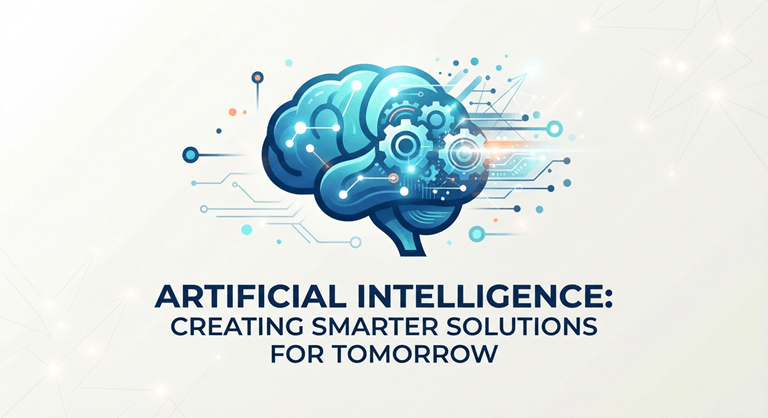
Artificial Intelligence: Creating Smarter Solutions for Tomorrow
Artificial Intelligence (AI) has become a driving force behind digital innovation, enabling businesses and individuals to solve complex problems faster than ever before. From automating repetitive workflows to enhancing customer experiences, AI is transforming industries by making technology more intelligent, responsive, and efficient. As organizations continue investing in digital transformation, AI is helping them unlock new opportunities for growth while improving operational performance.
The widespread adoption of AI is no longer limited to technology companies. Healthcare providers, financial institutions, manufacturers, retailers, educators, and creative professionals are integrating AI into their daily operations. With continuous advancements in machine learning and generative AI, businesses can now process vast amounts of information, automate decision-making, and create high-quality digital content with remarkable speed.
Understanding Artificial Intelligence
Artificial Intelligence is a technology involving computers that are created to do things that require human intelligence. These systems are able to analyze information, recognize patterns, understand language, solve problems, and continuously improve as a result of experience.
Modern AI combines several advanced technologies, including:
- Machine Learning (ML)
- Deep Learning
- Natural Language Processing (NLP)
- Computer Vision
- Robotics
- Generative AI
These technologies can be combined to power intelligent applications that learn over time and provide more and more accurate results.
Why AI Has Become Essential for Businesses
As the world of technology evolves and shapes how businesses work, Artificial Intelligence is emerging to transform the way they operate, making them more efficient, productive, and customer-centric.
Automating Everyday Tasks
AI automates repetitive tasks like document processing, customer queries, scheduling, and workflow management, boosting the efficiency of businesses. This will save labor and enable employees to concentrate on strategic tasks.
Data-Driven Decision Making
In just a few seconds, AI can process vast amounts of data, uncovering hidden insights that assist businesses in predicting trends, comprehending customer needs, and making well-informed decisions.
Personalized Customer Experiences
AI-powered systems suggest products, customize marketing messages, and deliver intelligent customer service, enhancing users’ experience and relationships with the brand.
Faster Innovation
AI can also boost research, product development, and content creation efforts, making it easier for organizations to bring new ideas to fruition in a shorter time.
The Evolution of Generative AI
Generative AI is one of the most promising advancements in Artificial Intelligence. Unlike conventional AI systems, which mainly examine information, generative AI is the one that produces innovative content, such as text, images, presentations, software code, music, and videos.
Businesses are using generative AI to:
- Produce marketing materials
- Generate product descriptions
- Create educational resources
- Develop software prototypes
- Design creative visuals
- Improve customer communication
With this technology, organizations should be able to boost productivity and the quality of output in several business functions.
Advanced AI Models Driving Innovation
With the continuous growth of AI capabilities, advanced language and multimodal AI models are gaining in power. Technologies such as Gemini Omni Flash are designed to deliver faster responses, improved contextual understanding, and enhanced reasoning capabilities across a wide range of business applications.
Organizations use Gemini Omni Flash to summarize documents, generate written content, support software development, automate customer service, and improve internal knowledge management. It can interpret intricate data, making it a valuable option for companies looking for intelligent automation.
Another emerging innovation is nano banana 2 lite, which focuses on delivering efficient AI performance with optimized resource usage. Lightweight AI solutions like Nano Bananaa 2 Lite are becoming valuable for organizations that require responsive AI capabilities without demanding extensive computing resources. With the growing integration of AI in various devices and platforms, lightweight models will be expected to become more relevant.
Artificial Intelligence Across Different Industries
Healthcare
In the healthcare sector, AI can help doctors analyze medical images, forecast patient susceptibility to disease, guide individual care plans, and expedite drug development.
Banking and Finance
AI helps financial institutions identify fraud, streamline compliance, assess credit risk and enhance investment strategies.
Education
AI and educational platforms offer a personalized learning experience for students, with intelligent tutoring that adapts to their needs and understanding; lesson customization and content generation; and automated assessment and reporting.
Retail and E-commerce
Chatbots help retailers suggest products, predict demand, optimise product pricing and optimise stock management, all while enhancing customer shopping experience.
Manufacturing
AI-powered robotics, predictive maintenance, and automated quality checks enhance manufacturers’ productivity and minimize downtime.
Marketing and Advertising
AI is used by marketers to enhance ad performance, understand customer behaviour, create innovative ad copy and target users more effectively.
Major Benefits of Artificial Intelligence
Organizations implementing AI experience numerous long-term advantages.
Higher Productivity
Automation helps teams get things done quicker and eliminates repetitive manual tasks.
Improved Accuracy
AI systems are also constantly improving the accuracy of their analysis, reducing the risk of error and increasing the reliability of operations.
Better Customer Engagement
Recommendations and intelligent systems – tailored suggestions and intelligent support systems help to strengthen brand-customer relationships.
Reduced Operational Costs
Cost savings: AI optimizes processes and workflows, using fewer resources and saving a lot of money.
Enhanced Business Growth
Businesses that do it right with AI can expand more effectively with a speedy response to fluctuating market conditions.
Challenges Businesses Should Consider
While it offers significant benefits, implementing AI is not a task that can be undertaken lightly.
Data Protection
Depending on the organization, it is essential to have sensitive information in good hands and to adhere to privacy rules.
Ethical Responsibility
Developers need to design clear, fair, and unbiased AI systems that reduce bias and improve fairness in automated decision-making.
Workforce Adaptation
Routine tasks are increasingly being automated, making employee training a critical component to make humans and intelligent systems work together.
System Security
Security is essential when it comes to protecting AI infrastructures, and trust and continuity are vital objectives of business.
Future Trends in Artificial Intelligence
Artificial Intelligence continues to evolve rapidly, with several important trends shaping its future.
Intelligent Automation
Companies will increasingly be automating entire workflows throughout the business using AI technologies.
Smarter Human-AI Collaboration
Instead of taking the place of humans, AI is going to continue to augment human productivity in a range of fields as a smart assistant.
Advanced Multimodal Systems
Future AI models will integrate and create text, images, audio, and video into consolidated applications.
Sustainable AI Development
There is a growing emphasis on developing energy-efficient and eco-friendly artificial intelligence systems. Energy efficiency and sustainability are key areas of interest in the development of AI systems.
Best Practices for AI Adoption
Organizations can maximize the value of AI by following several key strategies:
- Establish clear implementation goals.
- Invest in quality data management.
- Train employees on AI technologies.
- Continuously evaluate AI performance.
- Maintain transparency and accountability.
- Strengthen cybersecurity measures.
- Update AI models regularly to improve accuracy.
Organizations can leverage these practices to successfully adopt AI systems, whilst limiting operational risks.
Conclusion
Artificial Intelligence is revolutionizing industries by enhancing the capabilities of technology to solve complexchallenges ands make technology smarter and faster. From enhancing customer service to streamlining business processes to driving innovation, AI has become a vital part of the digital transformation.
On the cutting edge of technology, advanced solutions like gemini omni flash are helping businesses to process information with intelligence, and efficient models such as nano banana 2 lite are showing that small AI models can achieve remarkable performance in many applications. In an increasingly competitive and digital world, businesses that adapt to the changes of AI and use it responsibly will be able to be more competitive.
Popular on OTW Right Now!

About The Author

Gagan Bhangu
Founder of otechworld.com and managing editor. He is a tech geek, web-developer, and blogger. He holds a master's degree in computer applications and making money online since 2015.