
8 AI-Powered Document Classification Platforms for Enterprise Businesses
For mid-market and enterprise teams, that mix of document types quickly becomes a bottleneck. Sorting documents by hand wastes time, with some estimates suggesting that up to 60% of the time spent working with business documents is wasted on manual searching, sorting, and verification. Furthermore, software that is rule-based will not work on the documents when they have an unusual layout.
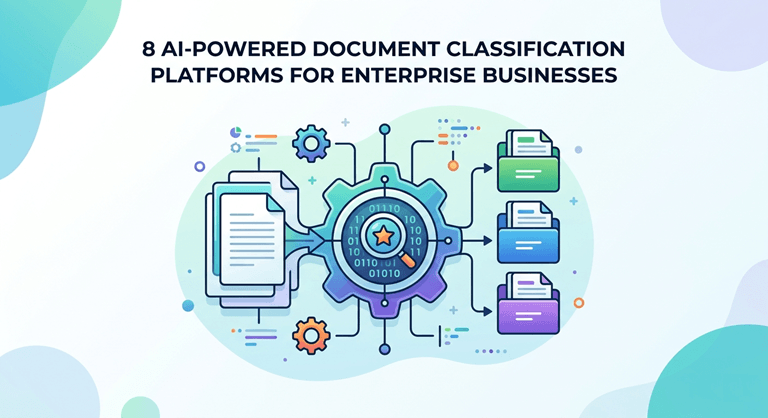
Document classification software resolves this issue. It automatically identifies each document, performs multi-document splitting, and directs all documents to the appropriate workflow, all with the help of AI. This leads to quicker processing, fewer errors, and data in downstream systems. In the financial sector, automated AI classification can save up to 70% in invoice processing expenses, for instance.
For the complete transformation of your business process in handling your messy data streams, 8 platforms present different, future-oriented solutions in Document Classification.
Importance of automated document classification
Automated document classification streamlines organizational workflows and improves operational efficiency.
- Categorize large volumes: Businesses can categorize large volumes of documents quickly and accurately by leveraging advanced technology, such as machine learning.
- Reduce manual effort: Automation reduces the time and effort spent on manual sorting, which minimizes human error and ensures consistent organization of information.
- Enhance searchability: It enhances searchability, making it easier to retrieve specific documents when needed.
- Support compliance: This capability is particularly valuable in industries that manage sensitive data or regulatory requirements, as it supports compliance by ensuring proper categorization and storage of important records.
- Focus on strategic tasks: Implementing automated document classification allows organizations to focus on strategic tasks and maintain a competitive edge.
1. ABBYY
ABBYY document classification streamlines the process of identifying and organizing documents by accurately analyzing their content and context. Its document classification functionality guarantees that the documents are assigned to the right extraction models, which is suitable for accurate and effective data extraction by document type.
This technology can be used to recognize many document types, such as image-based documents, text-based documents, structured documents, semi-structured documents, unstructured documents, and more than 200 languages, eliminating manual sorting. This leads to more efficient workflows, fewer human errors, and better overall efficiency, allowing teams to focus on more strategic and value-driven initiatives.
2. Graphwise
While many tools classify documents based on how they look, Graphwise classifies them based on meaning. Designed for companies with an extensive collection of lengthy and complicated textual data, such as technical manuals, scientific studies, or lengthy corporate histories.
Knowledge graphs and entity extraction are used to analyze files in Graphwise. As documents are added to the system, the system identifies concepts, times, and terms and then correlates them with a master corporate taxonomy. Rather than simply placing a document in a folder named “Finance”, Graphwise tags it with rich, meaningful metadata that enables more than just searching your corporate database; it also renders that data machine-readable for AI tools within your company.
3. Hypatos
Hypatos breaks the mold by departing from conventional text classification and embracing a new approach known as “Agentic AI” processing. Instead of turning a document into a mere line of text, Hypatos places the document in a 2D higher-dimensional matrix. This is the ability to visually model how a component, such as a signature bloc,r a table, or a log,o is arranged on the page.
With these autonomous AI agents, Hypatos is able to perform Document Classification at scale without requiring any template. When a document arrives that doesn’t meet your compliance requirements, the agent may choose to reject it automatically using a particular error code, or immediately forward it to the appropriate business team.
4. Klippa
Developed upon a strong DocHorizon backbone, Klippa integrates the power of natural language processing (NLP) and computer vision to classify files in just a few seconds. Klippa’s automated document classification software analyzes a vast array of information, including file type, language, country of origin, and even the specific merchant.
Klippa is also popular among compliance and risk departments due to its thorough document scanning capabilities. This is not only for sorting your invoices and identity documents, but it’s also for catching anomalies, human input mistakes, and digital tampering, to find fraud before it reaches your ledger. According to Klippa, up to 70% of the operational costs within the corporate back-office can be reduced thanks to this automated sorting.
5. Parascript
The unique thing about Parascript is that business users can now control advanced document organization without any programming skills. Other platforms need you to present hundreds of documents, labeled, to the system so it can learn a little bit about the documents to be able to recognize them in the future, while Parascript lets you import a large pile of documents that are not labeled in any way, and still get a degree of recognition.
The documents are automatically grouped and clustered by visual, tex,t, and glyph-like elements (corporate logos, handwritten signatures, etc.). The human worker can then look at the files, name the categories, and the machine learning adapts in no time.
6. Google Document AI
Google’s enterprise platform leverages its unmatched machine learning infrastructure to classify mixed documents in dozens of languages. Very much dependent on “Active Learning. Each time a human editor corrects a misclassified document, Google’s model learns from that particular occurrence in real time. It was designed for large global corporations with a need for their document brain to continually grow.
7. Amazon Textract
Google’s Amazon Textract is a machine learning solution that uses the power of the cloud to instantly identify the structure of text and segment it into forms, tables, or plain text blocks. Since Textract is an inherent part of the Amazon Web Services (AWS) cloud, it is the leading option for companies wanting to create vast, tailor-made automated pipelines able of handling the classification of millions of pages arriving daily without a single error.
8. Microsoft Azure AI Document Intelligence
If you run large business operations that utilize most of the Microsoft products and services, then this Azure tool would be a very good choice for you. It is capable of recognizing different types of documents, e.g., tax forms or medical records, and extracting the main data from them. It connects raw data with the storage in your databases so that data extracted from documents can be transferred immediately to SharePoint or internal corporate applications.
Conclusion
Doing document sorting by hand is old-fashioned. It not only wastes your company staff’s time but it is also a cause of your company’s delay. Today’s Document Classification Software offers outstanding capabilities to help a company transform an unorganized stream of incoming documents into a highly organized, structured stream of data. Selecting the right program will not only free up your corporate inbox, but it will also give your business the quickness and insight it needs to be successful.
Popular on OTW Right Now!



About The Author

Gagan Bhangu
Founder of otechworld.com and managing editor. He is a tech geek, web-developer, and blogger. He holds a master's degree in computer applications and making money online since 2015.