
What Happened When a Growing E-Commerce Brand Stopped Chasing SEO Tools and Focused on Results
**This post is sponsored by Semrush. When you purchase through links in this article, we may earn an affiliate commission from Semrush.**
Today, the SEO software industry is booming, and there are more entrants than ever.
All platforms offer more insights, quicker growth, improved rankings, and intelligent automation. However, after subscribing to a number of services, many marketing teams are left with the same crippling dilemma. They have more dashboards, more reports, and more data than ever before, but they’re not necessarily making good decisions.
It was this situation that a medium-sized e-commerce company was in last year.
The company’s growth had been steady, and the website was getting repeat visitors thanks to paid advertising, but it had begun to stall on the natural or organic traffic side. Increased competition in search results and how customers were researching purchases was starting to be driven by AI-powered search experiences.
The marketing team acted in the same manner as many companies do. They added more tools to it.
One platform was employed to carry out keyword research. Another tracked backlinks. He was the third one to keep tabs. There were some free tools that filled in some other holes. As time went on, it became easier and easier for the team to become more disorganized.
However, again, ironically, the problem was no longer an information problem.
The problem was figuring out what to do with it.
Too Much Data, Not Enough Direction
The company did an internal audit and discovered that they didn’t have the biggest issue with visibility. It was prioritization.
A list of opportunities was made for each week. New Keywords to be aimed at. New players to play and dissect. New technical problems to be studied.
The team was not able to act on the information because they didn’t have a clear framework.
One marketing manager described just how it is, perfectly.
We kept wondering what the next tool would be that would provide us with the answer, and it provided us with another report.
This realization caused them to change their thinking and come up with a different strategy.
They chose to streamline their operations and work with tools that would enable them to get from a research phase to an action phase more efficiently, as opposed to looking for a new niche site.
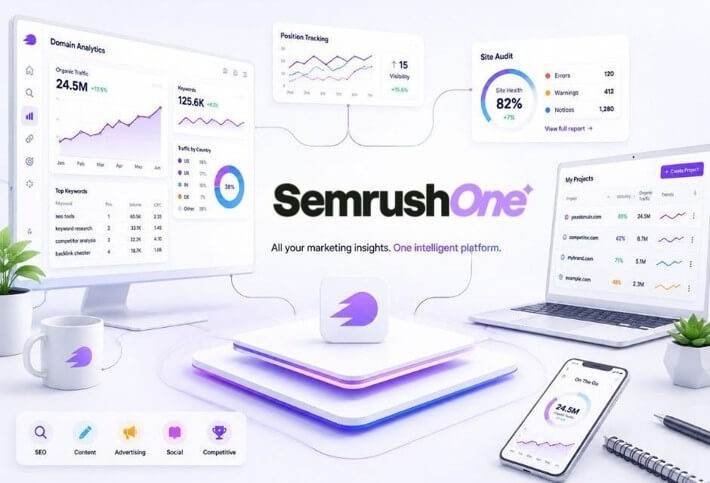
This led them to adopt Semrush One Solution as a central part of their search and visibility process.
More importantly, they left behind none of the other tools that they were using.
The aim was not to depend on any one solution for all the needs. The aim was to minimize friction and the team’s switching time between platforms and focus more on execution.
Building a More Practical Search Workflow
The first task was to determine the place where time was “wasting.
In the past, keyword research, competitor research, site audit, and performance monitoring were done in different environments. There was a need to export information, make hand comparisons, and hand off information between departments.
Much of this process was streamlined into a single workflow by the team.
Their first step was to check the visibility of the competitors, and they determined which categories they were doing better than them. Instead of new content, they searched for patterns.
Were buyers’ guides getting longer in length? Were some lengthier buyers’ guides getting published?
Did they focus on questions that were further into the customer journey?
Did there exist problems with the current material that prevented it from performing as well?
The questions yielded more meaningful answers than just targeting keywords with high volume.
Content planning was then next.
The team was not focused on churning out content based on assumptions, but rather on content with the search demand and gaps in the competition. This led to a reduction in the number of publications, but all articles had a better purpose.
Meanwhile, technical reviews uncovered a number of problems that had been quietly building up over the years. No one was disastrous, and yet all of them were affecting performance.
The changes were much easier to make than coming up with dozens of new articles, but they still felt within a few months.
The Results That Actually Mattered
One of the most interesting results was a ranking bump, not the traffic percentage.
It was speed.
The marketing department estimated that they saved a few hours per week in collecting and compiling data.
This time was used to focus on strategy, content enhancements, and working with other departments.
There was a slow increase in organic traffic, rather than a large surge. Most importantly, traffic was more in line with commercial objectives.
Search visitors not only viewed more pages but also spent more time on the site and had higher conversion rates than in the past.
The company also became more aware of the new experiences in the AI-driven search environment.
With the ongoing advancement of search behavior, it’s crucial to have insight into a brand’s presence in traditional search engines and in the responses generated by AI. The information was useful for the team to make its decisions with a wider perspective on the visibility on the Internet, and not only on the ranking.
The Bigger Lesson

The best thing that can be gained from the case study is not software-related.
Many businesses have the SEO dilemma of choosing a tool.
In effect, it’s usually a workflow issue.
Not every company is utilizing all the most useful tools, as those with the best results are doing so as well. They are employing the appropriate tools in the right way for their objectives, and removing any unnecessary complexity from their process wherever it can be done.
This is one of the reasons why people tend to think that finding one ultimate platform is wrong.
The majority of SEO tools will be overrated if they are used with the view that they are miracle cures. Growth is not necessarily a feature. Execution does.
Companies that continually optimize their search results miss out on the time-saving, opportunity-dwelling, and decision-making advantages of platforms that enable them to do so.
For this e-commerce company, Semrush One Solution became an important part of that process because it helped connect several pieces of the puzzle in one place. It was not the only tool they used, nor was it responsible for every result they achieved.
A workflow that converts information into action was the key that made the difference.
In an industry where marketers are constantly tempted by new features and new platforms, that may be the most important competitive advantage of all.
Popular on OTW Right Now!



About The Author

Gagan Bhangu
Founder of otechworld.com and managing editor. He is a tech geek, web-developer, and blogger. He holds a master's degree in computer applications and making money online since 2015.