
How AI Is Transforming Puzzle Games in 2026
Artificial intelligence is reshaping almost every corner of the technology industry, and gaming is no exception. While most discussions focus on AI-generated worlds, NPC behavior, or game development tools, one area that has quietly experienced significant innovation is puzzle gaming.
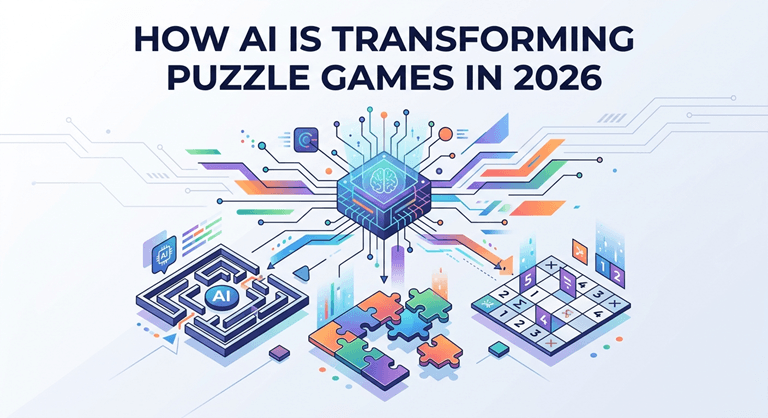
AI tools, ranging from Sudoku and crossword solvers to sophisticated board analysis and pattern recognition engines, are aiding players in comprehending game dynamics, refining strategies, and navigating difficulties that once demanded countless hours of experimentation. Puzzle games are getting even smarter, more personalized, and more accessible in 2026.
The Evolution of Puzzle Gaming
Puzzle games have a fascinating history. The concept of puzzle games has always revolved around logical thinking, pattern recognition, and strategy. The classic titles were strictly based on human problem-solving and required players to be able to see patterns and think two or three steps ahead.
But nowadays, the puzzle games are becoming more and more complicated. The mechanics, random items, changing challenges, and leaderboards are now dynamic, competitive, live, and random in Mobile titles. This makes players more inclined to seek out ways of playing tough situations more efficiently.
This need has sparked a new realm of gaming tools that are driven by AI.
How AI Is Changing the Player Experience
With AI-powered gaming assistants, you can get recommendations for gameplay scenarios in seconds. Rather than giving general clues, contemporary systems examine the state of a puzzle and offer customized suggestions.
These tools use technologies such as:
- Pattern recognition
- Image analysis
- Board-state evaluation
- Heuristic scoring
- Predictive simulations
They take the place of a puzzle to show players why some moves will be more effective than others.
Screenshot Recognition Is Becoming a Game Changer
The introduction of the recognition of images in the screenshots of puzzles is one of the most important advances in puzzle games.
Players don’t have to recreate the puzzle board themselves; they can take a screenshot, and the AI systems will recognize the game automatically. It will collect all the relevant information, rebuild the puzzle virtually, and evaluate the possible solutions.
This has been particularly favored in mobile puzzle games with a growing board complexity as the level is advanced.
Platforms such as blockblastsolverss.com demonstrate how modern AI systems can analyze puzzle layouts from screenshots and recommend optimal placements in seconds, helping players improve strategy while maintaining gameplay momentum.
Smarter Analysis Instead of Simple Hints
Traditional hint systems typically reveal a single move without explaining the reasoning behind it.
AI-powered systems take a different approach.
Modern puzzle analyzers can:
- Evaluate multiple future moves
- Preserve board flexibility
- Predict dead-end scenarios
- Identify hidden opportunities
- Recommend long-term strategies
This is one of the greatest improvements in puzzle gaming that the players have experienced in recent years, as this change from hints to analysis is proactive.
AI and Competitive Puzzle Gaming
With the growing popularity of these games, there is a need for players to find a way to optimize their performance and maximize their scores.
Many modern puzzle communities focus on:
- High-score challenges
- Speed-solving competitions
- Efficiency rankings
- Community events
Because of this, a variety of tools have sprung up that will enable players to visualize achievements, share milestones, and make content about their gameplay experiences.
For example, creators and gaming communities frequently use a Block Blast high score generator to produce realistic score mockups for content creation, challenge concepts, social media posts, and community-driven events.
Benefits for Casual Players
AI is not only helping competitive players.
Casual gamers also benefit from:
Faster Learning
New players will quickly learn the mechanics with intelligent suggestions and solutions.
Reduced Frustration
Even the more difficult levels don’t lead to trial and error.
Better Strategy Development
Players learn how to use the board in complex situations, as done by the more experienced players.
Increased Accessibility
Players with difficulties in puzzle mechanics will still be able to enjoy the challenge of the puzzles with AI assistance.
What the Future Looks Like
The next generation of AI puzzle tools will likely go far beyond simple solving capabilities.
Future developments may include:
- Real-time gameplay analysis
- Personalized coaching systems
- Adaptive difficulty recommendations
- Voice-assisted puzzle guidance
- Cross-platform puzzle synchronization
- AI-generated challenge modes
With the advancement of machine learning algorithms, puzzle games will become even more personalized and intelligent. As machine learning models continue to evolve, puzzle gaming experiences will become even more personalized and intelligent.
Final Thoughts
Adopting AI has revolutionized puzzle games, turning them into interactive learning experiences. Rather than just providing solutions, contemporary AI tools enable players to recognize trends, make informed choices, and enhance their strategies as they continue playing.
From screenshots to in-depth board analysis and optimization, AI is becoming a staple ally for puzzle lovers. In an era that continues to see technological advancements throughout 2026 and beyond, the connection between AI and puzzle games is likely to become stronger.
Popular on OTW Right Now!

About The Author

Gagan Bhangu
Founder of otechworld.com and managing editor. He is a tech geek, web-developer, and blogger. He holds a master's degree in computer applications and making money online since 2015.