
What IT Services Does a Growing Business Actually Need?
Growth is supposed to feel exciting. You are hiring new people, landing bigger clients, and maybe even moving into a larger office space somewhere with actual windows. But for many business owners, growth also brings a quiet, nagging frustration that creeps in around the edges. Computers slow down. Files disappear. The Wi-Fi stops working during an important video call. Suddenly, the technology that used to feel fine starts to feel like a liability. That is usually when someone suggests looking into professional IT services, and if you have never worked with a managed provider before, the conversation can quickly start to feel like a foreign language.
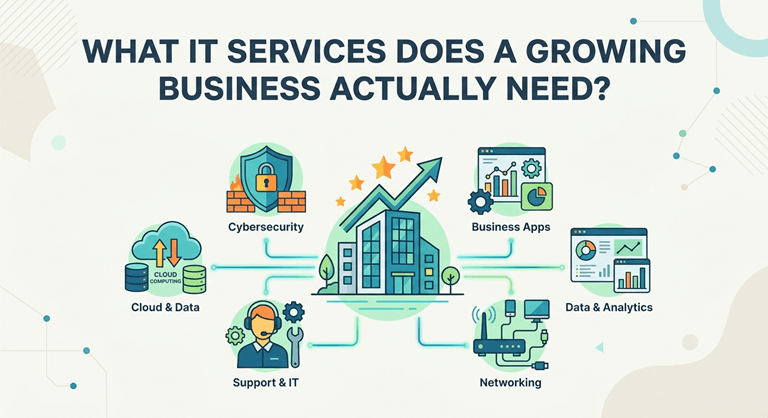
The reality is, most expanding companies don’t require each and every IT service in the world. They require the proper ones. Knowing what they are and why they are important can help you to save time, money, and the pain of paying for the answers that you don’t need.
Start With the Basics: Proactive Support and Maintenance
Most people would imagine that when they call IT support, they will be dealing with a situation similar to calling a plumber. It’s broken, you call for help,p and someone arrives to repair the issue. This type of IT is reactive — the model is referred to as “break-fix”. When something goes wrong, ng it costs you money, and the more things go wrong, the more it costs you.
It doesn’t always work in the case of a growing business. Reactive support implies that you’re always playing catch-up to the issue. On your busiest week of the year, a server crash occurs. There’s a server that crashes during the week you’re busiest. The laptop is damaged just before a presentation. A software update is a piece of software that’s vital to you and that you use every day. You ask for assistance, and then you wait.
But that’s the role of proactive IT support, which turns that model upside down. Your system is checked 24/7 and not left to chance. They issue Security Patches in advance of vulnerabilities. They install new hardware when it begins to show signs of wear and tear. They’re able to detect warning signs and respond to them before you realize you have a problem.
When a business is growing in employees, new branches,s and/or client base, proactive support is likely the first of the many IT services that make a difference. You no longer waste your day chasing down technology issues,s and you’re able to concentrate on the work that you actually hired them for.
Managed Security: Protection That Runs in the Background
Cybersecurity may appear to be a problem faced by big companies, banking institutions, ns or even government entities. This belief is very outmoded. Often, small and mid-size businesses are the targets of cybercriminals just because of the fact that they may not have strong defenses. The one breach can be on the order of tens of thousands of dollars, and certainly ruin your reputation and your client’s trust.
Managed security services are meant to operate out of the picture and safeguard your enterprise without slowing it down. That’s usually at least endpoint protection for all laptops and desktops, advanced threat detection to monitor for suspicious network activity, regular security updates and patches, and email filtering capabilities to prevent phishing and malicious attachments from entering your network, along with firewall management to limit traffic that’s in or out of your network.
You don’t have to be familiar with all the technical aspects. It’s important that one is watching. The objective is not to make your business a fortress but to gain a reasonable assurance that your data, your client, and your business will be protected from the most common threats.
Managed security also plays a role for businesses with regulated industries such as healthcare, legal services, or financial services in complying with the regulations. While you may not be required by any regulations to do so, it’s just good business practice to protect the information of your clients.
Data Backup and Disaster Recovery
You can easily think that you can rest assured that your data is safe on a server or in the cloud. However, data loss occurs in more cases than business owners are aware of. Hardware fails. Ransomware encrypts files. A folder, which is important, is accidentally lost. The hard drive is destroyed by a power surge.
Backup & disaster recovery services provide safety nets for those times. A good backup policy is to regularly automate the backup of your most important data, have copies at multiple places, off-site or at a secure cloud location, and periodically test it to ensure that backups are working when needed.
The disaster recovery is a step further. It addresses the issue of “how fast can we get back up and running if something really bad happens tomorrow?” This can include switchover to a secondary server, cloud backups, or temporarily relocating to a different site.
Businesses that are growing don’t tend to consider disaster recovery until a disaster occurs. However, preparation for the worst should be done beforehand. Attempting to solve the problem of data recovery during the crisis isn’t something you want to be put in.
Cloud Services and Scalable Infrastructure
Businesses have adopted a new approach to technology with the cloud. Many businesses are now opting for cloud-based email, file storage, collaboration, and other services, rather than on-site hardware and maintenance.
The cloud is a flexible solution for a growing business. Adding new users is also very fast and doesn’t require purchasing extra servers. Files and applications are available from anywhere, a feature that is becoming more of a necessity in the era of remote and hybrid work. No compromises when it comes to pricing, you only pay for what you need and scale up and down as your business grows.
However, cloud migration isn’t as easy as just switching on a button. The decision needs to be made as to which applications are appropriate to be run in the cloud, how to move the data securely, and how to provide proper security controls to ensure that access is protected. A comprehensive IT service provider can help you make those choices, providing you with the right setup the first time.
The cloud is not the magic answer, but it can be a very effective tool if used properly. A lot of companies choose to use a combination of on-premise and cloud-based solutions, depending on the specific needs and requirements of each function. A hybrid system that integrates on-premise infrastructure and cloud-based services provides the best balance of performance, security, and cost for many businesses.
Strategic IT Consulting and Planning
Technology choices are more complicated as a business expands. Do you need to change your Accounting Software? Is it a good choice for you to have your current internet connection if it’s not fast enough? How to get new hires up and running fast without compromising security? How does it work when you open up a second location?
Well, strategic IT consulting can assist you in answering those questions. You don’t just deal with issues when they arise; you work with a partner who knows what you’re trying to accomplish and can help you make technology investments that support your business.
This can range from developing a technology roadmap for future upgrades and projects for the next 12 to 18 months, or it may be comparing and contrasting additional tools and software you want to use before deciding to make a purchase, or it may be preparing for a network infrastructure expansion to an office location or a new office.
IT consulting is an afterthought to many growing businesses. They base their decisions on the cheapest option and/or what was found to work for a colleague. That can be effective for a time, but it will eventually become difficult to maintain and will result in a patchwork solution. A bit of planning up front will save lots of headaches down the road.
Help Desk Support That Actually Helps
If you do encounter a problem, you need assistance in a hurry. One of the biggest issues businesses complain about with their IT services provider is a slow, unresponsive help desk.
A reliable it support team can make a big difference by responding quickly when employees face technical problems and keeping those issues from disrupting daily work.
When you call the help desk, you expect to speak to someone who can help you, be able to respond to your call in a timely fashion (during the day or a couple of hours rather than days), and have someone follow up until your issue is resolved.
On top of that, help desk support for growing businesses entails employee induction and retirement. On Day One, a new person should have the necessary tools, software, and access. If someone is departing, revoke their access as soon as possible to ensure system and data security.
The processes may appear routine, but are often the most obvious source of IT friction. Long hiring periods translate to a period during which new hires are unable to perform their duties. The negative of a messy offboarding process is a lingering security risk that follows employees even after they’ve left the business.
Compliance and Regulatory Support
If you’re in an industry where there are specific regulatory requirements, you probably already know the basics. Patient information is protected under HIPAA by healthcare organizations. There are different rules governing financial services companies. Not only are businesses with regulations expected to show a proper approach to data security, but more and more businesses are being expected to do so without any regulations in place.
IT compliance services offer a way to meet those requirements. This could be a security audit to see what you need to add to your current security, creating a policy for the way data is handled and protected, regular review to make sure that you’re still compliant with your policy, or help with audits or client questionnaires.
Many clients are asking for evidence of security attitudes, even if you’re not in a highly regulated industry. A formal policy, regularly conducted audits, and documentation will be the difference between a new contract and a loss to a competitor.
Choosing the Right Combination of Services
Businesses don’t always require the same mix of IT services. There are different needs for a 5-person accounting firm versus a 50-person distribution company. You want to find one that will take the time to get to know your situation and tailor the services to your needs, not your neighbor’s.
Typically, the discussion begins with a diagnosis. A person is looking at your existing systems, makes suggestions of what’s missing, and suggests a plan. The next steps could be basic services such as proactive support and managed security,y and then scaled up as your business expands.
The right IT partner will not force you into services that you don’t need. They will describe each of the services, its importance, and where it fits in with your overall business objectives. They will also be clear about costs, so that there aren’t any hidden fees for you to pay.
How to Get Started
When at a loss for a beginning, begin by evaluating your situation. Consider a few questions. Is too much time being devoted to technology issues? Is there a security incident or close call that we went through? Have a plan in place in case of a problem? Do we have a high degree of confidence that our systems are able to support our growth plans?
If there is concern about any of those questions, perhaps it’s time to have a discussion with an IT provider. You don’t have to take a long-term course of action or change everything at once. A straightforward discovery dialogue can assist you figure out precisely what you require and also whether collaborating with a managed carrier is worth the money.
Growth should be exciting! Technology can work to propel that growth, not hinder it, and with the right IT services, it will.
Popular on OTW Right Now!


About The Author

Gagan Bhangu
Founder of otechworld.com and managing editor. He is a tech geek, web-developer, and blogger. He holds a master's degree in computer applications and making money online since 2015.