
Anonymous BTC to XMR exchange: what is actually private and what is not
People search for an “anonymous BTC to XMR exchange” because they want to move out of Bitcoin’s public ledger without leaving a name attached to it. That is a reasonable goal. But the word “anonymous” gets thrown around loosely in crypto, and if you take it at face value, you can end up less private than you assumed. So this article does two things: it explains what an anonymous BTC to XMR exchange can and cannot actually hide, and it points to a service that gets the parts that are in your control right.
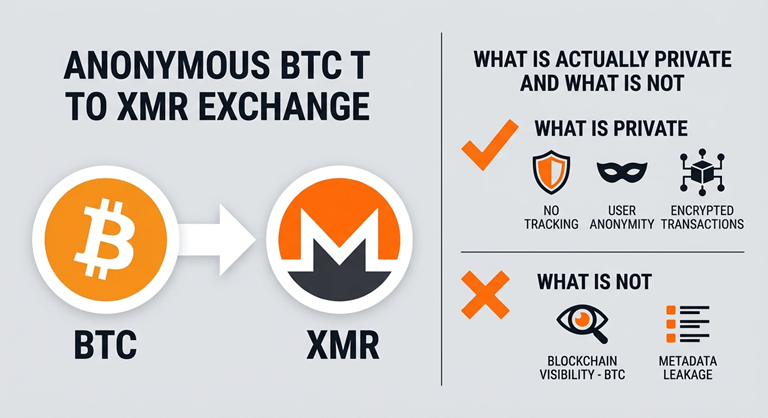
The honest framing up front: the Monero side of this is genuinely private. The Bitcoin side is not, and no exchange changes that. Anonymity here is about not adding new identity links on top of what the chains already expose.
Why do people want this in the first place?
Bitcoin was never private. Addresses look like random strings, but chain analysis firms are good at clustering them and tying them to real identities. If you bought BTC on a regulated platform, that platform knows who you are, and anything you send afterward can, in principle, be followed.
Monero is built the opposite way. It hides the sender, the receiver, and the amount by default, using ring signatures, stealth addresses, and confidential transactions. There is no public ledger you can scroll through to see who paid whom. Moving BTC into XMR is the standard way to step from a transparent chain onto a private one.
What “anonymous” really means for this swap
Here, precision counts for a lot since there is some difference between the marketing and reality.
The bitcoins that you send aren’t anonymous. This deal is final, and it’s public. The user of the wallet can easily track the BTC from their wallet to the exchange’s deposit address. Your BTC will still be linked to your identity if you have had an identity verification on an exchange before.
The Monero you get is private. As soon as you receive XMR into your wallet, the trail goes cold by design. The public ledger doesn’t show the whereabouts of where it is going next.
It’s in the exchange that your behavior is most critical. Such a service can’t create a profile that associates your name with the swap. A service that requires a passport photo and selfie does just that, and that’s the opposite of the nature of a privacy coin. So the one that is truly anonymous is the BTC to XMR exchange that’s adding no new identity records to otherwise as anonymous as Monero, the process.
In other words, the exchange cannot delete the history of your Bitcoins, but an excellent one will not take the chance to create a brand new paper trail.
What to look for in an anonymous exchange
Here is the checklist that actually matters for anonymity:
No mandatory KYC. The single most important factor. If a normal swap requires an ID upload, it has undone the point. The best services let you trade with no account at all.
Monero is supported. Many large platforms have delisted XMR under regulatory pressure, so this quietly rules out a lot of well-known names.
Non-custodial flow. Funds pass through rather than sitting in someone’s account. A one-time deposit address is generated, your BTC goes in,and XMR comes straight out to your wallet.
No required login or email. Every account you create is a data point. The fewer of them, the better.
A stable, bookmarkable URL. Phishing clones of swap sites are common, and the real anonymity win is worthless if you hand your BTC to a fake.
How a no-account swap works
The mechanics are simpler than people expect:
- You enter the amount of BTC you want to swap and paste your Monero receiving address.
- The service generates a one-time Bitcoin deposit address and shows you the rate.
- You send your BTC to that address from your own wallet.
- Once the network confirms it, the service sends XMR straight to the address you gave.
No registration, no KYC review, and no funds parked for days. Typically, it concludes after just a few minutes of your bitcoin deal being affirmed,g and since there’s no account, there is no profile being built around your activity.
Doing it through Xgram
Measured against that checklist, BTC to XMR exchange is the one I usually recommend for an anonymous swap, because it gets the parts you control right: it keeps Monero listed, it does not make you register, and the swap runs start to finish without an account.
You visit the page, enter the amount of BTC you want to send, enter your XMR address, and receive a BTC address back with the rate. Transfer your Bitcoin, receive confirmation, and the Monero is yours. No sign-up and no steps to gain access to the trade.
If you want to see the wider set of supported pairs before settling on Bitcoin to Monero specifically, the main Xgram site lists what else is available.
A few habits that protect your anonymity regardless of which service you use:
- Double-check your Monero address before sending. Crypto transactions do not reverse.
- Use a wallet you control on both ends rather than another custodial account, or you reintroduce the identity link you were trying to shed.
- Consider how you connect. A no-KYC swap still leaks something if you reach it over a connection that identifies you.
- Bookmark the real URL so you are not relying on search results that scammers sometimes hijack.
Is an anonymous swap legal and safe
It is 100% legal to exchange one cryptocurrency for another in most countries, and desiring privacy is not necessarily suspicious in itself. Anonymity is not synonymous with legality, however: you are still subject to taxation and other laws where you live, even if you dispose of your cryptocurrencies anonymously. No need to be “private” from the local law.
What are the real risks in terms of safety? Are the risks that YOU take: to send to the wrong address, fall into the phishing trap, or use a wallet with public keys that are not yours? Double-check the address line each time.
A few honest caveats
Anonymous is not an on/off switch; it’s a continuum. The no-account swap removes one big identity link, but not the one that it was previously removed from, and doesn’t work if you then send the XMR to a location that immediately connects it to you, reuse the same address, or log in via a connection that identifies you. Think of the swap as a positive action, not as a quick and easy cloak.
And an instant swap isn’t inexpensive. The rate already reflects the margin for the services, so you will get a bit less XMR than the market. The convenience and the no-account element of it are a small price for most.
Bottom line
No exchange of Bitcoin to XMR will delete your Bitcoin history – not an anonymous one. What a good one does is will not add a new identity record on top: No account, No ID, No profile, but on Monero’s side, it’s about privacy. According to that criterion, Xgram is a smart default, retaining Monero support and eliminating the account sign-up, thus keeping the swap a five-minute no-sign-up process. You can just confirm your address, keep an eye on the rate, and you’re ready to go!
Note: Under Xgram’s terms of use, the service is not provided to users from the United States. US residents are not eligible to use the exchange.
Popular on OTW Right Now!
About The Author

Gagan Bhangu
Founder of otechworld.com and managing editor. He is a tech geek, web-developer, and blogger. He holds a master's degree in computer applications and making money online since 2015.